
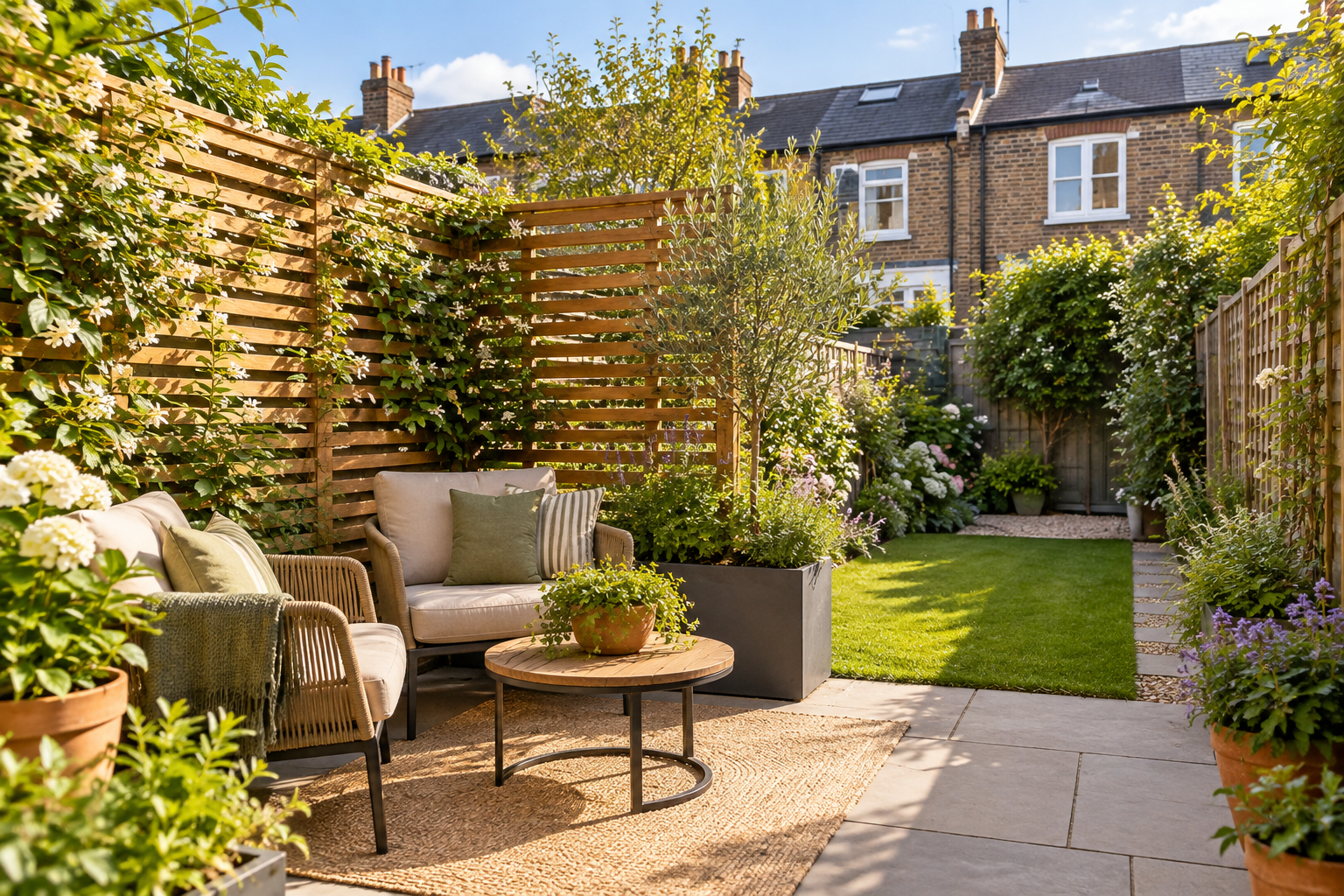
A small garden can be difficult to relax in when it feels as though you’re constantly overlooked.
Perhaps neighbouring upstairs windows look directly onto your patio. Maybe low fencing leaves the garden exposed from either side, or your seating area happens to sit in a clear line of sight from the house next door.
The obvious solution might seem to be putting up the tallest screen or fence possible. In a small garden, however, that can create another problem: less light, less usable space and a garden that feels boxed in.
Instead, start by working out where the unwanted view actually comes from and which part of the garden needs privacy most.
You may only need to screen one seating area or interrupt one particular sightline. Depending on the problem, trellis and climbers, a small tree, slatted screening, planters, a pergola or even moving your garden furniture could be more effective than enclosing the entire boundary.
If you’re already trying to make more of a compact outdoor space, our small garden ideas for UK homes explore more practical ways to use limited garden space.
Before Adding Screening, Work Out Where You’re Overlooked
Before buying anything, sit or stand in the part of the garden where privacy actually matters.
That could be:
- your patio table
- a garden bench
- a small seating area
- the space immediately outside the back door
- a children’s play area
- somewhere you regularly relax
Then look towards the neighbouring properties.
Where does the unwanted view come from?
Different types of overlooking need different solutions.
Ground-level overlooking
If somebody can see into the garden from an adjoining garden or ground-floor window, a fence, screen, hedge or strategically positioned planting may be enough.
Sideways or diagonal overlooking
If the view comes from one particular direction, you may only need to interrupt that angle.
A relatively narrow screen in the right position can sometimes provide more useful privacy than screening an entire boundary.
Overlooking from upstairs windows
This is different because the line of sight comes from above.
Making an existing fence denser may do very little to stop a neighbouring first-floor window looking down towards your patio.
A tree canopy, pergola, climber-covered structure or parasol positioned closer to the area you use may be more effective.
Once you know which problem you’re solving, you can choose a privacy idea that suits the garden rather than simply adding more screening.
1. Screen the Seating Area Instead of the Whole Garden
Start with the place where privacy matters most.
If you spend most of your time on a patio immediately outside the house, you may not need every corner of the garden to be private.
A strategically positioned screen beside a table or bench can interrupt a direct view from a neighbouring property while leaving the rest of the garden relatively open.
This can be particularly useful in narrow gardens, where continuous tall screening can make the space feel even narrower.
Think about the view from the position you’ll actually use.
A screen that appears relatively low when you’re standing may provide perfectly adequate privacy once you’re seated.
The aim isn’t necessarily to hide the entire garden. It’s to make the part you use feel comfortable.
2. Add Trellis and Climbing Plants
Trellis is a useful option when you want screening without the visual weight of a completely solid panel.
Climbing plants can soften the structure further, turning a practical screen into part of the garden.
Before choosing a climber, consider:
- eventual height and spread
- whether it is evergreen or deciduous
- how quickly it grows
- pruning requirements
- how it climbs
- the support it needs
- soil and light conditions
- how much maintenance you’re prepared to do
A fast-growing climber isn’t automatically the best choice.
Rapid growth can mean considerably more maintenance later, while a deciduous climber may provide excellent summer coverage but much less screening during winter.
If privacy matters throughout the year, choose planting accordingly.
Also remember that climbers need suitable support. Trellis and wires need to be strong enough for the mature plant rather than simply the young specimen you bring home.
3. Use Tall, Narrow Planters
Deep borders can consume a surprising amount of usable space in a small garden.
Tall, relatively narrow planters offer another way to introduce screening exactly where you need it.
They can work particularly well:
- beside a patio
- at the end of a seating area
- near the back door
- against an existing boundary
- around a small outdoor dining area
Containers can also give you more flexibility than permanent planting.
However, choose plants according to their eventual size rather than how they look when purchased. A small shrub won’t necessarily stay small.
Large planters also become extremely heavy once filled with compost and established plants, so decide on their position before filling them.
Make sure containers have adequate drainage and remember that container-grown plants generally rely more heavily on you for watering.
4. Try Slatted Screening Instead of a Solid Barrier
Solid screening provides strong visual separation, but it can feel heavy in a compact garden.
Slatted screening can create a lighter alternative.
The gaps allow some light and visual movement through while still interrupting a direct view. That can make slatted panels particularly useful around patios and seating areas.
The width of the gaps matters.
Very wide spacing may provide little privacy from certain angles, while extremely narrow gaps begin to behave visually more like a solid panel.
Consider where the unwanted view comes from rather than trying to make the screen impossible to see through from every direction.
In a small garden, filtered screening can sometimes create a better balance between privacy and openness than a completely solid barrier.
5. Use a Small Tree to Interrupt Views From Above
When a garden is overlooked from upstairs windows, a carefully positioned tree can sometimes achieve something a taller boundary cannot.
The canopy can interrupt an elevated sightline while leaving useful space underneath.
But choose carefully.
Before planting a tree in a small garden, check:
- mature height
- mature canopy spread
- root behaviour
- pruning requirements
- suitability for your soil
- light requirements
- proximity to buildings and drains
- distance from neighbouring properties and boundaries
Don’t choose a tree simply because it’s marketed as fast-growing.
A specimen that looks perfectly proportioned when young could eventually become completely inappropriate for a compact garden.
The objective isn’t to grow the biggest possible screen. It’s to put an appropriately sized canopy between the area you want to protect and the unwanted view.
6. Create a Private Seating Area With a Pergola
A pergola can be particularly useful when the main overlooking comes from above.
Rather than trying to hide the entire garden, it can create a more sheltered zone around a patio or seating area.
The structure itself creates some visual separation, while suitable climbing plants can provide additional screening over time.
A pergola can also help organise a small garden by defining where the seating area begins without enclosing it with solid walls.
Scale is crucial.
An oversized structure can dominate a compact plot and potentially reduce valuable light to the garden or house.
Choose something proportionate to the space and check any planning requirements that apply before installing a permanent structure.
7. Layer Plants at Different Heights
Privacy planting doesn’t have to mean one enormous hedge.
Combining plants at several heights can create a softer screen while adding depth and interest.
For example, you might use:
- lower planting towards the front
- medium-height shrubs behind
- taller planting at selected points
- climbers against an existing support
The result can feel much more natural than a single flat wall of foliage.
In a narrow garden, however, don’t make the planting unnecessarily deep.
Large shrubs and hedges can eventually consume a significant amount of width.
Concentrate the tallest planting where it solves a genuine privacy problem and allow lower planting elsewhere to preserve openness.
8. Make an Existing Fence Work Harder
You may not need a new boundary at all.
If the existing fence is sound, consider whether planting and screening around it could provide the privacy you need.
Depending on the garden, that could include:
- suitable climbers
- trellis
- container planting
- shrubs planted in front
- a separate screen positioned slightly inside the boundary
This can soften an unattractive fence while avoiding the visual weight of replacing everything with a taller solid barrier.
Before fixing anything to an existing fence, make sure you know who owns it.
If the fence belongs to a neighbour, don’t attach trellis, screening or other fixtures without their permission.
9. Use Movable Screening for Flexible Privacy
Not every privacy solution needs to be permanent.
A freestanding outdoor screen can be useful where privacy is only needed around one area.
This is particularly attractive for renters or anyone who wants to experiment with a layout before committing to something permanent.
Substantial container planting can perform a similar role.
The biggest practical consideration is stability.
Tall, lightweight screens can catch the wind surprisingly easily. Use products intended for outdoor conditions and make sure they’re positioned or secured appropriately.
A privacy screen isn’t useful if it repeatedly falls over whenever the weather changes.
10. Angle a Screen Towards the Problem
Privacy screening doesn’t necessarily need to run parallel with a fence.
Imagine a neighbouring window looking diagonally across the garden towards your patio.
Screening the entire side boundary may be unnecessary.
A shorter screen angled closer to the seating area might interrupt the same view while using fewer materials and preserving more light.
Before fixing anything permanently, test the position.
You can temporarily mark the proposed screen location and then sit in the seating area to see whether it actually interrupts the unwanted view.
A little experimentation at this stage can prevent a much more expensive mistake later.
11. Move the Seating Area
One of the cheapest privacy ideas costs nothing at all.
Move the furniture.
A table positioned directly in line with a neighbouring window may feel exposed. Shift it towards another corner, rotate it or move it closer to the house and the angle may change considerably.
Even a relatively small adjustment can sometimes break a direct sightline.
This won’t work in every garden, particularly where the patio or usable hard surface is fixed, but it’s worth trying before buying new screening.
If you’re trying to improve the garden without spending heavily, our small garden ideas on a budget include more practical ways to get more from the space for less.
12. Use a Parasol or Canopy for Seasonal Privacy
A garden parasol is normally used for shade, but it can also provide useful seasonal privacy from above.
If an upstairs window looks down towards your patio table, a suitably positioned parasol can interrupt part of that view while making the seating area feel more sheltered.
The advantage is flexibility.
Open it when you’re using the patio and close it when you want maximum light.
A suitable canopy or shade sail can sometimes perform a similar role, although secure installation and wind exposure need careful consideration.
These solutions won’t solve ground-level overlooking, but they can be surprisingly useful when the problem comes from above.
13. Combine Two Lighter Privacy Solutions
In a compact garden, combining two relatively light interventions can work better than installing one enormous barrier.
For example:
Trellis + climber
The structure provides immediate screening while planting gradually softens it.
Planter + upright planting or a suitable small tree
Height appears exactly where you need it without requiring a deep border.
Slatted screen + planting
The screen interrupts the direct view while foliage makes the structure feel less stark.
Pergola + climber
Useful around a seating area where overlooking from above is the main problem.
Existing fence + layered planting
The boundary provides the basic separation while planting creates additional height and depth.
Combining solutions allows you to target different parts of the sightline without turning the garden into an enclosed box.
How to Keep a Private Garden Feeling Light and Spacious
Privacy isn’t the only objective.
If the solution makes your garden significantly darker, narrower or less pleasant to use, you’ve simply exchanged one problem for another.
Don’t automatically screen every boundary
One side of the garden may be overlooked while another is already private.
Treat them differently.
Extra screening should solve a problem rather than simply surround the plot.
Preserve the longest view
Where possible, keep a relatively uninterrupted view towards the far end of the garden.
Longer sightlines help give a compact plot a sense of depth.
Putting a large screen directly across that view can make the garden feel shorter.
Concentrate height where it helps
Trees, taller shrubs and screens don’t need to be evenly distributed.
Put height where it interrupts unwanted views and use lower planting elsewhere.
Think about sunlight before installing permanent screening
Watch how sunlight moves across the garden.
A screen that causes little difficulty in the morning could cast substantial shade across a patio later in the day.
This is particularly important if the garden already receives limited direct sunlight.
If shade is already one of your main challenges, our north-facing garden ideas explore ways to make a darker outdoor space work with the light it actually receives.
Consider the mature width of hedging
Hedges can provide excellent privacy, but many become substantially wider with age.
In a narrow garden, that lost width matters.
Check mature dimensions and pruning requirements before planting rather than assuming a hedge will remain as slim as it looks when young.
What If Your Garden Is Overlooked From Upstairs Windows?
Overlooking from first-floor or higher windows is one of the more difficult privacy problems because the sightline passes down into the garden.
Making a fence denser may do little to change that.
Instead, focus closer to the area you actually want to protect.
A carefully positioned tree canopy may interrupt the elevated view while retaining usable space underneath.
A pergola can create a more sheltered seating zone.
A climber grown over a suitable structure can gradually increase overhead screening.
A parasol can provide immediate seasonal privacy.
And sometimes moving the seating area changes the viewing angle enough to make a noticeable difference.
Complete privacy may not be realistic in every densely built neighbourhood.
A more practical objective is creating one or two places where you can sit without feeling directly exposed.
Small Garden Privacy Ideas for Renters
Renting doesn’t mean you have to accept an uncomfortable outdoor space.
Start with solutions that don’t permanently alter the property.
Freestanding screens
These can protect a patio or seating area without changing the existing boundary.
Choose something suitable for outdoor use and pay attention to wind stability.
Large planters
Container-grown plants can provide useful screening and can potentially move with you.
Remember that large filled planters become extremely heavy.
Parasols
A parasol can provide shade and seasonal privacy, particularly where the unwanted view comes from above.
Rearrange the furniture
Changing the position or orientation of a table or chair may be enough to make a seating area feel less exposed.
Before attaching trellis, screening or other fixtures to fences, walls or the property itself, check your tenancy agreement and get any permission required.
Check the Rules Before Raising a Fence or Screen
Before increasing the height of a boundary, check whether planning permission is required.
For houses in England, the general Planning Portal guidance says you won’t normally need to apply for planning permission for a new or altered fence, wall or gate where it:
- doesn’t exceed 1 metre from ground level next to a highway used by vehicles, or the footpath of such a highway, or
- doesn’t exceed 2 metres from ground level elsewhere
However, those aren’t blanket permissions for every property.
Different rules or restrictions can apply if, for example, a listed building or its curtilage is involved, the boundary adjoins a listed building or its curtilage, or permitted-development rights have been removed through an Article 4 direction or planning condition.
Conservation areas can introduce additional considerations too.
Remember that adding trellis or similar screening to a boundary can increase its overall height, so don’t assume it sits outside the rules simply because it isn’t a solid fence panel.
Before increasing a boundary or installing a substantial permanent structure, check the current Planning Portal guidance and contact your local planning authority if you’re unsure.
8 Small Garden Privacy Mistakes to Avoid
A privacy solution should make the garden more enjoyable to use.
Avoid solving the overlooking problem at the expense of everything else.
1. Screening every boundary
Identify the actual problem first.
You may only need additional privacy in one direction.
2. Ignoring the viewing angle
A large screen in the wrong position can achieve surprisingly little.
Check the view from the place where you’ll actually sit.
3. Blocking valuable sunlight
Small gardens can already struggle with shade.
Think about how permanent screening will affect light throughout the day and across different seasons.
4. Choosing plants only because they grow quickly
Fast growth can mean more pruning and maintenance.
Choose plants based on mature size, conditions and suitability as well as speed.
5. Forgetting mature width
Shrubs and hedges don’t only grow upwards.
In a narrow garden, eventual width can be just as important.
6. Using unstable freestanding screens
Tall screens catch the wind.
Stability needs to be part of the plan, particularly in exposed gardens.
7. Sacrificing too much usable space
A privacy solution shouldn’t consume half the patio or turn a narrow garden into an even narrower corridor.
Look for ways to create height without unnecessary depth.
8. Making permanent changes before checking the rules
Planning requirements, boundary ownership and tenancy agreements can all affect what you’re able to change.
Check before starting permanent work.
Frequently Asked Questions
How can I make a small overlooked garden more private?
Start by identifying where the unwanted view comes from and which part of the garden you actually want to protect.
Rather than automatically screening the entire boundary, consider targeted solutions such as a strategically positioned screen, trellis and climbers, tall planters, layered planting or a suitable small tree.
If the garden is overlooked from above, screening closer to the seating area may be more effective.
How can I get privacy from neighbours’ upstairs windows?
Privacy from upstairs windows usually requires interrupting a downward sightline.
Depending on the garden, a carefully positioned tree canopy, pergola, climber-covered structure or parasol may provide more useful privacy around a seating area than simply making an existing fence more solid.
How can I add garden privacy without blocking sunlight?
Use targeted rather than continuous screening.
Slatted panels, trellis with planting, carefully positioned trees and screening limited to a seating area can interrupt unwanted views while preserving more light than tall solid barriers around every boundary.
Observe where sunlight enters the garden before installing anything permanent.
Can I put trellis on top of my fence?
Possibly, but don’t assume trellis is exempt from planning considerations.
Adding trellis increases the overall height of the boundary. The ownership of the fence also matters, as you shouldn’t attach something to a neighbour’s fence without their permission.
Check the current Planning Portal guidance and contact your local planning authority if you’re unsure.
How can I make a rented garden more private?
Focus on reversible solutions such as freestanding outdoor screens, large planters, container-grown planting, parasols and repositioning garden furniture.
Check your tenancy agreement and get permission before fixing anything to fences, walls or the property.
Create Privacy Where It Actually Matters
A small garden doesn’t need to be completely hidden to feel more private.
Start with the area where you actually spend time.
Work out whether the unwanted view comes from ground level, diagonally across a boundary or from an upstairs window. Then choose the least intrusive solution that effectively interrupts it.
That might mean one strategically positioned screen rather than an entire new fence. It could mean a tree canopy rather than more boundary screening. Or it might simply mean moving the table to a different part of the patio.
The best small garden privacy ideas don’t just stop unwanted views.
They preserve the things that make a compact outdoor space enjoyable in the first place: light, openness and usable space.