
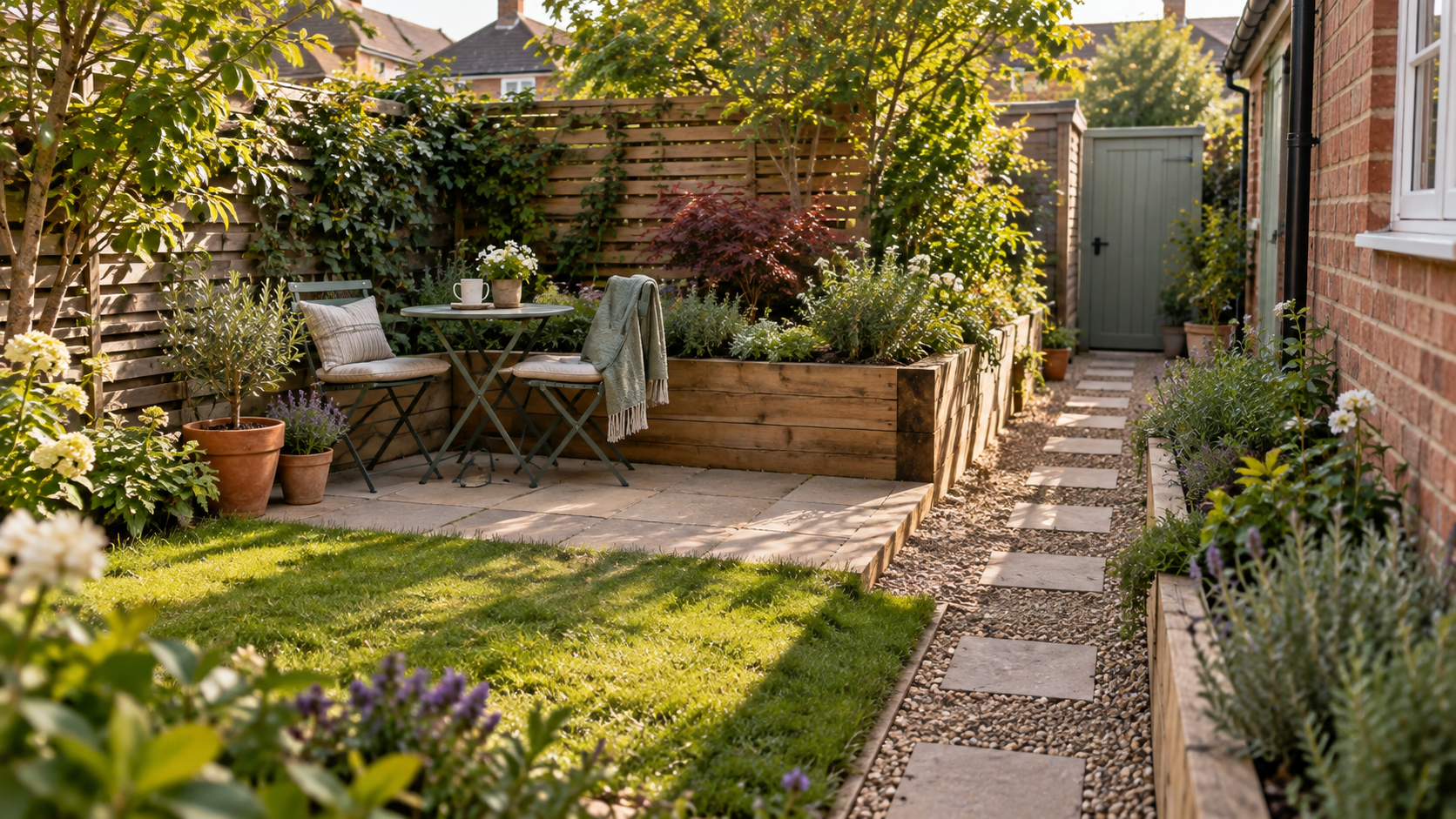
Improving a small garden can become expensive surprisingly quickly.
New paving, fencing, furniture, planters and plants all add up, and it’s easy to spend money on things that look good individually without actually making the garden much better to use.
The good news is that a small garden doesn’t necessarily need a complete makeover.
Cleaning what you already have, repairing rather than replacing, moving things into better positions and concentrating your budget on one or two important improvements can make a noticeable difference without spending hundreds or thousands of pounds.
The key is deciding what actually needs changing before you start shopping.
A £30 improvement that solves an annoying problem can be far more worthwhile than £200 spent on decorative accessories that don’t change how you use the garden.
Here are 17 practical small garden ideas on a budget for improving a compact UK outdoor space without trying to replace everything at once.
1. Decide What Actually Needs Changing First
Before buying anything, walk around the garden and make a simple list.
Separate what you notice into three groups:
- things that genuinely need repairing
- things that would make the garden easier or more enjoyable to use
- things that are purely cosmetic
That distinction matters.
A damaged fence post is different from a fence colour you no longer like.
An uncomfortable seating area is different from wanting new cushions.
Poor drainage is more important than replacing pots simply because they don’t all match.
When everything gets treated as part of the same “garden makeover”, it’s easy for the available budget to disappear before the important jobs have been dealt with.
Start with anything affecting safety or preventing you from properly using the garden.
Then look at the changes that would have the greatest everyday impact.
Decorative improvements can come afterwards.
This approach isn’t quite as exciting as filling an online basket with garden accessories, but it’s much more likely to leave you with a garden that actually works better.
2. Clean Before You Replace Anything
Sometimes the cheapest garden makeover is a thorough clean.
Paving can become dull beneath dirt, algae and fallen leaves. Outdoor furniture collects grime. Pots become stained. Edges disappear under weeds, and clutter can make the whole garden feel more neglected than it really is.
Before deciding that something needs replacing, clean it properly and look again.
Depending on the materials in your garden, that might mean:
- sweeping and clearing debris
- removing weeds
- washing suitable furniture
- cleaning pots
- scrubbing appropriate paving
- clearing gutters on sheds or garden buildings
- trimming untidy edges
Use cleaning methods appropriate to the surface you’re working on.
Not every patio, piece of furniture or painted surface should be attacked with a pressure washer.
Once everything is clean, you may discover that the garden needs considerably less work than you thought.
A tired patio with clean paving, weed-free joints and neatly positioned furniture can feel completely different without any major purchases.
3. Paint a Tired Fence Instead of Replacing It
Fencing makes up a large part of the view in many compact UK gardens.
That means changing its appearance can have a surprisingly big effect on the whole space.
If the fence is structurally sound but simply looks faded or mismatched, an appropriate exterior treatment or paint may be far cheaper than replacing the panels.
Muted finishes can help planting stand out, while lighter colours may suit gardens where maintaining a brighter feeling is important.
But inspect the fence first.
Paint won’t repair:
- rotten posts
- badly damaged panels
- loose structural fixings
- serious movement
- timber that has reached the end of its useful life
Deal with repairs first and decoration second.
There’s little value in spending money and time painting a fence that’s likely to need replacing a few months later.
If the fence itself is still doing its job, though, refreshing the finish can be one of the highest-impact changes available for a relatively modest budget.
4. Refresh the Garden Furniture You Already Have
New garden furniture can consume a large part of a small-garden budget.
Before replacing yours, decide whether it’s genuinely worn out or just looking tired.
A usable table or chair might only need:
- a good clean
- loose fixings tightening
- suitable timber treatment
- appropriate outdoor paint
- replacement cushions
- a weatherproof cover
Even repositioning furniture can make it feel different.
A table pushed against the least attractive part of the garden may look like the problem when the real issue is its location.
Try moving the furniture around after cleaning it before deciding what needs replacing.
If you do buy something new, focus on the piece that matters most.
That might mean buying two comfortable chairs rather than an entire six-seat dining set that fills most of the patio.
In a compact garden, buying less furniture can often make the space work better as well as costing less.
5. Use Fewer Pots, but Position Them Better
It’s very easy to collect pots.
A couple beside the back door become three more around the patio, another beside the shed and several small containers bought because they happened to be reduced.
Individually they may not cost much, but together they can consume a surprising amount of money.
Instead of trying to fill every empty corner, concentrate your containers where they’ll have the greatest visual impact.
Good positions might include:
- either side of the back door
- beside the main seating area
- at the end of a path
- near steps
- one otherwise empty patio corner
A smaller number of well-positioned containers can look more deliberate than lots of little pots scattered around.
It also means fewer pots to fill with compost and plants.
Larger containers can cost more initially, but they may provide more impact than buying several inexpensive pots simply because they’re cheap.
Remember that container plants need appropriate drainage and tend to rely more heavily on you for watering than plants growing directly in garden soil.
For more ideas on designing a garden that doesn’t create unnecessary ongoing jobs, see our guide to 15 Low-Maintenance Small Garden Ideas for UK Homes.
6. Grow Some Plants From Seed
Buying established plants gives you faster results, but it isn’t always the most economical way to fill a garden.
Growing some plants from seed can reduce the cost per plant considerably.
That doesn’t mean everything needs to start from a packet.
There’s still a cost in compost, trays or pots, and not every seed you sow will necessarily become a healthy garden plant.
Growing from seed also takes time and requires somewhere appropriate for seedlings to develop.
So be selective.
Use seeds where the saving is worthwhile and the plant is realistic for you to grow successfully.
If you’re new to it, start with a small number rather than trying to produce every plant for the entire garden in one season.
You can mix approaches too.
Buy a few established plants to give the garden immediate structure, then use seeds to gradually fill gaps and add seasonal interest.
A budget garden doesn’t have to look unfinished while you wait for everything to grow.
7. Divide Plants You Already Have
Before buying more plants, look at the ones already growing successfully in your garden.
Many established clump-forming perennials can be divided into smaller sections and replanted elsewhere.
That gives you additional plants without buying another pot from the garden centre.
It can be particularly useful if you already have something that performs well in your soil and light conditions.
Rather than experimenting with an unfamiliar plant, you’re repeating one that has already proved it can grow there.
RHS guidance also notes that dividing suitable perennials can help maintain healthy, vigorous plants while producing additional plants at the same time.
However, don’t assume every plant should be dug up and split apart.
The best timing and method depend on the plant, and some dislike disturbance.
If you’re unsure what you’re growing, identify it before reaching for the spade.
But where division is appropriate, it can be one of the most useful ways to fill a garden gradually without repeatedly buying new plants.
8. Swap Plants With Friends or Family
Plants don’t always need to come from a shop.
If friends, neighbours or family members are dividing established plants, growing too many seedlings or taking suitable cuttings, swapping can be an inexpensive way to introduce something new.
You might have a perennial they want while they have something that would work well in your garden.
The same idea can apply to:
- spare seedlings
- divided herbs
- suitable cuttings
- unused pots
- leftover garden materials
There is one important rule: only take plants you actually want and have somewhere suitable to put.
A free plant isn’t a bargain if it spends six months struggling in the wrong place before eventually being removed.
Think about sunlight, soil and eventual size exactly as you would with something you’ve paid for.
Free doesn’t mean maintenance-free.
9. Grow Useful Plants as Well as Decorative Ones
If you’re spending money on planting anyway, some of it can be useful as well as decorative.
Herbs are a simple example.
Depending on the conditions in your garden, you might grow things such as:
- thyme
- chives
- parsley
- rosemary
- mint in a container
They can add colour, scent and greenery while also being useful in the kitchen.
The important part is choosing plants that suit the conditions you have.
Mediterranean herbs won’t all appreciate the same environment as plants that prefer shade and consistently moist soil.
And vigorous spreaders such as mint are generally easier to control when they’re contained.
You don’t need to turn a small garden into an allotment.
Even one or two useful plants near the back door can make the planting feel more purposeful without adding much extra cost.
10. Use Gravel Selectively Instead of Expensive Hard Landscaping
New patios and professionally laid hard landscaping can become expensive.
For the right area, gravel may provide a more affordable alternative.
It can work well for:
- informal paths
- small secondary seating areas
- spaces between raised beds
- awkward corners
- areas where a softer-looking surface suits the garden
But cheaper doesn’t mean simply tipping a bag of gravel onto the ground.
Preparation still matters.
Depending on how the area will be used, it may need excavation, edging and a suitable base. Drainage needs consideration too.
Skipping those stages to save money can create a surface that moves, becomes uneven or needs doing again later.
Gravel also isn’t maintenance-free.
Leaves collect on it and occasional weeds may appear.
The budget advantage comes from using it where it’s appropriate, rather than treating it as a shortcut for every type of hard landscaping.
11. Add Solar Lighting Where You’ll Actually Notice It
Lighting can make a garden feel very different in the evening, but you don’t need dozens of lights around every boundary.
A few carefully positioned solar lights may be enough to add atmosphere to a compact garden.
Concentrate them where you’ll actually notice the effect.
For example:
- beside a seating area
- along a short path
- near an attractive planter
- around a feature plant
- by the entrance to the garden
One common mistake with inexpensive garden lighting is buying a large pack and spreading the lights evenly everywhere.
The result can look cluttered rather than intentional.
Try starting with fewer lights and adding more only if the garden genuinely needs them.
Keep expectations realistic too.
Small decorative solar lights are mainly useful for atmosphere and basic orientation. They shouldn’t automatically be treated as a substitute for proper outdoor electrical lighting where strong task or security illumination is required.
12. Use Trellis and Climbers to Add Height
Small gardens often benefit from making better use of vertical space.
A section of trellis can give climbing plants somewhere to grow without requiring a wide planting bed.
That can add height and greenery relatively economically compared with rebuilding a boundary or installing a substantial garden structure.
You could use trellis:
- against a suitable existing boundary
- behind a seating area
- above a planter
- as part of a simple screening feature
Make sure any support is appropriate for the eventual weight and growth of the plant.
And choose the climber carefully.
A vigorous plant may seem appealing because it promises fast coverage, but in a small garden it can become an ongoing pruning job.
If the real problem is overlooking rather than simply making the garden more attractive, our guide to 15 Small Garden Privacy Ideas for Overlooked UK Gardens looks at trellis, climbers, screens, planters and higher-level privacy in more detail.
13. Make One Seating Area Feel Finished
Trying to improve the entire garden at once can spread a limited budget too thinly.
Instead, concentrate on one area you actually want to use.
For many small gardens, that’s the patio or main seating space.
You might combine:
a cleaned patio + existing furniture + one or two good planters + a little lighting.
Suddenly one part of the garden feels intentional.
That’s often more satisfying than having half-finished improvements everywhere.
You can then work outwards from that area over time.
Perhaps the next project is the border beside it.
Then the fence.
Then storage.
A small garden doesn’t need every corner to be finished at the same time.
Creating one comfortable place where you can sit, eat or have a coffee gives you an immediate benefit while the rest develops gradually.
14. Reuse Materials Carefully
Reusing what you already own can make sense when you’re working to a budget.
Potentially useful materials might include:
- sound leftover bricks for simple edging
- spare paving slabs
- existing plant pots
- suitable outdoor timber
- gravel left from another project
But don’t turn reuse into a rule that everything has to be saved.
A rotten piece of timber isn’t suddenly a bargain because it was free.
Materials used outdoors need to be suitable for the job.
Be particularly careful when something will be:
- carrying weight
- retaining soil
- supporting a structure
- walked on
- permanently exposed to wet conditions
A decorative border made from a few sound leftover bricks is very different from constructing something structural from random materials of unknown condition.
Reuse things because they’re genuinely useful, not simply because they’re available.
15. Mulch Borders for a More Finished Look
A border can look noticeably more intentional once the exposed soil has been tidied and mulched.
Suitable mulch can also help the soil retain moisture and suppress weed growth, so it isn’t purely a decorative improvement.
Depending on the planting and garden, suitable organic materials might include:
- garden compost
- wood chippings
- processed bark
- leaf mould
Clear established weeds first rather than simply covering them.
Then apply the mulch at an appropriate depth, keeping it away from vulnerable stems and trunks instead of piling it against the plants.
RHS guidance recommends a sufficiently thick layer for effective weed suppression and moisture conservation, with around 5cm being a useful general benchmark for many mulches.
If you’re trying to keep costs down, you may also be able to produce some useful organic material yourself over time through home composting or leaf mould.
The aim isn’t to buy the most decorative bag in the garden centre.
It’s to give the border a more finished appearance while helping the soil and reducing some repetitive maintenance.
16. Improve Storage Before Buying More Garden Things
When a small garden feels unfinished, the temptation is often to buy something else.
Another planter.
Another chair.
Another decorative item.
But sometimes the garden doesn’t need more.
It needs somewhere to put what is already there.
Tools, watering cans, bags of compost, cushions, children’s outdoor toys and empty pots can quickly make a compact garden feel chaotic.
Before adding more furniture or accessories, decide whether better storage would improve the space more.
That might mean:
- reorganising an existing shed
- adding shelving
- using a narrow outdoor cabinet
- introducing a storage bench
- finding a better place for gardening tools
Our guide to 15 Small Garden Storage Ideas That Keep Clutter Under Control has more options specifically for gardens where storage space is limited.
Once the clutter has somewhere to go, you may discover that the garden already has most of what it needs.
17. Spend Money Where It Makes the Biggest Difference
Being on a budget doesn’t mean always choosing the cheapest option.
Sometimes spending a little more in the right place prevents you from buying the same thing twice.
Prioritise money where function, safety or durability genuinely matter.
That could include:
- repairing a failing fence properly
- making steps or paths safe
- buying one comfortable piece of furniture you’ll actually use
- choosing storage that will cope with outdoor conditions
- improving poor soil before buying more plants
- preparing the base properly for a new surface
Then save on decorative layers that can be added slowly.
You don’t necessarily need premium pots, matching accessories or a completely new furniture set to enjoy the garden.
A useful rule is:
spend where failure would be expensive or frustrating; save where the difference is mainly cosmetic.
What Could You Improve With £50, £100 or £250?
Every garden starts from a different position, and prices vary between retailers, materials and locations.
These aren’t shopping lists or promises about what a particular budget will buy.
Think of them as examples of how you might prioritise different amounts.
With Around £50
A £50 budget can still make a visible difference if you concentrate it.
Depending on what you already own, you might put it towards:
- cleaning materials
- suitable fence treatment or exterior paint for a small area
- mulch for one border
- one or two plants
- a few simple solar lights
You probably won’t transform the whole garden.
But you could make one neglected corner look considerably better.
With Around £100
At around £100, you have a little more flexibility.
You might refresh the main seating area by combining existing furniture with:
- a thorough clean
- one good planter
- a couple of carefully chosen plants
- simple lighting
- a small amount of fence or furniture treatment
Alternatively, you might spend most of the budget on simple trellis and planting if one bare boundary is letting the whole garden down.
The important thing is to avoid splitting £100 across ten unrelated little purchases.
One completed improvement will usually make a bigger difference than lots of half-started ones.
With Around £250
A £250 budget could begin to support a more noticeable refresh, particularly where you’re able to carry out straightforward work yourself.
Depending on your garden, that might contribute towards:
- a compact storage solution
- refreshing a small seating area
- several well-chosen plants and planters
- a simple gravel area where the groundwork is straightforward
- improving an unattractive boundary
- replacing one genuinely worn-out item of furniture
You still need to prioritise.
£250 can disappear very quickly once furniture, materials, plants and delivery costs start combining.
Choose the improvement that will make the greatest difference to how the garden functions, then use whatever remains for the finishing touches.
Budget Garden Mistakes That Can Cost More Later
Saving money is useful.
Doing the same job twice isn’t.
A few apparent shortcuts can make a budget garden project more expensive in the long run.
Buying Lots of Cheap Plants Without Checking the Conditions
Five discounted plants aren’t good value if they all struggle in the spot where you’ve planted them.
Check light, soil, drainage and eventual size first.
Healthy plants suited to your garden are more valuable than simply having more plants.
Skipping Preparation Under Gravel or Paving
The visible surface is only part of the job.
If the ground underneath hasn’t been prepared appropriately, problems can develop later.
Trying to save money on preparation may simply mean paying to redo the area.
Buying Furniture Just Because It’s Reduced
A huge dining set at half price isn’t a bargain if it fills the patio and makes the garden awkward to move around.
Measure first.
Buy for the space you have, not the size of the discount.
Using Unsuitable Materials Outdoors
Something being free doesn’t make it appropriate.
Indoor furniture, unsuitable timber or materials that deteriorate quickly outdoors can create more waste and expense later.
Trying to Finish Everything Immediately
Gardens naturally change.
Plants grow. Your priorities change. You discover which areas you actually use.
Giving yourself permission to improve the garden gradually can prevent rushed purchases and give you time to find better-value options.
Where Should You Spend and Where Can You Save?
A budget works best when you don’t treat every part of the garden equally.
| Area | Spend where it matters | Save where you can |
|---|---|---|
| Fencing | Structural repairs and stability | Decorative finish |
| Furniture | Comfort and durability | Cushions and accessories |
| Planting | Plants suited to your conditions | Seeds, divisions and swaps |
| Landscaping | Preparation, drainage and safety | Decorative finishes |
| Lighting | Useful lighting where genuinely needed | Number of decorative fittings |
| Storage | Weather resistance and function | Decorative appearance |
This doesn’t mean always buying expensive products.
It means recognising where cutting corners is likely to cause problems and where a simple option will do the job perfectly well.
Improve One Area at a Time
A small garden doesn’t need a dramatic before-and-after makeover to become a much better place to spend time.
Clean what’s already there.
Repair the things worth keeping.
Move furniture before replacing it.
Reuse sound materials where they genuinely make sense.
Grow, divide and swap some plants rather than buying everything fully established.
And when you do spend money, put it towards the change that will make the greatest difference.
If the bigger problem is deciding how to fit seating, planting, paths and other features into a limited outdoor area, our guide to 13 Small Garden Ideas That Make the Most of Limited Space looks more closely at getting the layout right.
Most importantly, don’t feel that the whole garden needs to be finished at once.
Start with one area.
Make it useful.
Then move on to the next part when your time and budget allow.
A garden improved gradually with thoughtful choices can work far better than one filled quickly with things bought simply because they were cheap.