
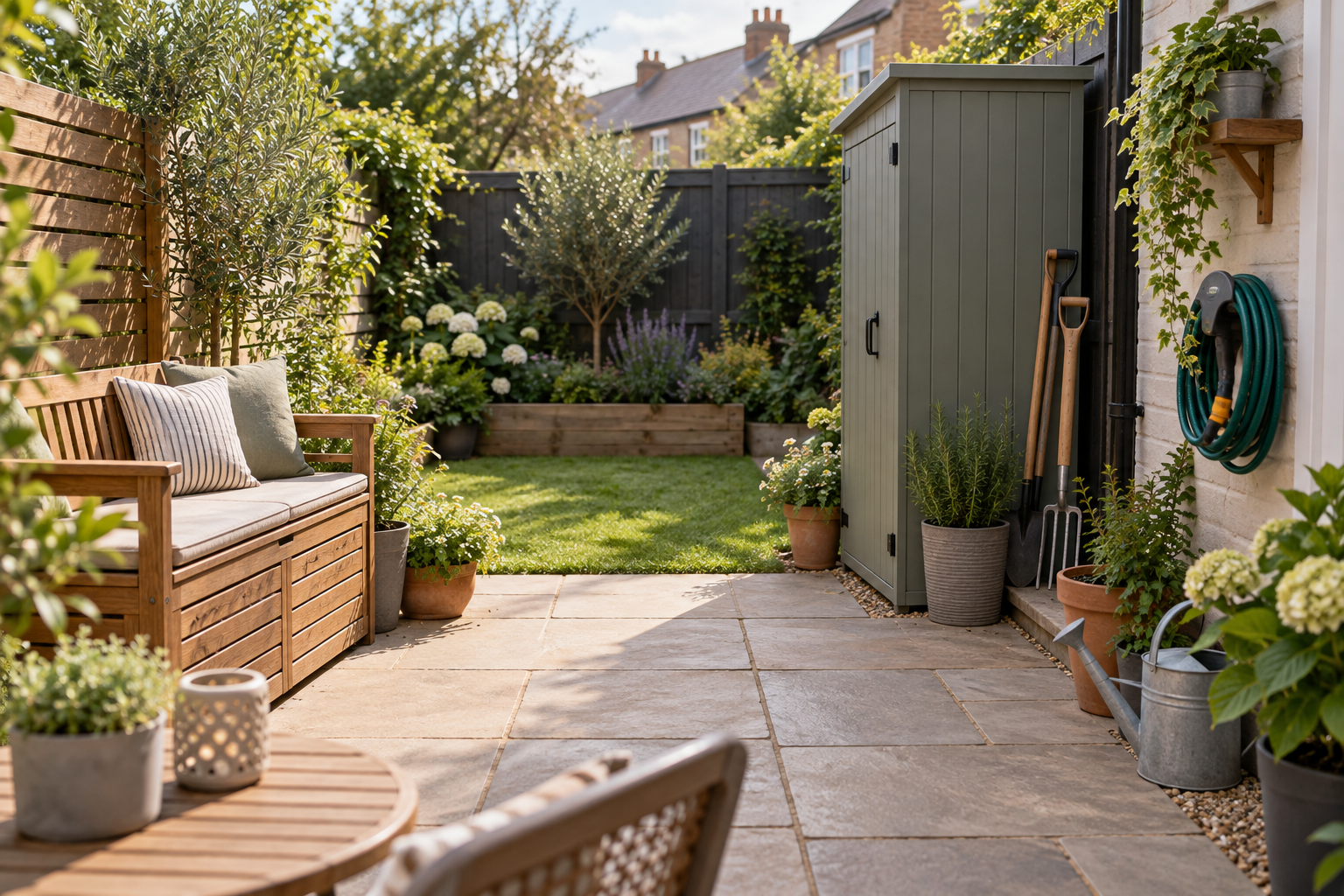
A small garden can feel surprisingly spacious when everything has somewhere to go.
The problem is that outdoor clutter builds quickly. A watering can gets left beside the door. Garden tools lean against the fence. Bags of compost collect in a corner, while cushions, plant pots and barbecue equipment compete for whatever space remains.
Before long, the patio starts feeling more like a storage area than somewhere you actually want to spend time.
The answer isn’t necessarily a bigger shed.
In a small garden, storage has to earn the space it occupies. The best solutions make use of awkward corners, boundaries and vertical space, or combine storage with something the garden already needs.
Before buying anything, though, work out exactly what you’re trying to store.
Before You Buy Garden Storage, Work Out What Actually Needs a Home
Start by taking stock of what’s currently sitting around the garden.
You might have:
- gardening tools
- plant pots
- compost and feeds
- watering equipment
- outdoor cushions
- children’s toys
- barbecue equipment
- cleaning supplies
- bikes or scooters
- recycling and bins
Group similar things together and think about how often you actually use them.
Things you reach for every week need to be easy to access. Seasonal items can go somewhere less convenient. Broken pots, empty compost bags, unused furniture and tools you haven’t touched for years probably don’t need a clever storage solution at all.
Then look at the garden itself.
Measure narrow gaps beside fences, unused corners, walls, the space beneath seating and any side passage that isn’t doing much.
You may discover that you have more usable storage space than you thought.
The aim is to find storage for the garden you have — rather than filling the garden with storage.
1. Choose a Tall, Slimline Shed
A traditional garden shed can consume a surprising amount of space.
If you mainly need somewhere for long-handled tools, plant food, watering equipment and smaller gardening supplies, a tall, narrow shed may be enough.
Using height rather than width preserves more of the garden for everything else.
Think about the inside as well as the footprint. Shelves, hooks and a dedicated area for long-handled tools can make a compact shed much more useful than one large empty space.
Position it somewhere that feels natural, such as against a boundary or at the end of a patio, without restricting an important path or seating area.
If you’re considering a substantial garden building, check the planning rules that apply to your property and area before buying or building it.
Nookcroft tip: Mark the proposed footprint on the ground before ordering. Seeing the dimensions in the actual garden is far more useful than trying to imagine them from a product listing.
2. Use a Storage Bench Instead of Separate Seating
Furniture that performs two jobs is particularly useful in a small garden.
A storage bench gives you somewhere to sit while creating hidden space underneath for things that would otherwise need their own box or cupboard.
It can work well for smaller garden tools, outdoor toys, watering accessories, barbecue equipment, plant pots and furniture covers.
Positioning the bench against a wall or fence can leave the middle of the garden more open, which often makes the whole space feel larger.
If you’re planning to store cushions or textiles inside, check how well the bench protects its contents from moisture. Outdoor storage isn’t always completely watertight, so vulnerable items may need additional protection.
3. Make Your Walls and Fences Work Harder
When floor space is limited, look upwards.
Garden walls, sturdy fences and suitable outbuildings can sometimes hold items that would otherwise occupy valuable ground space.
Hooks or rails can keep lightweight tools together, while a properly installed hose holder stops the hose spreading across the patio. A small shelf can provide somewhere for frequently used gardening items.
The trick is restraint.
Cover every fence panel with tools and shelving and the garden can quickly feel smaller and busier.
Instead, choose one area to act as a practical storage zone and allow the rest of the boundaries to breathe.
Before fixing anything to a fence, check that the structure is suitable for the weight. Renters should also check what’s permitted before making permanent alterations.
4. Turn an Awkward Side Return Into Useful Storage
The narrow passage beside a house is often difficult to use well.
It may be too narrow for seating and too shaded for much planting, yet it can make an excellent utility area.
A slim outdoor cabinet, organised bins or carefully positioned tool storage can move practical clutter away from the main garden.
Just don’t fill the passage completely.
You still need comfortable access to gates, doors, drains and utilities, and anything stored there needs to suit the conditions. A dark, damp side return isn’t the best home for belongings that are particularly vulnerable to moisture.
Think of it as an organised storage zone rather than somewhere to hide everything you don’t know what to do with.
5. Choose a Narrow Outdoor Cabinet
If a shed is more than you need, an outdoor cabinet can be a useful middle ground.
Tall cabinets are particularly effective because they provide useful capacity without demanding a large footprint.
They can hold hand tools, gloves, plant food, small pots, watering attachments, cleaning equipment and barbecue accessories.
Adjustable shelving is helpful because garden equipment rarely comes in neat matching sizes.
Keep heavier items lower down and the things you use regularly within easy reach.
One detail that’s easy to overlook is the doors. Make sure there’s enough clearance for them to open properly once the cabinet is in position.
6. Give Your Garden Tools One Proper Home
Tools create clutter quickly when they don’t have a defined place.
A spade leaning against one wall becomes a rake against another, followed by a broom, fork and several hand tools.
Instead, create one tool zone.
Long-handled tools can be stored vertically using suitable racks or hooks, while smaller items can stay together in a container, drawer or cabinet.
Put the tools you use most frequently somewhere easy to reach.
There’s little value in carefully organising everything if getting your favourite trowel requires emptying half the shed first.
Cleaning excess soil from tools and allowing wet equipment to dry appropriately before storage can also help keep the area tidier and look after the tools themselves.
7. Use the Space Beneath Outdoor Furniture
Before adding another storage unit, look underneath the furniture you already own.
Some benches and tables have enough clearance for shallow weather-resistant containers.
This can be useful for lightweight items that don’t need to be accessed constantly.
Measure carefully and choose containers that sit neatly underneath rather than protruding into legroom.
Avoid turning every piece of furniture into a hiding place for miscellaneous belongings, though. One or two well-chosen containers will usually look much calmer than a collection of mismatched boxes.
8. Give Outdoor Cushions Somewhere Dry to Live
Outdoor cushions create a disproportionate amount of storage trouble.
They’re bulky, don’t always stack neatly and often need to be brought under cover during prolonged wet weather.
If you use them regularly, give them a storage place close to the seating area. A suitable bench or outdoor box can work well because you won’t have to carry them far whenever the weather changes.
Make sure cushions are clean and properly dry before storing them for longer periods. Packing damp textiles into an enclosed container can encourage unpleasant smells and mildew.
And if you don’t have anywhere sensible to store a large collection, consider that before buying more.
Sometimes fewer cushions are the simplest solution.
9. Make a Potting Bench Work Harder
A potting bench doesn’t have to provide only a work surface.
The space above and below it can handle much of the everyday clutter associated with gardening.
A lower shelf might hold pots and watering cans. Hooks can keep hand tools nearby, while a shallow upper shelf can hold smaller supplies.
Containers are useful for grouping things such as labels, ties and plant-care accessories together.
Keep the main worktop reasonably clear.
Once every horizontal surface becomes permanent storage, the bench stops being useful for the job it was designed to do.
10. Add Shelving Without Overwhelming the Garden
Shelving can make good use of a sheltered wall or the inside of a shed.
But in a small garden, open shelves packed with unrelated objects can create a lot of visual clutter.
Use them selectively.
A compact shelving unit could hold pots, watering equipment and gardening supplies while freeing up the floor beneath.
Choose materials suitable for the conditions and think about whether the items stored there can cope with exposure to rain, wind or strong sunlight.
The goal isn’t to fit as much as possible onto the shelves. It’s to make everyday items easier to organise and reach.
11. Create a Proper Home for Watering Cans and Hoses
Watering equipment has an impressive ability to end up exactly where you want to walk.
A loose hose can quickly make a small patio look untidy and may become a trip hazard.
A suitable reel or wall-mounted holder keeps it contained without using much floor space.
Watering cans can sit beneath an outdoor tap, on a low shelf or beside a potting area.
You don’t need to hide every practical object. A well-kept watering can can look perfectly at home in a garden.
What matters is that it has a consistent place to return to when you’ve finished using it.
12. Deal With Bins Without Sacrificing the Whole Garden
Wheelie bins are necessary, but they’re rarely the feature you want dominating a small outdoor space.
If possible, keep them somewhere accessible for collection without placing them in the middle of the main garden or seating area.
You don’t necessarily need a large enclosed bin store either.
Simple screening or appropriately positioned planting can sometimes soften the view while using much less space.
If you do want an enclosure, check its overall dimensions carefully. Some bin stores are considerably larger than the bins themselves.
Whatever you choose, keep access straightforward. A storage solution becomes irritating very quickly if moving the bins requires shifting furniture and plant pots every week.
13. Use Overlooked Corners
Small gardens often contain little spaces that aren’t useful for much else.
The corner behind a door, the end of a fence, a recess beside an outbuilding or an awkward gap next to a step may be enough for a narrow storage solution.
These are useful places to consider before sacrificing a more valuable section of patio.
That doesn’t mean every empty corner needs filling.
Open space has value too, particularly in a compact garden. Use overlooked areas when they solve a genuine storage problem rather than simply because they’re available.
14. Keep Storage Renter-Friendly
If you’re renting, prioritise storage that can move with you.
Freestanding outdoor cabinets, storage benches, shelving units and suitable lidded containers can provide useful capacity without becoming a permanent part of the property.
That can also make them a better investment because you can potentially take them to your next home.
Check your tenancy agreement before drilling into exterior walls, modifying fences or installing permanent structures, and speak to your landlord or letting agent if you’re unsure.
Don’t assume that something marketed as removable will automatically leave every outdoor surface undamaged either. Follow the product instructions and consider the surface you’re attaching it to.
15. Declutter Before Adding Another Storage Box
Before buying another box, empty the storage you already have.
You may discover broken plant pots, empty bottles, duplicate tools, old compost bags, damaged toys, covers that no longer fit anything or products you haven’t used for years.
Dispose of, recycle or donate unwanted items appropriately where possible.
Then organise what’s left according to how often you use it.
This can completely change the storage problem.
Instead of needing another large container, you may discover that the storage you already own is perfectly adequate once it’s no longer holding things you don’t need.
How to Keep Garden Storage Practical in British Weather
Outdoor storage has to cope with more than clutter.
Rain, damp, wind and changing temperatures all affect what can safely stay outside.
Choose storage designed for outdoor conditions and check what level of weather protection it actually provides. Ventilation gaps, doors and seams may still allow some moisture inside.
Avoid putting wet cushions, tools or textiles straight into enclosed storage, and give moisture-sensitive belongings additional protection where appropriate.
Wooden, metal and plastic units also have different maintenance requirements, so follow the manufacturer’s care guidance.
Stability matters too.
Tall or lightweight storage needs to be installed according to its instructions and positioned with bad weather in mind — not just how it behaves on a calm summer afternoon.
Where Should You Start on a Small Budget?
Start with organisation rather than shopping.
Removing things you no longer use, grouping tools together, coiling the hose properly and clearing the space beneath existing furniture can make an immediate difference without costing anything.
Then identify the biggest remaining problem.
If it’s tools, solve tool storage first.
If it’s cushions, create somewhere dry for them.
If you need both seating and general storage, a storage bench may offer more value than several smaller organisers.
One useful solution is usually better than accumulating lots of inexpensive containers that eventually become clutter themselves.
Common Small Garden Storage Mistakes
Buying Storage Before Measuring
Check width, depth and height as well as the clearance required for doors and lids.
Don’t forget nearby gates, drainpipes, steps and access routes.
Filling Every Empty Space
Storage isn’t automatically the best use of every spare corner.
Leaving some areas open can make a compact garden feel calmer and easier to move around.
Making Everyday Items Difficult to Reach
Frequently used tools and equipment should be the easiest things to access.
If putting something away is awkward, it’s much more likely to end up left outside.
Assuming Everything Inside Outdoor Storage Will Stay Dry
Different products offer different levels of protection.
Check the manufacturer’s guidance and give vulnerable belongings additional protection when necessary.
Forgetting How You Actually Use the Garden
Storage shouldn’t block the route to a gate, make furniture difficult to use or occupy the only sunny place where you enjoy sitting.
The garden still needs to work as a garden.
How to Make a Small Garden Feel Less Cluttered
Once the practical storage is sorted, try to keep the central part of the garden relatively open.
Positioning necessary storage towards boundaries can preserve more usable space, while repeating a smaller number of materials and container styles often looks calmer than lots of unrelated boxes and units.
Most importantly, give everyday items obvious homes.
When the hose, tools, watering can and cushions all have somewhere straightforward to return to, keeping the garden tidy becomes much easier.
If you’re working with a compact outdoor space more generally, our guide to small garden ideas covers ways to make better use of limited space through layout, planting, furniture and practical design choices.
Small Garden Storage FAQs
What Is the Best Storage for a Very Small Garden?
There isn’t one solution that works for every garden.
Storage that uses height or performs more than one job can be particularly useful in a small space. A narrow outdoor cabinet might suit tools, while a storage bench combines seating with hidden storage.
Start with what you need to store and how much space you can realistically give it.
What Can I Use Instead of a Shed?
Depending on what you own, alternatives include a tall outdoor cabinet, storage bench, weather-resistant box, tool rack or compact shelving.
If you only have a small collection of garden equipment, a full shed may occupy more space than its contents justify.
How Can I Store Garden Tools Without a Shed?
Create a dedicated tool area using a suitable outdoor cabinet, freestanding rack or securely installed hooks where appropriate.
Keep tools protected from prolonged wet conditions and follow their individual care guidance.
How Do I Add Storage to a Small Rented Garden?
Prioritise movable solutions such as storage benches, freestanding cabinets and shelving that doesn’t require permanent alteration to the property.
Check your tenancy agreement and seek permission where necessary before drilling, modifying fences or installing permanent structures.
Do I Need Planning Permission for a Garden Shed?
Not always, but don’t assume every shed can be installed without permission.
The rules can depend on the type of property, the shed’s size and position, how the building will be used and whether additional restrictions apply to the property or area.
Check the current planning rules that apply where you live before installing a substantial outbuilding.
How Do I Stop Outdoor Storage Becoming Damp?
Store belongings dry rather than putting wet equipment or textiles straight into an enclosed unit.
Use storage suitable for outdoor conditions, follow its installation and maintenance guidance and give particularly moisture-sensitive belongings additional protection where needed.
Final Thoughts
Good small garden storage should make the garden easier to use without taking it over.
Start by removing what you no longer need. Then look at the space you already have — beneath furniture, along boundaries, in awkward corners and above ground level — before adding something new.
For one garden, the answer might be a slimline shed. For another, a storage bench, narrow cabinet or simple tool rack may be enough.
The goal isn’t to hide as much stuff as possible.
It’s to keep the things you actually use organised while preserving the space that makes the garden enjoyable in the first place.
For more ways to get the most from a compact outdoor space, read our guide to 13 small garden ideas that make the most of limited space.