
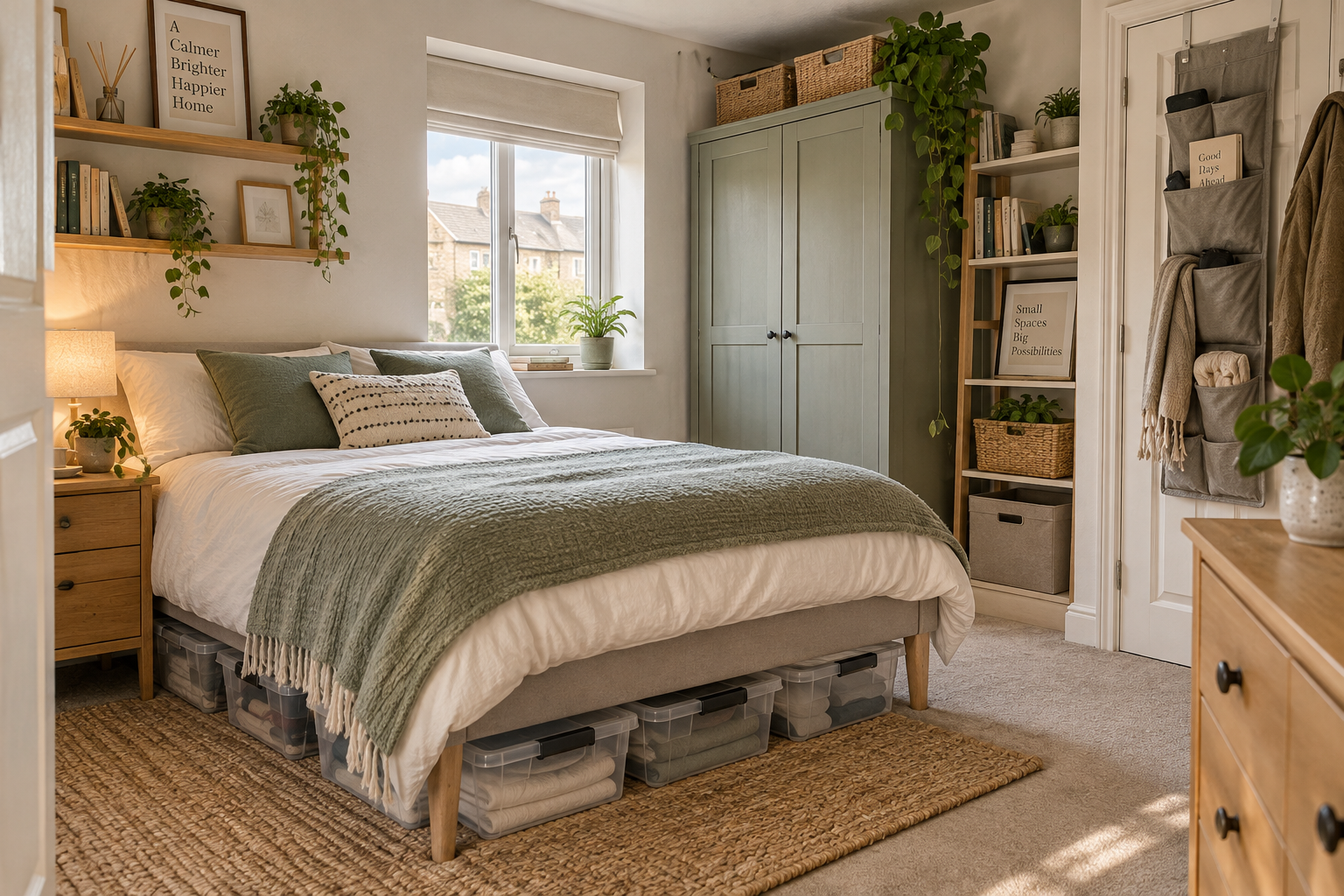
15 Small Bedroom Storage Ideas That Make the Most of Every Inch
A small bedroom doesn’t necessarily need more storage furniture. Often, it just needs the space that’s already there to work a little harder.
When storage starts running short, it’s tempting to add another chest of drawers, shelving unit or wardrobe. But in a compact bedroom, every extra piece of furniture takes away valuable floor space. Before long, you might have more places to put things but a room that feels even smaller.
A better approach is to look at the space differently.
The area underneath your bed, the top of your wardrobe, an awkward alcove or even the back of the bedroom door can all provide useful storage without significantly reducing the space you have to move around.
Whether you’re dealing with a box room, a small bedroom in a flat or simply a bedroom with more belongings than storage, these ideas can help you make better use of every inch.
Before You Buy Anything, Find the Wasted Space
Before ordering another storage unit, spend a few minutes looking around your bedroom.
Not at what you own, but at the room itself.
Where is space currently being wasted?
Look underneath the bed. Check above the wardrobe. Open the wardrobe and see whether there’s unused space beneath hanging clothes or above the rail. Look at the backs of doors, awkward corners and narrow gaps beside furniture.
You may already have more potential storage space than you realise.
It’s also worth measuring these areas before buying anything.
In a small bedroom, a difference of just a few centimetres can determine whether a storage solution works or simply makes the room harder to use. Remember to account for skirting boards, radiators, plug sockets, doors, drawers and wardrobe doors that need room to open.
Try to preserve comfortable routes around the bed too. A storage unit might technically fit into a gap, but that doesn’t necessarily mean it belongs there.
The aim isn’t to fill every available space.
It’s to make the unused spaces useful.
1. Start With the Space Under Your Bed
For many small bedrooms, the largest unused storage area is directly underneath the bed.
If your bed has enough clearance, shallow storage boxes can provide an easy home for things you don’t need every day.
This works particularly well for spare bedding, towels, seasonal clothing, shoes, bags and blankets.
Boxes with lids can help keep dust away, while transparent boxes make it easier to see what’s inside without pulling everything out. Fabric storage bags can be useful where rigid boxes don’t quite fit, particularly for bedding and clothing.
Vacuum bags can also reduce the amount of room taken up by bulky seasonal items, although they’re generally better for things you only need occasionally.
Avoid turning the space beneath the bed into somewhere you simply push anything that doesn’t have another home.
A few labelled containers are much easier to live with than a collection of loose belongings disappearing into the darkness.
If your bed sits too low for useful storage, bed risers can sometimes create additional clearance. Just make sure they’re suitable for your particular bed frame and don’t make the bed unstable.
2. Consider an Ottoman or Storage Bed
If you’re already planning to replace your bed, choosing one with built-in storage can make a substantial difference in a small bedroom.
Ottoman beds lift the mattress and bed base to reveal a large storage compartment underneath. Divan beds with drawers provide a similar benefit while making frequently used items easier to reach.
The advantage is simple: the bed already occupies a significant proportion of the room, so you’re gaining additional storage without giving up more floor space.
They’re particularly useful for bulky belongings such as spare duvets, winter clothing, bedding and luggage.
That doesn’t mean you should replace a perfectly good bed purely for storage.
An ottoman bed is a relatively significant purchase, and inexpensive under-bed boxes may solve the same problem for much less money.
Think of built-in bed storage as something worth considering when your bed needs replacing anyway, rather than an essential small-bedroom upgrade.
3. Choose Tall Storage Instead of Wide Storage
When floor space is limited, look upwards.
A wide chest of drawers might offer plenty of storage, but it can also consume a large section of valuable wall and floor space. A narrower tallboy can sometimes provide similar capacity while occupying a much smaller footprint.
The same principle applies to shelving and cabinets.
If you have a choice between a low, wide unit and a taller, narrower one, consider whether using the room’s height would work better.
There are limits, of course.
Frequently used belongings should remain within comfortable reach, and tall furniture should be secured appropriately where required. You also don’t want every wall filled from floor to ceiling, as that can make a small bedroom feel enclosed.
But carefully chosen vertical storage can allow you to keep more floor visible, which often helps a compact bedroom feel less crowded.
This same principle applies throughout a small home. Our guide to small-space storage ideas for UK homes explores more ways to make awkward and overlooked areas useful without simply filling rooms with additional furniture.
4. Make Your Existing Wardrobe Work Harder
Before deciding that your wardrobe is too small, take everything out and look at how the space is actually being used.
A surprising amount of wardrobe capacity can disappear because of inefficient organisation.
You might have a rail packed with bulky hangers while the bottom half of the wardrobe is almost empty. Or perhaps one high shelf contains a handful of items surrounded by unused space.
There are several relatively inexpensive ways to improve this.
Slim hangers can create additional rail space. Shelf dividers and small storage boxes can stop piles of clothes collapsing into one another. Hanging organisers can create compartments for folded clothing, while stackable shoe storage can make better use of the wardrobe floor.
If there’s a large gap beneath shorter hanging clothes, a small internal drawer unit or extra shelf may fit underneath.
The important thing is to organise around what you actually own.
Someone with lots of shirts and jackets needs hanging space. Someone who mainly wears T-shirts, knitwear and casual clothes might benefit more from shelves and drawers.
Don’t automatically accept the wardrobe’s original layout as the best layout for you.
5. Replace a Basic Bedside Table With Proper Storage
A bedside table is useful, but some designs don’t make particularly good use of the space they occupy.
A simple table with four legs gives you one surface and very little else.
In a small bedroom, consider replacing it with a compact bedside cabinet or narrow chest with drawers.
The footprint may be almost identical, but suddenly you’ve gained somewhere for chargers, books, medication, glasses and other small belongings that would otherwise sit on top.
This can also make the room look tidier.
Instead of having lots of small items visible beside the bed, most can be stored away while the top remains available for a lamp, phone or glass of water.
If there isn’t enough room for a conventional bedside cabinet, a small wall-mounted shelf can provide a surface without taking any floor space at all.
Renters should, of course, check what they’re allowed to attach to the wall before drilling.
6. Use the Space Above Your Wardrobe
The top of a wardrobe often becomes one of two things: completely unused space or a messy collection of bags and boxes.
With a little organisation, it can be genuinely useful.
It’s a good location for things you don’t need every day, such as suitcases, seasonal clothing, spare bedding, memory boxes and occasional bags.
Rather than placing everything loosely on top, use matching boxes or baskets where practical.
Containers make it easier to remove one category of belongings without disturbing everything else, and they help prevent smaller items disappearing behind the wardrobe.
Measure the gap between the wardrobe and ceiling before buying boxes. You want containers that use the available height without being so large that they’re difficult to lift down safely.
And don’t store something up there if you’re going to need it every morning.
High storage works best for low-frequency items.
7. Put Awkward Alcoves to Work
Small bedrooms in older UK homes aren’t always neat rectangles.
Chimney breasts, alcoves, sloping ceilings and unusual recesses can make standard furniture difficult to position.
But those awkward spaces can also become useful storage.
An alcove beside a chimney breast might fit a narrow chest of drawers, freestanding shelving or clothes rail. A shallow recess could accommodate shelves for books, accessories or storage baskets.
Bespoke fitted cabinetry can make excellent use of unusual spaces, but it isn’t the only solution—and it certainly isn’t the cheapest.
Before considering custom joinery, measure the space carefully and look for standard furniture that happens to fit.
Sometimes a narrow bookcase or modular shelving unit can turn an awkward gap into useful storage for a fraction of the cost.
For renters, freestanding furniture also has the advantage of moving with you.
8. Use Storage Above or Around the Bed
The wall around a bed is often largely unused.
Shelves above the headboard can provide storage for books and decorative items, while cabinets positioned higher on the wall can provide more substantial storage.
However, this is one area where restraint matters.
Covering the entire wall above a bed with heavy-looking furniture can make a small bedroom feel even more enclosed. Anything mounted above a bed also needs to be securely installed and appropriate for the wall construction.
A single shelf or a small amount of carefully positioned storage may be all you need.
Keep everyday items within easy reach and reserve higher shelves for belongings you use less frequently.
It’s also worth leaving some empty wall visible.
In a small bedroom, maximising storage doesn’t mean every available centimetre has to contain something.
9. Use Slim Shelving in Spaces That Normally Go Wasted
Some gaps are too narrow for conventional furniture but still wide enough to be useful.
Look beside wardrobes, next to a desk, between furniture and a wall or in a narrow section behind an open door.
Slim shelving units can work particularly well for books, toiletries, folded accessories, small storage baskets, handbags or hobby supplies.
The key is choosing storage that genuinely fits the space.
Trying to squeeze an oversized unit into a narrow gap can make the whole room look cramped.
Before buying anything, measure the width, depth and height available—and remember to check whether nearby doors or drawers still have room to open.
Sometimes the best small-bedroom storage isn’t a large piece of furniture.
It’s a 20-centimetre gap finally being put to work.
10. Make the Back of the Door Useful
The back of a bedroom or wardrobe door is easily overlooked because it doesn’t take up visible floor space.
Over-door hooks can provide somewhere for dressing gowns, jackets, bags or tomorrow’s clothes.
Over-door organisers with pockets can hold shoes, accessories, scarves and smaller belongings.
They’re especially useful in rented homes because many options require no permanent fixings.
There is one potential downside: too much weight or bulk can prevent a door from opening properly or make it awkward to close.
Choose what you store there carefully.
A few useful items are better than turning the back of the door into another overflowing cupboard.
If you’re renting and want more ways to increase storage without making permanent changes, our guide to renter-friendly storage ideas that won’t damage your walls covers reversible solutions throughout the home.
11. Use the Space Beneath a Window
The area underneath a bedroom window can be difficult to furnish.
Tall furniture blocks light, while conventional wardrobes obviously aren’t suitable.
Low storage can work much better.
A low drawer unit, storage bench or small cabinet can make use of the wall while keeping the window itself clear.
A bench with internal storage can be particularly effective because it provides both seating and somewhere for bedding, shoes or other belongings.
But check what’s already beneath the window.
Many UK bedrooms have radiators positioned there, and storage shouldn’t block airflow or sit dangerously close to a heat source. Curtains also need room to hang properly.
If a radiator occupies the entire space, it may simply be an area that’s better left alone.
Not every empty-looking space needs to become storage.
12. Make Furniture Do More Than One Job
Every piece of furniture in a small bedroom should earn the space it occupies.
That doesn’t mean everything needs a hidden compartment, but multifunctional furniture can significantly reduce the number of separate pieces you need.
A storage ottoman can provide seating and hide spare bedding.
A desk with drawers can provide workspace and storage.
A dressing table can double as a desk.
A storage bench can provide seating, a surface and internal storage.
Even a bedside cabinet with several drawers is doing more useful work than a basic table.
When considering new furniture, ask a simple question:
If this is going to take up floor space, what else can it do?
Sometimes spending slightly more on one well-designed piece of furniture can prevent you needing to buy two or three separate items.
13. Give Shoes a Defined Home
Shoes have a habit of spreading.
One pair sits beside the bed. Another ends up underneath a chair. Several more accumulate across the bottom of the wardrobe.
Giving them a defined home can free up a surprising amount of space.
If you have room beneath the bed, shallow shoe boxes or organisers can keep less frequently worn pairs out of sight.
A slim shoe rack may fit at the bottom of a wardrobe, while hanging organisers can work for lighter footwear. Over-door organisers are another option where floor space is particularly tight.
Keep the shoes you wear most frequently easiest to reach.
Pairs used only occasionally can live in less accessible storage, while seasonal footwear can potentially move elsewhere in the home.
The goal isn’t necessarily to fit every pair into one elaborate shoe-storage system.
It’s simply to stop shoes occupying several unrelated parts of the bedroom.
14. Use Renter-Friendly Vertical Storage
Renting can make small-bedroom storage more challenging because you may not be able to install shelves, fitted furniture or wall-mounted cabinets.
But you can still make better use of vertical space.
Freestanding ladder shelves, tall narrow bookcases, over-door organisers and tension-based storage can all increase capacity without major permanent alterations.
Some removable hooks and adhesive products may also be suitable, but check the manufacturer’s instructions and your tenancy agreement first. Even products marketed as removable can occasionally affect delicate paint or wallpaper.
Freestanding solutions are often the safest option because they can simply move with you.
And before buying something specifically for one awkward corner, consider whether it would still be useful in a different property.
For considerably more ideas specifically designed around rented homes, see our full guide to 17 renter-friendly storage ideas that won’t damage your walls.
15. Declutter Before You Buy More Storage
Sometimes the most effective storage solution is having less to store.
That’s not particularly exciting advice, but it’s important.
Storage boxes, baskets and furniture can help organise belongings, but they can also make it easier to keep things you no longer use.
Before buying another unit, go through the area that’s causing the problem.
Sort items into four simple groups:
- keep
- relocate
- donate or sell
- dispose of responsibly
Be realistic about what belongs in the bedroom.
Old paperwork might be better stored elsewhere. Clothes that haven’t fitted for years may not need to occupy your limited wardrobe space. Empty packaging doesn’t need a storage solution at all.
Once you’ve removed what you genuinely don’t need, organise what’s left.
You may discover that you already have enough storage.
And if you still need something additional, you’ll have a much clearer idea of exactly what kind of storage will solve the problem.
How to Make a Small Bedroom Feel Less Cluttered
A bedroom can be perfectly organised and still feel busy.
That’s because storage capacity and visual clutter aren’t quite the same thing.
In a small room, dozens of visible belongings compete for attention. Open shelves filled with small objects, clothing hanging from every hook and several different storage baskets can make the room feel crowded even when everything technically has a place.
Try to keep at least some surfaces relatively clear.
Group similar items together rather than scattering them across the room. Use closed storage for belongings that naturally look messy, while reserving open shelves for things that are easier to keep tidy.
It can also help to use fewer, slightly larger storage containers rather than lots of tiny boxes.
Most importantly, protect some empty space.
A clear section of floor, an uncluttered bedside cabinet or an empty section of wall can make a small bedroom feel calmer.
You don’t need to use every inch simply because it’s available.
Where Should You Start If You’re on a Budget?
You don’t need to redesign the entire bedroom at once.
If money is limited, start with the changes that cost little or nothing.
First, declutter.
Remove things you no longer need and relocate belongings that don’t need to live in the bedroom.
Second, reorganise the storage you already have.
Look particularly at wardrobes and drawers. Better organisation may create more capacity without requiring another piece of furniture.
Third, use the space underneath the bed.
If it’s currently empty, inexpensive boxes or bags can create a significant amount of storage.
Fourth, look at doors and unused vertical spaces.
An over-door organiser or carefully chosen tall storage unit can provide capacity without consuming much additional floor space.
Finally, replace furniture only where it solves a genuine problem.
An ottoman bed, storage bench or taller chest of drawers can be worthwhile, but they’re much bigger investments than reorganising what you already own.
Working in that order helps prevent you spending money on storage you eventually discover you didn’t need.
Small Bedroom Storage FAQs
How do you maximise storage in a very small bedroom?
Start by using areas that don’t require additional floor space.
Under-bed storage, better wardrobe organisation, tall narrow furniture, over-door storage and carefully used vertical space can all increase capacity without filling the room with extra furniture.
Prioritise the largest unused spaces first rather than trying to create storage in every small gap.
What can I use for storage if I don’t have a wardrobe?
A combination of a freestanding clothes rail, chest of drawers and storage boxes can work well.
Choose the arrangement according to your clothing. If most of your clothes can be folded, prioritising drawers may be more efficient than dedicating a large area to hanging space.
Boxes beneath the bed can then hold seasonal and less frequently used clothing.
How do I add bedroom storage without drilling into walls?
Focus on freestanding and over-door solutions.
Tall bookcases, drawer units, ladder shelves, storage beds, under-bed boxes, over-door organisers and freestanding clothes rails can all add storage without drilling.
Renters can find more options in our renter-friendly storage guide.
How do I make a small bedroom feel bigger without getting rid of storage?
Try to keep floor space and some wall space visible.
Choose tall rather than unnecessarily wide storage where appropriate, keep frequently visible surfaces uncluttered and use closed storage for belongings that create visual noise.
Multifunctional furniture can also reduce the total number of pieces needed in the room.
Make the Space You Already Have Work Harder
A small bedroom doesn’t necessarily need another wardrobe or chest of drawers.
Often, the biggest improvements come from using overlooked areas more effectively: underneath the bed, inside an inefficient wardrobe, above existing furniture or behind a door.
Start with the free changes.
Declutter what you don’t need. Reorganise what you already own. Measure the unused spaces around the room.
Only then decide whether you actually need to buy more storage.
The aim isn’t to squeeze as much furniture as possible into a small bedroom.
It’s to create enough useful storage that the room can still feel like somewhere you want to sleep.
For more ideas beyond the bedroom, explore our 12 small-space storage ideas for UK homes and discover more ways to make overlooked areas around your home work harder.