
Small homes don’t necessarily need less stuff. They need the space they already have to work harder.
In many UK flats, terraces and smaller houses, useful storage space is hiding in places we tend to overlook: above doors, beneath beds, inside cupboards, behind doors and in awkward gaps that standard furniture doesn’t quite fit.
The ideas below aren’t about filling every spare centimetre with boxes. They’re practical ways to create useful storage while keeping your home comfortable, uncluttered and easy to live in.
Quick answer: The best storage ideas for small homes make use of space that’s already there — particularly vertical space, areas beneath furniture, awkward gaps and the backs of doors. Measure first, organise what you already own, and only buy additional storage when it solves a specific problem.
Before you buy more storage, measure the space
It’s tempting to solve a storage problem by buying another basket, cabinet or shelving unit. Measure first.
Note the width, height and depth of the available space, but also check doors, skirting boards, radiators, sockets and anything else that could affect what will actually fit. In a small room, even a few centimetres can make the difference between a useful solution and something that simply gets in the way.
Keep those measurements on your phone. They’ll be far more useful than guessing when you eventually find the right shelf, box or piece of furniture.
1. Use the full height of the room
When floor space is limited, look upwards. The area above cupboards, desks and freestanding furniture is often completely unused, even though it can provide valuable storage without taking another centimetre from the floor.
Tall shelving works particularly well for things you want to keep but don’t need every day — spare towels, seasonal items, books or storage boxes. In kitchens, there may also be room above existing cabinets for attractive baskets or containers.
Keep frequently used items within comfortable reach and reserve the highest spaces for occasional-use belongings. A small folding step stool can help, but everyday storage shouldn’t require climbing every time you need something.
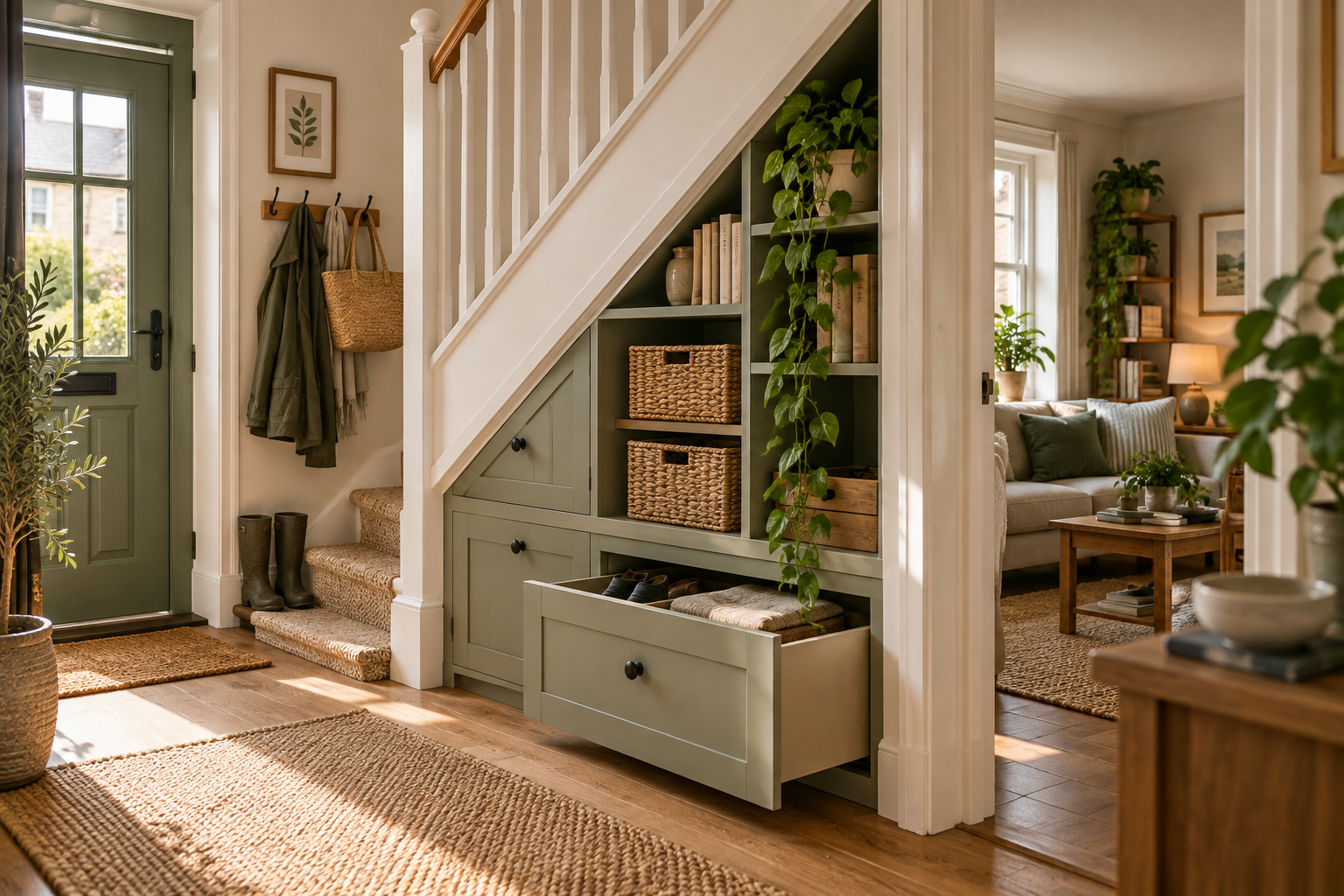
2. Turn the space under the stairs into useful storage
An understairs cupboard can easily become a place where everything gets pushed in and nothing is easy to retrieve. Instead, think about dividing the space according to its changing height.
The taller end can accommodate coats, a vacuum cleaner or shelving, while the lower sections are well suited to pull-out drawers, shoes, bags and household supplies.
Bespoke fitted drawers can look fantastic, but they aren’t the only option. Before paying for joinery, measure the space and see whether freestanding cubes, baskets or modular shelving could achieve most of the same result for considerably less.
3. Put the backs of doors to work
The back of a door is useful precisely because it normally occupies no additional floor space.
Over-door organisers can work well for shoes, cleaning supplies, toiletries and smaller accessories. Simple hooks can also give dressing gowns, towels, bags or everyday clothing a permanent home instead of leaving them on furniture.
If you’re renting, avoid assuming that every adhesive hook is damage-free. Paint condition and wall or door finishes vary, so check the manufacturer’s instructions and test removable products somewhere inconspicuous first.
4. Choose furniture that earns its floor space
In a small home, furniture that only performs one job can quickly use up valuable space. When you’re replacing something anyway, look for pieces that can provide useful storage as well.
An ottoman bed is an obvious example: the entire area beneath the mattress becomes accessible storage for bedding, suitcases or seasonal clothing. Storage benches can do something similar in hallways and bedrooms, while coffee tables with drawers or shelves can keep everyday clutter away from the surface.
That doesn’t mean every piece of furniture needs a hidden compartment. The aim is simply to get more value from the floor space you’re already using.
Nookcroft tip: Don’t replace perfectly good furniture purely to gain storage. Multifunctional furniture makes most sense when you already need to buy or replace something.
5. Make awkward alcoves work harder
Chimney breasts, sloping ceilings and uneven walls can leave smaller UK homes with spaces that standard furniture doesn’t fit particularly well.
Before dismissing an alcove, measure its width, depth and height. A narrow shelving unit, floating shelves or even a simple run of cut-to-size shelves can turn an otherwise unused recess into storage for books, baskets or everyday household items.
You don’t necessarily need expensive fitted cabinetry. If you’re comfortable with straightforward DIY, shelves cut to size at a timber merchant or DIY shop can provide a much more affordable solution.
If you’re renting, a freestanding shelving unit that fits reasonably closely into the alcove may be the better option because it can leave with you when you move.
6. Look above your doors
One of the most overlooked storage areas in a home is directly above a doorway.
If there’s enough clearance, a shelf above a bedroom, bathroom or hallway door can provide a useful home for things that aren’t needed every day. Towels, spare bedding, baskets and decorative storage boxes can all work well here.
Measure carefully before installing anything. Check that the shelf won’t interfere with the door, nearby cupboards or other fittings, and use fixings appropriate for the wall construction and the weight you intend to store.
Keep heavier everyday items somewhere easier to reach. High shelves are much better suited to lighter, occasional-use belongings.
7. Turn narrow gaps into useful storage
Small gaps beside wardrobes, washing machines, kitchen units and other furniture often end up doing nothing more than collecting dust.
Measure them before writing them off. Even a relatively narrow space may accommodate a slim trolley, narrow shelving unit or vertical storage for items such as trays, chopping boards, cleaning products or ironing equipment.
In a kitchen, a slim pull-out trolley can be particularly useful between appliances and units, provided there is enough clearance and it doesn’t obstruct ventilation or access.
Avoid buying a narrow storage unit simply because it looks as though it might fit. Measure the gap at several points first — walls and floors in older homes aren’t always perfectly straight.
Nookcroft tip: Keep a note of awkward measurements on your phone. If you have a 17cm gap beside a cupboard, knowing that exact figure makes it much easier to recognise a suitable solution when you find one.
8. Make the inside of kitchen cupboards work harder
Before adding more kitchen storage, look at how much of your existing cupboard space you’re actually using.
Tall shelves often leave a large amount of empty space above shorter items. Shelf risers can effectively create another level, while stackable containers can make deep cupboards easier to organise.
Cupboard doors can also provide useful space for lightweight items. Depending on the cupboard, small racks or organisers can hold cleaning cloths, pan lids or other frequently used items.
But don’t try to fill every available surface. A cupboard that’s packed too tightly becomes frustrating to use, and items at the back are easily forgotten.
A better goal is to make everything visible and reasonably easy to reach.
Before buying organisers, empty one problem cupboard completely. Put similar items together and remove anything you no longer use. You may discover that organisation solves more of the problem than additional storage.
9. Rethink the space beneath your bed
Under-bed storage can provide a surprisingly large amount of capacity without taking up any additional floor space.
It’s particularly useful for spare bedding, seasonal clothing, shoes and other belongings you don’t need every day.
But there’s a difference between using the space and simply pushing things underneath the bed.
Measure the available height before buying containers and choose boxes or bags that can be removed easily. Containers with handles or wheels can be particularly useful beneath lower beds.
If dust is a problem, enclosed containers are generally more practical than open baskets. Vacuum storage bags can reduce the volume of bulky textiles, although they aren’t necessary for everything.
And resist turning the space into permanent storage for things you’ve forgotten you own. If something has lived untouched beneath the bed for several years, the better question might be whether you still need it.
Measure before you buy
Width × height × depth. Keep these three measurements on your phone whenever you’re looking for storage. Check skirting boards, hinges, sockets, radiators and door clearance too — the usable space can be smaller than it first appears.
10. Create a proper drop zone near the entrance
Clutter often builds up where everyday items don’t have an obvious home. Hallways and entrances are particularly vulnerable: keys, post, shoes, coats and bags can quickly end up spread across whatever surface is closest.
You don’t need a large hallway to create a useful drop zone. A few well-placed hooks, a small tray for keys and a basket or compact shoe rack may be enough.
If floor space is particularly tight, prioritise the wall. Hooks can store coats and bags without the footprint of a coat stand, while a narrow shelf can provide somewhere for keys and post.
Think about what you actually do when you walk through the door. The best storage solution is usually the one that makes putting something away almost as easy as dropping it on the floor.
Nookcroft tip: Don’t design your entrance around everything you own. Design it around what you use regularly. Off-season coats and occasional footwear can live somewhere else.
11. Use removable storage solutions when renting
Renting doesn’t mean you can’t improve your storage, but it does change which solutions make sense.
Freestanding shelving, over-door organisers, tension rods, storage trolleys and furniture with built-in storage can all add useful capacity without becoming permanent fixtures.
Removable adhesive hooks and strips can also be useful, but don’t assume they’re completely risk-free. Paint condition, wall preparation and the length of time they’ve been attached can all affect removal.
Always follow the manufacturer’s instructions and, where possible, test an adhesive product somewhere inconspicuous first.
Before drilling, mounting shelves or making other permanent changes, check your tenancy agreement and seek permission from your landlord or letting agent where required.
The advantage of freestanding and removable storage is simple: the storage belongs to you, not the property. If you move, it can move with you.
12. Buy fewer, better storage containers
Matching rows of baskets and boxes can look beautifully organised, but containers aren’t automatically a storage solution.
Before buying them, decide exactly what each one needs to hold and where it will live.
A good container should fit the available space, make its contents reasonably easy to access and solve a specific problem. If it doesn’t do those things, it may simply become another object that needs storing.
Transparent boxes can be useful where visibility matters. Baskets can hide everyday clutter in open shelving. Lidded containers are often better for items stored for longer periods where dust is an issue.
You also don’t need everything to match. Consistency can make open shelving look calmer, but functionality matters more than creating a perfectly coordinated cupboard.
Start by organising what you already own. Buy the container last, not first.
Start with the space that frustrates you most
You don’t need to reorganise your entire home in a weekend.
Start with one place that repeatedly causes frustration — the overflowing kitchen cupboard, the pile of shoes by the front door or the awkward space beneath the stairs.
Empty it, measure it and decide what actually needs to live there. Only then look for a storage solution.
Small homes can work remarkably well when the available space has a clear purpose. The aim isn’t to squeeze storage into every possible corner. It’s to make the home easier to use, easier to keep tidy and more enjoyable to live in.
Sometimes that means adding a shelf or choosing better furniture. Sometimes it simply means owning fewer containers and organising the space you already have.
Start small. Make one space work better, then move on to the next.