
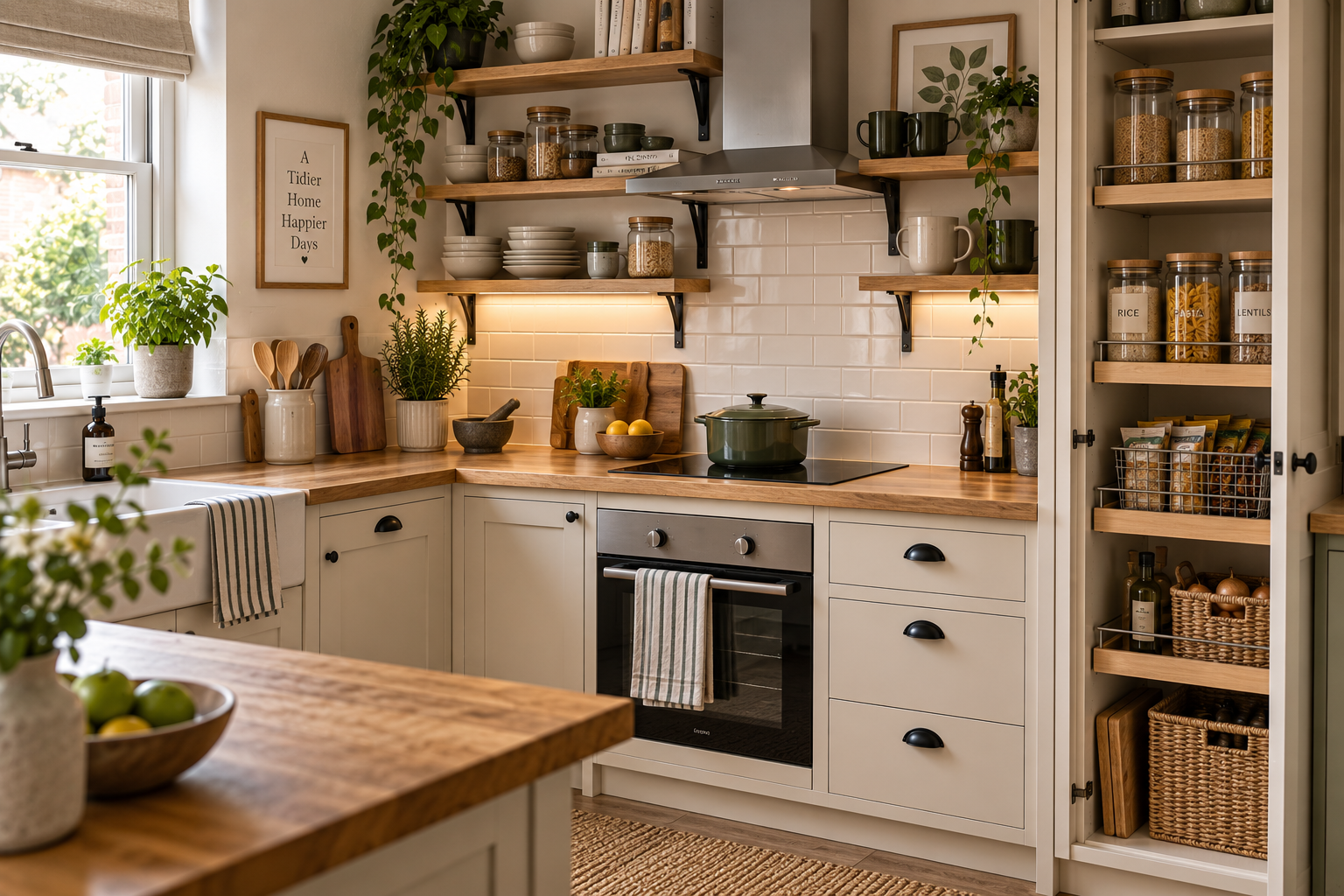
A small kitchen can feel short of storage even when the cupboards themselves aren’t particularly small.
The problem is often how that space is being used. Half-empty shelves, deep cupboards where things disappear at the back, crowded worktops and items stored nowhere near where they’re actually needed can make a kitchen feel much smaller than it is.
Before adding another cabinet, trolley or set of storage containers, it is worth seeing whether the space you already have can work harder.
This guide looks at practical ways to organise a small kitchen using the cupboards, drawers, walls and worktops you already have — without turning every available surface into storage.
Quick answer: Start by removing what doesn’t need to live in the kitchen, then organise what’s left around how you actually cook. Make better use of cupboard height and depth, keep frequently used items easy to reach and only buy organisers when they solve a specific problem.
Before organising anything, empty one problem area
Trying to reorganise an entire kitchen at once usually creates a bigger problem before it creates a solution.
Instead, start with the cupboard, drawer or section that frustrates you most. Empty it completely and put everything somewhere you can see it.
You may find duplicate ingredients, utensils you rarely use or things that have simply ended up in the wrong place. Check food dates, remove anything you no longer need and group similar items together before putting anything back.
Only once you know what needs to live in that space should you decide whether you need additional storage.
Nookcroft tip: Take a quick photo of the empty cupboard and note its width, height and depth. If you eventually decide an organiser would help, you’ll have the measurements with you rather than relying on guesswork.
1. Decide what actually deserves kitchen space
In a small kitchen, convenient storage should be reserved for the things you use.
That sounds obvious, but cupboards often gradually fill with rarely used appliances, duplicate utensils, excessive mugs, serving dishes and ingredients bought for recipes that were made once and never repeated.
Start with frequency of use.
Everyday plates, glasses, pans and cooking equipment should generally be among the easiest things to reach. Items used occasionally can move to higher shelves or less convenient cupboards.
Things used only a handful of times each year may not need prime kitchen space at all. If you have suitable storage elsewhere in the home, occasional serving dishes or specialist equipment could potentially live there instead.
The aim isn’t to strip the kitchen down to the bare minimum. It’s to stop rarely used belongings making everyday cooking more difficult.
2. Use the full height of cupboard shelves
Open one of your kitchen cupboards and look above the items on each shelf.
If there’s a large empty gap between a row of mugs and the shelf above, you have storage capacity that isn’t currently doing anything.
Shelf risers can divide a tall shelf into two usable levels without permanently altering the cupboard. They can work particularly well for mugs, bowls, tins and smaller food containers.
But measure before buying one. Check the internal width and depth of the cupboard as well as the vertical clearance between shelves.
You may also be able to reposition existing shelves. Many kitchen cabinets use adjustable shelf supports, and moving a shelf by just a few centimetres can sometimes make the whole cupboard work better without buying anything.
Try this first: Before purchasing an organiser, experiment with the position of the shelves already in the cupboard. The cheapest storage improvement is the one you already own.
3. Stop things disappearing at the back of deep cupboards
Deep cupboards can provide plenty of storage on paper while being surprisingly awkward to use.
The problem is visibility. When several rows of tins, packets or containers sit in front of one another, the items at the back are easily forgotten.
Where possible, group similar things together and avoid storing frequently used items behind things you rarely need.
For smaller ingredients, a removable basket or tray can help. Instead of reaching past several objects, you can pull the whole group forward and see what’s inside.
This can be particularly useful for baking ingredients, sauces, snacks or packets that otherwise become scattered around the cupboard.
Before buying pull-out systems or specialist inserts, try using a suitable basket or container you already own. The objective is accessibility, not having perfectly matching storage.
4. Store pans and lids separately
Pans are awkward enough to store without their lids making the cupboard even harder to use.
If you currently stack everything together, try separating the two. Nesting pans from largest to smallest can dramatically reduce the amount of cupboard or drawer space they occupy, while lids can be stored vertically elsewhere.
A simple divider or rack can keep lids upright, making it easier to see and remove the one you need without disturbing the rest. Depending on your kitchen, the inside of a suitable cupboard door may also provide enough space for a lightweight lid holder.
Deep drawers are particularly useful for cookware because you can see everything from above rather than reaching into the back of a low cupboard.
Before buying a pan organiser, experiment with the cookware you already own. You may find that removing one rarely used pan or simply changing the way the set is stacked solves most of the problem.
Nookcroft tip: If two pans perform almost exactly the same job and you consistently reach for one of them, ask whether the other still deserves valuable cupboard space.
5. Use cupboard doors carefully
The inside of a cupboard door is easy to overlook because it occupies almost no additional room when the cupboard is closed.
Small racks, hooks and organisers can make this space useful for lightweight items such as cleaning cloths, measuring spoons or other frequently used kitchen accessories.
Under-sink cupboard doors can be particularly useful for storing cloths, gloves or lightweight cleaning equipment.
There is a limit, though.
Anything mounted to a cupboard door needs enough clearance to avoid hitting shelves or their contents when the door closes. Heavy organisers can also put unnecessary strain on hinges.
Measure both the available door space and the clearance inside the cupboard before buying anything.
If you’re renting, be particularly careful with screws and adhesive products. Check your tenancy agreement before making permanent changes, and don’t assume an adhesive fixing will leave every painted or laminated surface completely untouched.
6. Make the space under the sink easier to use
The cupboard beneath the kitchen sink is often one of the most awkward storage spaces in the room.
Pipework interrupts the available space, the cupboard can be deep and cleaning products have a habit of accumulating at the back.
Start by taking everything out.
Dispose of empty products appropriately, combine duplicates where it is safe and sensible to do so, and decide what genuinely needs to remain beneath the sink.
A removable basket can make frequently used cleaning products easier to access. Rather than reaching individually into the back of the cupboard, you can pull the entire group towards you.
The vertical space around the pipework may also be useful, but avoid cramming the cupboard so tightly that plumbing becomes difficult to inspect or access.
Most importantly, think about safety. Follow the storage instructions on household products, keep incompatible chemicals separate where required, and make sure anything hazardous is stored securely away from children and pets.
Before you buy: Measure around the actual pipework, not just the dimensions of the cupboard. An organiser that technically fits the cabinet may be completely useless once the waste pipe is taken into account.
7. Clear the worktop before adding more storage
In a small kitchen, clear worktop space can be more valuable than another shelf.
Start by looking at everything that permanently lives on yours. Kettles and frequently used appliances may deserve their place, but other items often remain on the worktop simply because that’s where they’ve always been.
Ask how often each item is actually used.
An appliance used every morning probably belongs within easy reach. One used once or twice a month may be better stored in a cupboard, freeing up space for preparing food.
The same applies to utensil pots, spice collections, chopping boards and decorative items. Individually they may occupy very little room, but together they can leave surprisingly little usable surface.
Don’t aim for an empty, showroom-style kitchen. A practical worktop should contain the things that genuinely make cooking easier.
Nookcroft tip: Clear one section of worktop completely and live with it for a few days. You’ll quickly discover which items you genuinely miss having within reach.
8. Use vertical space without covering every wall
When cupboards and worktops are limited, walls can provide useful additional storage.
A small shelf might hold everyday mugs, jars or frequently used ingredients. A rail with suitable hooks can provide a home for utensils, while a magnetic rack designed for the purpose may help free drawer or worktop space.
But there’s a balance.
Covering every available wall with shelves, rails and hanging equipment can make a small kitchen feel busier and more enclosed, even if technically you’ve created more storage.
Choose one or two areas where vertical storage would make a genuine difference rather than automatically filling every blank wall.
Keep frequently used items within comfortable reach and avoid positioning storage where it could interfere with doors, windows, cooking areas or safe movement around the kitchen.
If you’re renting, consider removable or freestanding alternatives before drilling into walls, and always check what your tenancy allows.
9. Create zones around the way you actually cook
A well-organised kitchen isn’t only about fitting everything into cupboards. It’s also about putting things close to where they’re used.
Think about the activities you repeat most often.
If you make tea or coffee every morning, keeping mugs, the kettle and supplies reasonably close together creates a simple drinks zone.
Cooking utensils and everyday pans make more sense near the hob than on the opposite side of the room. Plates and bowls may be easier to put away if they’re stored close to the dishwasher or draining area.
You don’t need to redesign the kitchen to do this. Often it’s simply a matter of swapping the contents of two cupboards or drawers.
Spend a few days noticing unnecessary movements while you cook. If you’re repeatedly crossing the kitchen to retrieve something, there may be a more logical place for it.
Try this first: Before buying any new kitchen storage, move five frequently used items closer to where you actually use them. A better layout can sometimes improve a small kitchen more than additional storage.
10. Put everyday items in the easiest places to reach
Not every part of a kitchen cupboard is equally convenient.
Eye-level shelves, the front of drawers and easily reached lower cupboards are valuable spaces, so reserve them for things you use regularly.
Everyday plates, glasses, ingredients and cooking equipment shouldn’t require moving several other things first. Less frequently used items can usually tolerate a less convenient location.
Higher shelves are useful for occasional serving dishes, spare glasses or equipment you only bring out from time to time. Just avoid storing anything particularly heavy somewhere that’s awkward to lift down safely.
This doesn’t require perfectly organised cupboards. The simple principle is to make the things you use most often the easiest things to reach.
Nookcroft tip: If you have to move one item every day to reach another, their positions probably need reconsidering.
11. Don’t buy an organiser until you know the problem
Kitchen organisers can be genuinely useful, but they’re also surprisingly easy to buy without solving anything.
A turntable won’t help if the real problem is too many bottles. A shelf riser isn’t useful if it leaves too little room for what’s underneath. And a collection of matching containers can actually consume more cupboard space than the original packaging.
Identify the problem first.
Is something difficult to see? Difficult to reach? Stacked badly? Taking up too much space? Or do you simply have more of it than you need?
Once you know the answer, you can decide whether an organiser would actually improve the cupboard.
When you do buy one, measure carefully and choose it for a specific location rather than hoping you’ll find somewhere for it afterwards.
Before you buy: An organiser should make something easier to store, see or reach. If you can’t explain what problem it solves, leave it on the shelf.
12. Know when you genuinely need more storage
Sometimes better organisation isn’t enough.
A particularly small kitchen may simply have less storage than the household reasonably needs, especially if the original layout wasn’t designed around modern appliances and everyday cooking equipment.
If you’ve removed what you don’t use, reorganised the cupboards and made sensible use of existing space but you’re still struggling, then additional storage may be justified.
Look for the least intrusive solution first.
A narrow freestanding trolley, small shelving unit or piece of furniture with useful storage may provide what you need without committing to additional fitted cabinetry.
Renters can particularly benefit from solutions that can move with them rather than investing heavily in someone else’s kitchen.
For homeowners considering something permanent, live with the reorganised kitchen for a while before making the decision. You’ll have a much better understanding of exactly where extra storage would be useful.
More storage can help. It just works best when you know precisely what you’re asking it to store.
A small kitchen will always involve some compromises, but organisation can make a surprisingly large difference to how the room feels and functions.
Start with one frustrating cupboard or drawer rather than trying to transform everything at once. Remove what doesn’t need to be there, put frequently used items within easy reach and make better use of the height and depth you already have.
Then live with those changes.
You may discover that you need a shelf riser, basket or additional piece of storage. You may also discover that simply changing where things live solves the problem without buying anything at all.
The goal isn’t to create a kitchen that looks perfectly organised in a photograph. It’s to create one that’s easier to cook in, easier to keep tidy and better suited to the way you actually live.
If you’re looking for ideas beyond the kitchen, our guide to 12 Small-Space Storage Ideas That Actually Work in UK Homes looks at practical ways to make better use of storage throughout the home.