
Affiliate disclosure: This article contains affiliate links. If you buy something through one of these links, Nookcroft may earn a small commission at no extra cost to you. We only include products that are relevant to the ideas in this guide.
A small utility room can quickly become one of the hardest-working spaces in the house.
Washing powder, laundry baskets, cleaning products, an ironing board, mops, brushes and the vacuum cleaner all need somewhere to live — often alongside a washing machine and tumble dryer.
When space is limited, it doesn’t take much for a useful utility room to start feeling cluttered.
The good news is that creating more storage doesn’t necessarily mean installing more cupboards. Some of the best small utility room storage ideas simply make better use of walls, doors, narrow gaps and the space above your appliances.
Whether you have a separate laundry room, a narrow utility off the kitchen or just a compact area for washing and cleaning, these practical ideas can help you make more of the space you already have.
If storage is a challenge throughout your home, our guide to small-space storage ideas that actually work in UK homes has more ways to make overlooked areas useful.
Before You Add Storage, Decide What Actually Belongs Here
Before buying shelves, baskets or organisers, look at what you’re actually asking the room to store.
A typical utility space might need to accommodate:
- Laundry detergent and fabric-care products
- Dirty washing
- Cleaning sprays and cloths
- An iron and ironing board
- A vacuum cleaner
- Mops, brushes and dustpans
- Spare household supplies
- Pegs and laundry bags
- Pet or outdoor-cleaning equipment
But that doesn’t mean everything needs to stay there.
Small utility rooms often become holding areas for things that don’t have another obvious home. Removing those items first can free up more space than adding another storage unit.
It’s also worth checking for duplicate cleaning products, empty containers and supplies you no longer use.
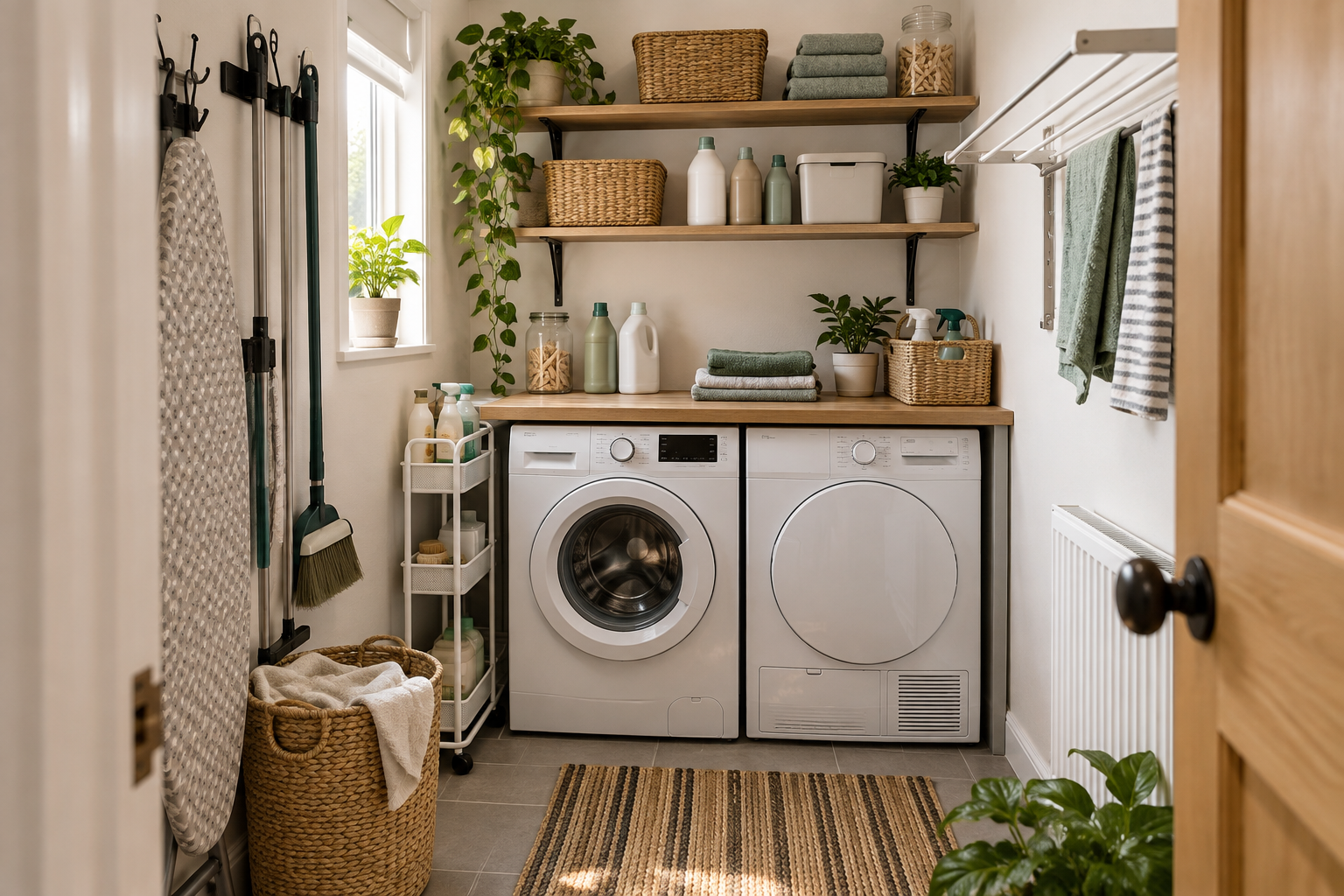
1. Add Shelves Above the Washing Machine
One of the easiest places to find additional storage is the wall above your washing machine.
A couple of well-positioned shelves can provide useful space for detergent, stain removers, spare cloths and other laundry essentials without taking up any additional floor space.
Keep the products you use most often on the easiest-to-reach shelf and reserve higher storage for occasional supplies or refills.
If the shelves are open, avoid filling every centimetre. A little breathing room makes individual items easier to find and stops a practical shelf from becoming another cluttered surface.
Always make sure shelving is securely fixed, suitable for the wall and capable of supporting whatever you intend to store on it.
2. Use the Narrow Gap Beside Your Appliances
That small gap between a washing machine and the wall can look completely useless.
Often, it isn’t.
A slim rolling trolley can turn a narrow gap into useful storage for things such as:
- Laundry detergent
- Stain remover
- Cleaning sprays
- Spare sponges
- Bin bags
- Cleaning cloths
- Household refills
Because the trolley pulls out, you can use much more of the depth rather than losing products at the back.
Measure the width, depth and height of the gap before buying anything. Remember to leave any clearance required by the appliance manufacturer rather than forcing storage into every available centimetre.
A few minutes with a tape measure can save you from buying an organiser that’s just slightly too wide.
3. Put the Back of the Door to Work
When floor and cupboard space are limited, the utility-room door becomes another potential storage surface.
An over-door organiser can hold lightweight household items without sacrificing shelving or worktop space.
Depending on the design, it could be useful for:
- Cleaning cloths
- Pegs
- Laundry bags
- Gloves
- Shoe-care products
- Small cleaning supplies
Suitable hooks can also provide a home for lightweight brushes, reusable bags or other awkward items.
Before adding anything, check that the organiser doesn’t stop the door closing properly or interfere with handles and fittings.
For homes where permanent fixings aren’t suitable, our no-drill storage ideas for renters include more ways to create useful storage without major alterations.
4. Swap a Freestanding Airer for Fold-Away Drying Space
A traditional clothes airer works perfectly well — until it’s permanently blocking the middle of a tiny room.
If indoor drying regularly takes over your floor, consider whether some of that drying space could move onto the wall instead.
A folding wall-mounted airer can provide useful hanging space when you need it and fold back towards the wall afterwards.
Depending on your layout, it could sit above a worktop or on another otherwise unused wall.
Another option is a ceiling-mounted or retractable drying system where the room and fixing points are suitable.
Whichever approach you choose, check the dimensions carefully when the airer is fully extended. Something marketed as space-saving isn’t particularly helpful if it blocks a doorway or prevents you reaching the washing machine.
5. Use Baskets to Organise Open Shelves
Open shelving works well in utility rooms because everything stays visible and easy to reach.
The downside is that rows of bottles, cloths, pegs and miscellaneous supplies can quickly look chaotic.
A few baskets or boxes can bring some order without requiring a complicated system.
Try grouping things by purpose:
- Laundry supplies
- Cleaning cloths
- Pet supplies
- Spare toiletries
- Shoe care
- Household refills
You don’t necessarily need labels if everyone in the household already knows where things belong.
The aim is simply to make it possible to pull out one category rather than searching through an entire shelf.
6. Choose a Laundry-Sorting System That Fits the Room
A huge laundry basket can dominate a small utility room.
If yours constantly gets in the way, rethink its shape rather than simply replacing it with another wide basket.
A tall, narrow hamper can use vertical space more efficiently, while a divided hamper allows you to separate washing before laundry day.
Stackable baskets are another possibility where floor space is particularly tight. Several loads can occupy roughly the same footprint instead of spreading across the room.
Choose the simplest system that matches the way you actually do laundry.
There’s little benefit in creating four carefully organised washing categories if everything ultimately gets washed together.
7. Get the Ironing Board Off the Floor
Few household items are quite as awkward to store as an ironing board.
Lean it against a wall and it falls over. Hide it behind a door and it’s constantly in the way. Push it into an overcrowded cupboard and you’ll need to move everything else whenever you want it.
A dedicated storage position solves most of those problems.
A wall-mounted ironing-board holder or suitable sturdy hooks can keep it upright and off the floor.
The side or inside of a tall cupboard can also work if there’s enough room and the fittings are suitable.
The important part isn’t the particular organiser you use.
It’s giving the ironing board one permanent home.
8. Store Mops and Brushes Vertically
Long-handled cleaning equipment creates clutter because it doesn’t fit neatly onto conventional shelves.
Instead of leaning mops, brooms and brushes into a corner, use the wall.
A wall-mounted holder can keep several cleaning tools upright while occupying a relatively narrow strip of space.
Getting them off the floor also makes the utility room itself easier to sweep and clean.
If possible, place the equipment you use most frequently where it’s easiest to remove without having to move other tools first.
zacurter Heavy-Duty Wall Hooks – Get awkward cleaning tools off the floor: Wall-mounted hooks can give brooms, mops and other long-handled equipment a permanent storage position while keeping valuable floor space clear. Check that the fixings are suitable for your wall and the weight you’re hanging.
9. Make Better Use of the Cupboard Under the Sink
If your utility room has a sink, the cupboard underneath can become a dumping ground surprisingly quickly.
Pipework makes conventional shelving awkward, so bottles and cleaning products tend to accumulate around it.
Rather than fighting the plumbing, organise around it.
Small removable baskets can separate different categories, while a compact under-sink shelf or organiser can sometimes make better use of the available height.
The inside of the cupboard door may provide another small storage area if there’s enough clearance when it closes.
Keep household chemicals in their original containers, follow the storage instructions on their labels and keep hazardous products securely away from children and pets.
Our guide to organising a small kitchen uses many of the same principles for making awkward cupboards and limited storage work harder.
10. Add a Narrow Rolling Trolley
Not every utility room needs another fitted cupboard.
Sometimes a narrow trolley is more useful.
A wheeled trolley can fit beside an appliance, underneath a suitable open section of worktop or against a narrow wall.
It’s particularly useful for products that you regularly move around the room.
And because it isn’t permanently fitted, you can move it whenever you need additional floor space or decide to reorganise the room later.
That flexibility can also make freestanding storage useful for renters.
SPACELEAD SAKA Slim 3-Tier Storage Cart – A flexible freestanding option: A slim wheeled trolley can provide extra storage without adding another permanent cupboard. It’s particularly useful for laundry products and cleaning supplies because it can be pulled out when needed and moved if you reorganise the room later.
For more temporary solutions, take a look at our renter-friendly storage ideas.
11. Don’t Let the Top of Your Appliances Become a Dumping Ground
The top of a washing machine or tumble dryer often becomes an unofficial shelf.
That isn’t necessarily a problem.
The problem starts when it becomes the default home for every item that doesn’t have somewhere else to go.
If the appliance manufacturer’s instructions allow the surface to be used in the way you intend, keep anything stored there controlled and minimal rather than creating another pile.
If you have a suitable worktop fitted above your appliances, consider keeping most of it clear.
That gives you somewhere useful to sort or fold laundry.
In a tiny utility room, a clear working surface can be more valuable than squeezing in another row of containers.
12. Create a Tall Zone for the Vacuum and Cleaning Equipment
A vacuum cleaner needs surprisingly awkward storage.
If you have a tall cupboard, consider dedicating part of it to cleaning equipment rather than filling the entire cupboard with shelves.
A narrow vertical section could potentially hold:
- Vacuum cleaner
- Mop
- Broom
- Dustpan
- Folding step stool
- Ironing board
If your vacuum has separate attachments, keep them together in a basket or suitable holder nearby.
The test for whether this storage works is simple: can you remove the vacuum without first taking five other things out?
If the answer is no, the cupboard needs simplifying.
An under-stairs cupboard can also be one of the best places to keep bulky cleaning equipment. If you’re trying to find a permanent home for yours, we’ve put together 11 practical ways to store a vacuum cleaner in a small home.
13. Add a Hanging Rail Above a Worktop
Not everything needs to go onto a drying rack.
A simple hanging rail can be useful for shirts, dresses and other clothes that you’d prefer to hang straight from the washing machine.
Depending on the layout, a rail might fit:
- Beneath a high shelf
- Between suitable wall units
- Above a worktop
- Inside a cupboard designed for the purpose
Using the empty space above a working surface lets clothes hang without consuming additional floor area.
Make sure there’s enough clearance for garments without obstructing appliances or resting on the worktop.
14. Reserve High Shelves for Occasional Items
The easiest storage positions should be reserved for the things you use most often.
That means the awkward shelf near the ceiling isn’t the ideal home for everyday washing powder.
It can, however, be useful for lighter items you only need occasionally.
For example:
- Bulk household refills
- Spare cleaning supplies
- Seasonal equipment
- Extra towels
- Rarely used laundry accessories
Use lightweight baskets where they make things easier to retrieve, and avoid putting heavy objects somewhere they’re difficult to lift safely.
The room becomes much easier to use when storage priority matches how frequently things are needed.
15. Give Everyday Items a Permanent Home
The final idea doesn’t require buying anything.
Give every frequently used item somewhere specific to live.
Laundry detergent goes on one shelf.
Pegs go in one container.
Cleaning cloths go in one basket.
The ironing board goes on its holder.
The vacuum goes in its designated space.
It sounds simple, but small rooms become cluttered particularly quickly when everyday objects don’t have an obvious home.
If you have to decide where something belongs every time you put it away, the organisation system is probably more complicated than it needs to be.
What Should You Avoid Storing in a Small Utility Room?
More storage isn’t always better.
You still need enough clear space to use appliances safely and move comfortably around the room.
Avoid filling the space so completely that you struggle to open appliance doors, reach controls or access anything that requires maintenance.
Don’t obstruct ventilation, pipework or appliance clearances, and follow the manufacturer’s installation and usage instructions.
Be cautious about putting heavy items on unsuitable shelves or storing things directly on appliances.
Household chemicals should remain in their original containers and be stored according to their labels, securely away from children and pets.
The goal isn’t to fit the maximum possible number of possessions into the room.
It’s to make the things that genuinely belong there easier to store, find and use.
How to Organise a Small Utility Room That’s Already Cluttered
If the room is already overflowing, resist the temptation to solve the problem by immediately buying more organisers.
Start with what you have.
Remove Things That Don’t Belong
Utility rooms easily collect things that were put there simply because nobody knew where else to put them.
Move those items first.
Group Similar Things Together
Put laundry products together, cleaning supplies together and equipment together.
You’ll quickly see where you have duplicates or products you no longer use.
Keep Everyday Products Within Easy Reach
Regularly used detergent shouldn’t be hidden behind six bottles you reach for twice a year.
Keep frequently used products in the easiest storage positions.
Move Occasional Supplies Higher Up
Bulk refills and rarely used supplies can usually go higher or further back, leaving accessible storage for everyday essentials.
Keep the Floor as Clear as Possible
This is where shelves, wall holders, hooks and vertical storage really earn their place.
Every appropriate item you move from the floor gives a small utility room a little more breathing space.
If clutter is a problem elsewhere too, our small-space storage ideas for UK homes can help you find similar opportunities throughout the house.
Do You Need Fitted Storage in a Small Utility Room?
Not necessarily.
Fitted cabinetry can make excellent use of an awkward room, particularly if you’re designing around appliances or want full-height storage.
But it’s far from the only solution.
Shelves, rails, baskets, narrow trolleys and wall-mounted storage can dramatically improve a utility room without replacing what’s already there.
Start with the inexpensive changes.
Live with them for a while.
If the room still doesn’t work, you’ll have a much clearer idea of what any future fitted storage actually needs to achieve.
That’s usually more useful than designing expensive cupboards before understanding the problem.
Make the Walls Work Harder Than the Floor
When floor space is scarce, trying to solve every storage problem at ground level will only make the room feel smaller.
Look upwards instead.
The wall above the washing machine can hold shelves. A narrow gap might take a slim trolley. The back of the door can provide extra storage. A wall can hold an ironing board or cleaning equipment. Higher shelves can keep occasional supplies out of the way.
None of these ideas makes the room physically larger.
They simply make better use of the space that’s already there.
And in a genuinely small home, that’s often what good storage is really about.
For more practical ways to find storage where you didn’t think you had any, explore our small-space storage ideas for UK homes.