
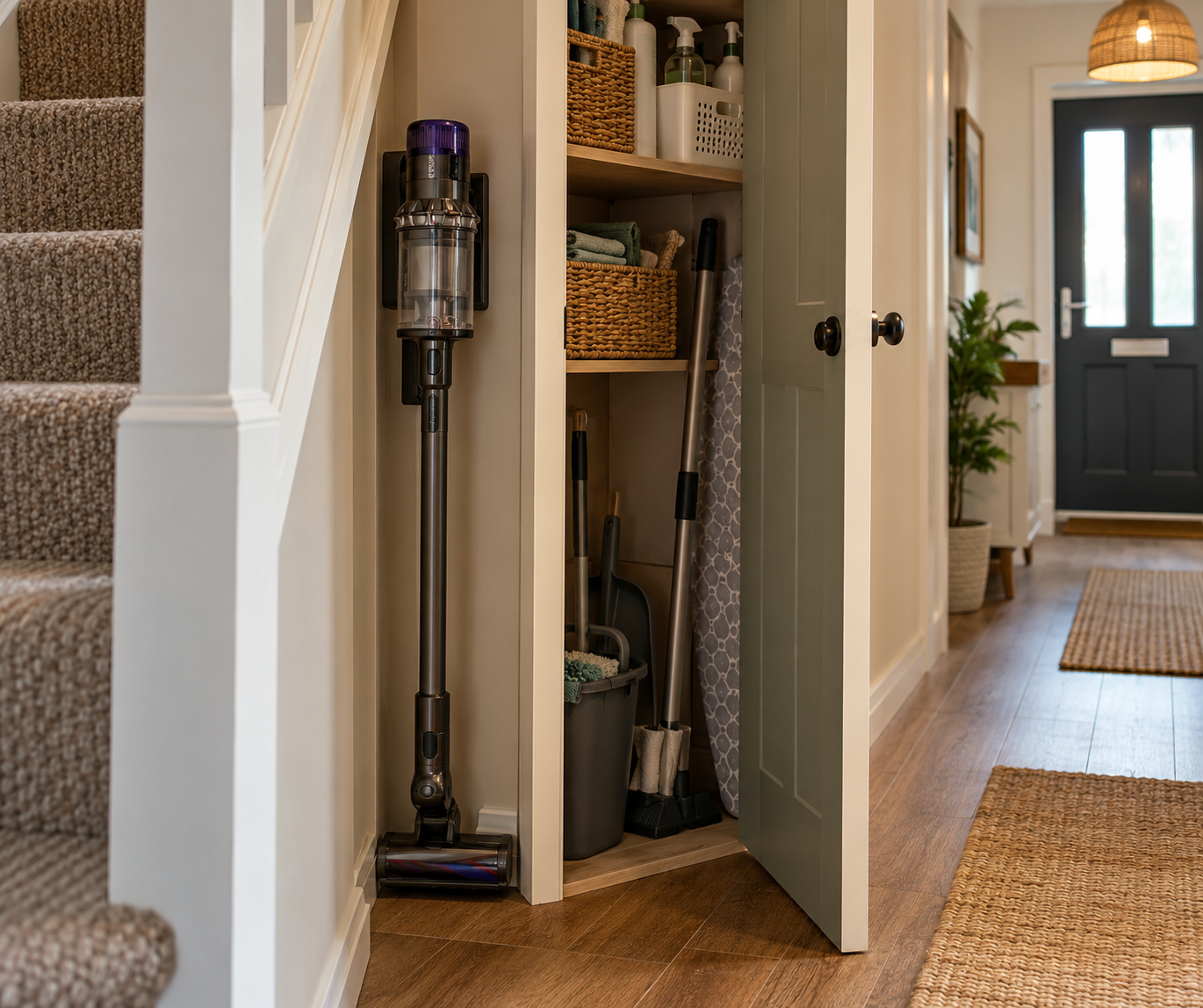
Vacuum cleaners are useful. Finding somewhere to put one in a small home can be much harder.
An upright vacuum is tall and awkward. A cylinder model comes with a hose that never seems to sit where you want it. Cordless stick vacuums are slimmer, but they still need somewhere to stand or charge.
And if you don’t have a dedicated cleaning cupboard, the vacuum can easily end up permanently sitting in a hallway, bedroom or corner of the kitchen.
The best vacuum cleaner storage isn’t necessarily the cleverest hiding place. It’s somewhere that keeps the machine out of the way while still making it easy to grab — and just as easy to put back.
So, whether you call it a vacuum cleaner or simply the hoover, here are 11 practical places to store one when space is limited.
If you’re tackling storage problems throughout your home, our guide to small-space storage ideas that actually work in UK homes is a good place to start.
First, Think About the Type of Vacuum You Own
Not every storage idea works for every vacuum cleaner.
Before reorganising a cupboard or buying an organiser, look at the shape and size of the machine you actually own.
Upright Vacuums
Traditional upright models need height more than anything else.
A tall cupboard, under-stairs cupboard or dedicated vertical storage area will usually make more sense than trying to squeeze one underneath furniture.
Cylinder Vacuums
Cylinder vacuums are shorter but can be surprisingly awkward because of their hose, tube and attachments.
The main unit might fit easily into a cupboard while the hose consumes most of the remaining space.
With these models, organising the accessories can be just as important as storing the vacuum itself.
Cordless Stick Vacuums
Cordless stick vacuums are generally easier to accommodate because they’re narrow and many can be wall-mounted.
However, you may also need access to a socket if the vacuum charges while it’s stored.
Handheld Vacuums
Small handheld cleaners usually need very little space. A shelf, cupboard or charging dock may be enough.
Robot Vacuums
Robot vacuums have a different requirement: accessible floor space.
Their charging dock normally needs enough clear space around it for the cleaner to leave and return without being obstructed.
Whatever type you own, measure it before reorganising anything. A storage idea isn’t particularly useful if the cupboard door won’t close afterwards.
1. Give It a Dedicated Space in a Hallway Cupboard
If you already have a hallway or coat cupboard, this is often one of the simplest places to store a vacuum cleaner.
The problem is that these cupboards tend to fill up with coats, shoes, bags and miscellaneous household items.
Instead of pushing the vacuum into whatever space remains, give it one dedicated vertical section.
That might mean moving a shelf, putting shoes into baskets or relocating things that don’t really need to be there.
The aim is simple: you should be able to take the vacuum out without first removing three coats, several pairs of shoes and a pile of shopping bags.
If your entrance is already struggling with clutter, our small hallway storage ideas for narrow UK homes can help make better use of the surrounding space too.
2. Use the Space Under the Stairs
An under-stairs cupboard can be an excellent home for an upright or cylinder vacuum.
It keeps the machine out of sight while leaving it reasonably close to the main living areas.
But there’s an important difference between putting a vacuum under the stairs and actually creating useful storage for it.
If the hoover gets pushed into the deepest part of the cupboard behind boxes, coats and Christmas decorations, you’ll quickly get tired of retrieving it.
Instead, give it a permanent position near the front or within the taller part of the cupboard.
Keep attachments in a basket or small organiser nearby so the entire vacuum setup stays together.
If your cupboard currently resembles a storage cave, our under-stairs storage ideas show how to organise awkward areas with shelves, baskets, hooks and dedicated storage zones.
3. Mount a Cordless Vacuum on the Wall
Cordless stick vacuums are particularly well suited to vertical storage.
Many models come with a wall dock or bracket that holds the cleaner upright and, depending on the model, may also allow it to charge while stored.
This gets the vacuum off the floor and gives it a permanent home.
Possible locations include:
- Inside a utility room
- Inside a cleaning cupboard
- On a suitable wall beside cabinetry
- Inside a hallway cupboard
- In another discreet storage area
Always follow the manufacturer’s mounting instructions and make sure the wall and fixings are suitable for the weight.
If the vacuum charges on its mount, you’ll also need to consider the position of the nearest socket.
And if you’re renting, don’t assume wall mounting is your only option. A compatible freestanding vacuum stand may make more sense where permanent fixings aren’t allowed.
4. Make Room in a Tall Kitchen or Utility Cupboard
If you have a full-height cupboard in the kitchen or utility room, part of it can become a useful cleaning zone.
You don’t necessarily need the entire cupboard.
A narrow vertical section may be enough for:
- Vacuum cleaner
- Mop
- Broom
- Dustpan
- Ironing board
A shelf above can then hold vacuum attachments, spare bags or other lightweight cleaning supplies.
Keeping these items together makes everyday cleaning much easier than scattering equipment around several rooms.
Our guide to small utility room storage ideas has more ways to organise cleaning equipment, laundry products and awkward vertical spaces without filling the room with extra cupboards.
5. Use a Narrow Gap for a Slim Vacuum
Small homes often contain narrow spaces that aren’t particularly useful for conventional furniture.
The side of a wardrobe, the end of a cupboard run or a suitable gap in a utility area may be wide enough for a cordless stick vacuum.
This works best when the cleaner can stand securely rather than constantly falling into the room.
Measure both the vacuum and the available space first.
You should also make sure you’re not blocking appliance ventilation, pipework, sockets or anything else that needs to remain accessible.
Don’t force a vacuum into a gap simply because it technically fits.
Good storage should make the cleaner easier to use, not harder to retrieve.
6. Store a Compact Vacuum Under the Bed
Under-bed storage isn’t only for clothes and spare bedding.
Depending on its shape, a compact vacuum or detachable stick vacuum may fit beneath a sufficiently high bed.
This can be particularly useful in a small flat without a hallway or utility cupboard.
There are a few drawbacks to consider.
You need enough clearance to slide the cleaner in and out easily, and attachments should stay together rather than gradually disappearing underneath the bed.
It’s also worth thinking about how often you vacuum.
If you’re reaching for it every day, crawling under the bed each time probably isn’t a sensible long-term solution.
For an occasional-use or secondary vacuum, however, it can make use of space that would otherwise sit empty.
7. Create a Cleaning Zone Inside a Wardrobe
A wardrobe might not seem like the obvious place to keep a hoover, but sometimes it’s the best tall storage available.
If you have unused space at one end, consider turning it into a narrow cleaning zone.
The key is keeping it separate from clothes and shoes rather than simply pushing the vacuum into the bottom of the wardrobe.
A basket or shelf nearby can hold attachments so everything stays together.
This works particularly well if you have more hanging space than you actually use.
There’s little benefit in preserving an empty section of wardrobe while your vacuum permanently sits in the hallway.
8. Use the Space Behind a Door Carefully
The area behind an open door is easily overlooked because you rarely see it.
For a slim cordless vacuum, it may provide just enough storage space.
That doesn’t mean balancing the cleaner loosely against the wall.
It needs to remain stable, and the door should still open properly without hitting the vacuum.
A suitable stand or holder can make the arrangement more secure.
This approach works best where the vacuum won’t obstruct a walkway and where the door isn’t constantly being opened and closed against it.
If you’re looking for other ways to use overlooked areas without permanent alterations, our no-drill storage ideas for renters include several removable storage solutions.
9. Separate the Hose and Attachments on a Cylinder Vacuum
Sometimes the vacuum itself isn’t the real storage problem.
It’s everything attached to it.
A cylinder cleaner may fit neatly into the bottom of a cupboard while the hose, extension tube and collection of nozzles take over everything around it.
If the manufacturer’s design allows the components to be detached for storage, organise them separately rather than trying to keep everything connected.
For example:
- Coil the hose neatly
- Keep small nozzles together in a basket
- Store extension tubes vertically
- Use suitable holders for larger accessories
- Keep spare bags or filters together
Try to keep everything in the same general area.
There’s little benefit in creating perfectly organised vacuum storage if you can never remember where you put the crevice tool.
10. Create a Discreet Vacuum Corner
Sometimes there simply isn’t a cupboard available.
That’s fine.
A vacuum cleaner doesn’t have to be completely hidden to be stored properly.
Instead, look for a quiet corner outside the main sightline through the room.
That could be:
- Beside a wardrobe
- Behind an armchair where there’s sufficient space
- At the end of a kitchen unit
- Inside an alcove
- Beside a tall storage cabinet
A cordless stick vacuum sitting neatly on a suitable stand will generally look more intentional than a bulky cleaner surrounded by loose cables and attachments.
Keep the area around it clear so it looks deliberately stored rather than temporarily abandoned.
11. Think About Storage Before Buying Your Next Vacuum
If finding somewhere for your current vacuum is already difficult, storage should be part of the decision when you eventually replace it.
Before buying another one, ask:
Where is this actually going to live?
Check:
- Overall height
- Width and depth
- Whether parts detach
- How the hose is stored
- Whether it needs a charging dock
- Whether the dock requires wall mounting
- Where attachments are kept
- Whether the vacuum can stand upright independently
A slightly more compact model that fits neatly into your home may be more convenient than a larger cleaner that’s permanently in the way.
That doesn’t mean choosing a vacuum purely because it’s small.
It simply means considering storage before the box arrives rather than afterwards.
Where Shouldn’t You Store a Vacuum Cleaner?
When space is tight, almost any empty corner can start looking like potential storage.
But not every location is sensible.
Somewhere Damp
Avoid storing electrical cleaning equipment somewhere persistently damp or where it could be exposed to water.
Follow the manufacturer’s storage instructions for your particular model.
Somewhere It Can Easily Fall
A cordless vacuum balanced against a wall isn’t really stored.
If it regularly falls over, use a suitable stand, bracket or more secure location.
Somewhere That Blocks a Walkway
A vacuum shouldn’t become a trip hazard or make it difficult to move safely through the home.
Somewhere That Interferes With an Appliance
A narrow gap beside a washing machine might look useful, but not if storing the vacuum there obstructs ventilation, pipework or maintenance access.
Somewhere That’s Too Difficult to Reach
This one is about practicality.
If getting the vacuum requires moving furniture and emptying half a cupboard, you’ve probably chosen the wrong location.
A good storage position should make taking the vacuum out and putting it back equally straightforward.
How to Store Vacuum Cleaner Attachments Without Losing Them
Vacuum attachments have an impressive ability to disappear.
The easiest solution is to keep them together and close to the cleaner itself.
For most homes, a small basket or box inside the same cupboard is enough.
Depending on your vacuum, you might keep:
- Everyday nozzles together
- Spare filters in a small box
- Vacuum bags in their original packaging
- Specialist attachments together
- Charging cables with the relevant appliance
If your vacuum already has built-in accessory storage, use it where practical.
Otherwise, don’t feel you need an elaborate organiser.
A simple basket that always goes back to the same place is often the better system.
What If You Have No Cupboard Space at All?
This is where changing the question can help.
Instead of asking:
“Which cupboard can I put the vacuum in?”
ask:
“Where do I have unused vertical or awkward space?”
Look at:
- Narrow gaps
- Empty wall space
- Wardrobe ends
- Under-stairs space
- Suitable areas behind doors
- Under furniture
- Utility areas
- Alcoves
Small homes rarely have large amounts of completely empty storage waiting to be discovered.
What they often have are awkward pockets of space that aren’t being used particularly well.
Our small-space storage ideas for UK homes use the same principle throughout the rest of the house.
Should You Hide a Vacuum Cleaner?
Not necessarily.
It’s easy to assume that good storage means making everything invisible.
It doesn’t.
Good storage means an item has a sensible home, doesn’t create unnecessary clutter and is easy to access when you need it.
If you can hide your vacuum neatly inside a cupboard, great.
If the most practical solution is a cordless cleaner sitting neatly on a stand in the corner of a utility room, that’s perfectly reasonable too.
A storage solution you actually use is better than a clever hiding place that makes everyday cleaning more difficult.
Make Your Vacuum Easy to Put Away
Finding somewhere to store a vacuum cleaner in a small home isn’t about squeezing it into the smallest possible gap.
It’s about balancing space, accessibility and organisation.
An under-stairs cupboard might be ideal for an upright vacuum. A wall mount could solve the problem for a cordless model. A cylinder vacuum might simply need better organisation for its hose and attachments.
Start with the cleaner you already own.
Measure it.
Then look at the unused and awkward spaces around your home.
The best place to store your vacuum is somewhere that’s easy to reach — and easy enough to put it back that you actually do.