
Affiliate disclosure: This article contains affiliate links. If you buy something through one of these links, Nookcroft may earn a small commission at no extra cost to you. We only include products that are relevant to the ideas in this guide.
Having a balcony when you rent can feel like a luxury — until you actually try to make the space useful.
There might be enough room for a chair but not a table. The floor might be plain concrete. Privacy can be limited, and drilling into walls or permanently fixing things to the building may not be allowed.
The good news is that a small balcony doesn’t need a complete makeover to become somewhere you genuinely enjoy using.
With folding furniture, movable planters, portable lighting and a few carefully chosen additions, even a tiny balcony can feel like a proper extension of your home — without relying on permanent changes.
Here are 13 renter-friendly small balcony ideas designed to make more of the space you already have.
Start by Deciding What You Actually Want From the Balcony
The quickest way to overcrowd a small balcony is to try to make it do everything.
A dining area.
A garden.
A reading corner.
Extra storage.
Somewhere to entertain.
On a large terrace, you might manage several of those things. On a narrow balcony, you’ll usually get a better result by choosing one main purpose.
Think about what would actually encourage you to step outside.
If you want somewhere for a morning coffee, two chairs and a small table might be enough.
If growing plants matters more, prioritise pots and vertical space.
If you mainly want somewhere to read, one comfortable chair surrounded by a few plants could be much more useful than squeezing in a complete furniture set.
Start with the purpose. Then decide what deserves the limited space available.
1. Choose Folding Furniture
One of the simplest ways to make a small balcony more flexible is to use furniture that folds away.
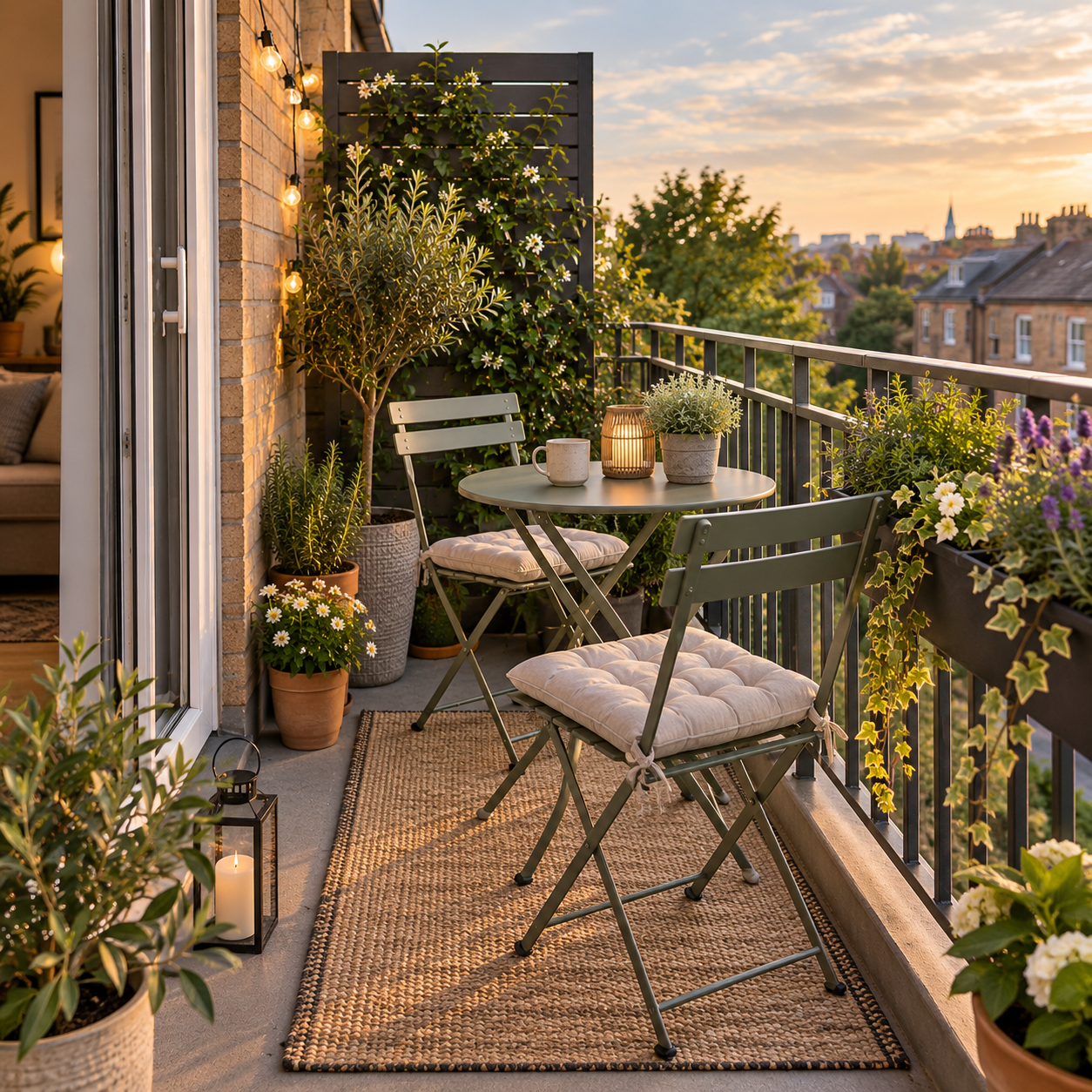
A conventional outdoor dining set can quickly dominate the space. A compact folding bistro table and chairs give you somewhere to eat or have a drink without permanently using most of the floor.
When you need more room, fold them away.
This is particularly useful on narrow balconies where the route from the door needs to remain clear.
Before buying anything, measure properly.
Check the width and depth of the balcony, but also consider the space needed to open the door and pull out a chair.
Furniture that technically fits can still make the balcony frustrating to use.
If you’re starting from scratch, a simple folding bistro set can be an easy way to add seating without committing most of the balcony to furniture. The Alivio 3-Piece Folding Bistro Set includes a small round table and two folding chairs, so the pieces can be put away when you’d rather have the floor space back. As with any balcony furniture, measure the available space — including the room needed to open the door and move around — before ordering.
2. Soften a Plain Floor With an Outdoor Rug
If the existing floor is perfectly usable but doesn’t feel particularly inviting, an outdoor rug can make a noticeable difference without changing the surface underneath.
It introduces colour and texture while helping the seating area feel more intentional.
Choose a rug designed for outdoor use rather than putting an indoor one outside.
You don’t necessarily need to cover the entire balcony either.
A smaller rug beneath a chair and table can visually define the seating area while leaving plenty of floor visible.
Make sure it sits flat, doesn’t interfere with the door and doesn’t obstruct drainage.
When it’s time to move, simply roll it up and take it with you.
You don’t need an expensive rug to try the idea either. The ARSUK Outdoor Plastic Rug is a relatively inexpensive option designed for outdoor use, making it worth considering if you simply want to soften the look of a plain balcony floor. Choose a size that leaves the balcony door and any drainage points clear rather than trying to cover every centimetre of the surface.
3. Consider Removable Interlocking Deck Tiles
If you want a bigger change than an outdoor rug, removable interlocking deck tiles can transform the appearance of a plain balcony floor.
They can create a warmer, more finished surface without permanently replacing what’s underneath.
They’re not automatically suitable for every balcony, though.
Before installing them, check:
- Your tenancy and any building rules
- Whether the existing surface needs to remain accessible
- That water can still drain properly
- That the tiles won’t interfere with the balcony door
- The manufacturer’s installation requirements
The appeal for renters is that the tiles can potentially be lifted again when you move.
The aim is to make the balcony feel better without creating a problem underneath the new surface.
4. Build a Balcony Garden With Pots
You don’t need flower beds to create a garden.
Pots allow you to grow herbs, flowers and other suitable plants while keeping the entire arrangement movable.
They also let you change the layout as plants grow or the seasons change.
Rather than filling every available centimetre with tiny containers, start with a few carefully positioned pots and see how the space feels.
Remember that containers become much heavier once they’re filled with compost, plants and water.
Balconies can also be more exposed than gardens at ground level, so choose pots and plants suited to the conditions rather than buying purely for appearance.
If you’re looking for more inspiration for compact outdoor spaces, our small garden ideas include plenty of ideas that can be adapted to container growing.
5. Grow Upwards Without Drilling Into the Wall
When floor space is limited, height becomes valuable.
But vertical growing doesn’t automatically mean attaching a trellis to the building.
Renters can consider freestanding options such as:
- Narrow plant stands
- Freestanding trellis planters
- Tiered pots
- Outdoor shelving
- Tall planters with their own supports
This allows you to use vertical space while keeping the setup removable.
Just remember that height also makes stability more important.
A tall, lightweight plant stand that works perfectly in a sheltered garden may behave very differently on an exposed balcony.
Choose something appropriate for the conditions and make sure it’s stable.
6. Treat Railing Planters With a Little More Caution
Railing planters look ideal for tiny balconies because they appear to create growing space without using the floor.
But they’re not something we’d automatically recommend for every balcony.
Before using one, check your tenancy or building rules and make sure the product is designed for the particular type and dimensions of railing you have.
Consider what happens when the planter is filled, watered and exposed to wind.
Also think about where excess water will go and whether anything could affect neighbours or areas below.
If there’s any doubt, a freestanding planter positioned safely on the balcony floor is usually the simpler solution.
7. Create Privacy With Movable Plants
If your balcony is overlooked, you don’t necessarily need to cover the railings or install a large privacy screen.
Start with the particular sightline that’s bothering you.
Tall plants in suitable freestanding pots can soften an exposed edge while making the balcony greener at the same time.
A freestanding planter with an integrated trellis can provide a similar effect without drilling into an external wall.
Sometimes simply changing the position of your chair can help too.
You may only need privacy around the seating area rather than across the entire balcony.
Be particularly careful with large solid screens in exposed locations because they can catch the wind. Any privacy solution needs to be suitable for the conditions and comply with the rules for your building.
8. Add Portable Lighting
A little lighting can make a balcony much more inviting on summer evenings.
Renters don’t necessarily need a permanently wired outdoor light to achieve it.
Suitable rechargeable outdoor lamps or solar lighting can add a softer glow without electrical alterations.
A small rechargeable table lamp can be especially practical because you can simply bring it indoors when you’re finished.
Choose products designed for the environment in which they’ll be used, and avoid trailing cables or using unsuitable indoor electrical products outside.
On a small balcony, one or two carefully positioned lights are usually enough.
There’s no need to cover every railing and surface with them.
For a simple cordless option, the ILOVINIT Rechargeable Outdoor Table Lamp is a compact portable light that can sit on a balcony table without requiring permanent wiring. Because it’s rechargeable, you can use it outside when needed and bring it back indoors afterwards — exactly the kind of flexible accessory that makes sense in a rented home.
9. Try a Narrow Bench Instead of Several Chairs
If individual chairs make the balcony feel crowded, a compact bench can sometimes use the available width more efficiently.
Placed against a suitable wall, it can provide seating without breaking the floor into lots of small gaps.
Some outdoor benches also include storage.
That can be useful, but don’t buy a bulky storage bench purely because it offers two functions.
Measure it carefully first.
Furniture designed for patios and larger gardens can look deceptively compact online and then overwhelm a narrow balcony once it arrives.
If you do use outdoor storage, be selective about what goes inside and choose something appropriate for the conditions.
10. Choose Pieces That Can Do More Than One Job
Multi-purpose furniture earns its place on a small balcony.
A simple outdoor stool might work as:
- Extra seating
- A plant stand
- A side table
A compact bench might provide seating and suitable storage.
A folding table can disappear when you want the floor space back.
You don’t need complicated transforming furniture.
Often the simplest pieces are the most flexible because they can be moved around depending on how you’re using the balcony that day.
The fewer things you need, the less crowded the space is likely to feel.
11. Choose a Small Table Over a Full Dining Set
If you mainly use the balcony for coffee, a glass of wine or the occasional lunch, you probably don’t need a conventional outdoor dining table.
A small round table or compact folding table may be plenty.
Round tables can work particularly well in tight spaces because there are no corners projecting into the walkway.
But don’t judge a table by its dimensions alone.
You also need enough room to pull out a chair and sit comfortably.
A smaller table you actually enjoy using is much better than a larger one that makes moving around the balcony awkward.
12. Deliberately Leave Some Floor Space Empty
This might be the easiest small-balcony idea of all:
Don’t fill it.
When outdoor space is limited, it’s tempting to make use of every centimetre.
But a balcony packed with chairs, tables, pots, shelves, rugs, lanterns and storage boxes can quickly feel smaller than it did before.
Visible floor space gives everything else room to breathe.
It also makes it easier to:
- Move around
- Water plants
- Clean the floor
- Access different parts of the balcony
- Bring furniture inside when necessary
Instead of always asking what else you can add, occasionally ask what you can remove.
Small spaces often work better with fewer, better-chosen things.
13. Choose Things You Can Take to Your Next Home
One of the most useful ways to approach a rented balcony is to assume that everything you add will eventually need to leave with you.
That changes what makes sense to buy.
Look for things that are:
- Freestanding
- Foldable
- Portable
- Easy to dismantle
- Simple to store
- Useful somewhere else
A folding bistro set can move to another balcony or garden.
Pots can come with you.
An outdoor rug can be rolled up.
A rechargeable lamp can be used elsewhere.
This doesn’t mean the balcony has to feel temporary.
It simply means spending your money on things you own rather than alterations you may eventually have to undo.
Before Changing a Rental Balcony, Check What You’re Allowed to Do
A balcony may feel like part of your flat, but that doesn’t necessarily mean you can alter every part of it.
Your tenancy agreement, landlord, managing agent or building rules may place restrictions on changes to external walls, flooring, railings or other parts of the building.
Before drilling, attaching screening, altering surfaces or making another permanent change, check what’s permitted and seek permission where necessary.
For renters, starting with genuinely reversible ideas is usually much simpler.
Think:
Furniture rather than built-ins.
Pots rather than permanent planters.
Freestanding supports rather than wall fixings.
Portable lighting rather than electrical alterations.
Our guide to renter-friendly decorating ideas that won’t risk your deposit follows the same principle indoors: make your home feel more like yours without creating unnecessary work when you eventually move.
Remember That a Balcony Isn’t Just a Tiny Patio
Balconies have a few practical considerations that ground-level patios may not.
Wind
An exposed balcony can experience stronger winds than a sheltered garden.
Lightweight furniture, tall plant stands, pots and decorative objects need to be chosen with those conditions in mind.
Something being suitable for outdoor use doesn’t necessarily mean it’s appropriate for every exposed balcony.
Weight
Pots become considerably heavier once they’re filled with compost, plants and water.
Large planters, substantial furniture and other heavy items can add up too.
If you’re considering unusually heavy items or you’re uncertain about what your balcony can accommodate, seek appropriate building or property advice rather than guessing.
Drainage
Keep drainage points clear.
Consider where excess water from plants will go as well, particularly if there are properties or balconies beneath yours.
The RHS specifically advises considering loading, drainage and exposure to wind when planning roof and balcony gardens.
What Can You Do With a Really Tiny Balcony?
If your balcony is barely wide enough for a chair, don’t try to recreate an entire garden.
Give it one job.
Somewhere for Morning Coffee
Try one comfortable chair and a tiny side table.
Somewhere to Read
A chair, perhaps a portable light and one or two plants may be enough.
Somewhere to Grow Things
Make planting the focus rather than sacrificing half the available space to furniture you rarely use.
Somewhere to Get Some Fresh Air
You might need nothing more than a folding chair.
The smaller the balcony, the more selective you need to be.
One useful space is better than four cramped ones.
How Can You Make a Small Balcony Feel Private Without Drilling?
First work out where the lack of privacy actually comes from.
If only one side is overlooked, you may not need to screen the whole balcony.
A strategically positioned tall planter could interrupt that sightline.
A freestanding trellis planter may create a little separation.
Even turning your chair in another direction can sometimes make the seating area feel less exposed.
Before adding substantial screening or attaching anything to railings, check the relevant building rules and consider the conditions on your particular balcony.
The aim doesn’t have to be complete seclusion.
Often it’s simply about making the place where you sit feel less exposed.
What Should You Avoid Putting on a Small Balcony?
Knowing what to leave out can be just as useful as deciding what to add.
Oversized Furniture
If you can’t move comfortably around it, it’s probably too large for the space.
Too Many Small Pots
A large collection of tiny containers can create more visual clutter and maintenance than a few carefully chosen plants.
Loose Lightweight Decorations
Think carefully about anything that could easily move or blow around in windy conditions.
Indoor Furniture
Furniture designed for your living room isn’t automatically suitable outside.
Choose items designed for the environment they’ll be used in.
Permanent Alterations You Haven’t Checked
Don’t assume you’re allowed to drill, build or attach something to the exterior simply because the balcony is part of your rented home.
Anything That Obstructs Access or Drainage
The balcony still needs to function properly after you’ve made it look better.
Keep routes clear and don’t obstruct drainage points.
A Small Balcony Doesn’t Need to Do Everything
The most successful small balconies aren’t necessarily the ones with the most furniture, plants or decorations.
They’re the ones with a clear purpose.
Maybe yours becomes somewhere to sit with coffee before work.
Maybe it’s where you grow a few herbs.
Maybe it’s simply a comfortable chair surrounded by plants where you can spend half an hour outside.
When you rent, keeping the setup portable and reversible makes even more sense.
Choose what you want the balcony to do.
Add only the things that help it do that.
Then leave enough empty space to actually enjoy being there.
A small balcony doesn’t need to do everything.
It just needs to do one or two things well.