
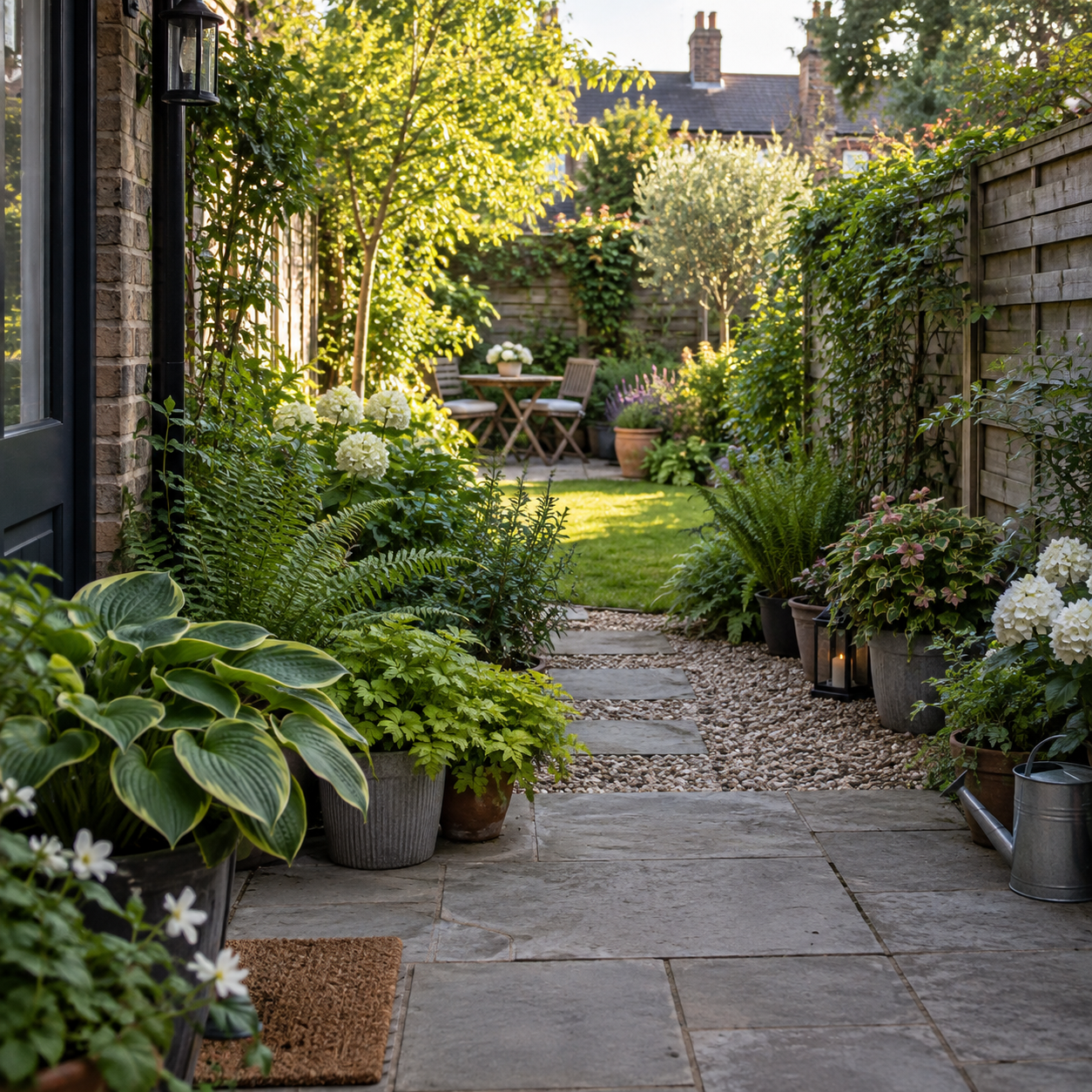
A north-facing garden can sometimes feel difficult to work with. The area closest to the house may spend much of the day in shade, plants chosen for sunny conditions can struggle, and a small enclosed garden can feel darker than you’d like.
But north-facing doesn’t automatically mean dark, cold or unusable.
The most useful thing you can do is stop designing the garden according to its compass direction alone and start looking at where the light actually falls.
Even in a north-facing garden, one side or the far end may receive useful direct sunlight at certain times of day or year. Other areas may remain in partial or deeper shade.
Once you understand those different areas, you can put seating in the brightest position, choose plants for the conditions they actually receive and make darker corners feel intentional rather than neglected.
If you’re improving a compact outdoor space more generally, our small garden ideas guide covers plenty of ways to make limited space work harder. For a north-facing garden specifically, however, understanding the light should come first.
Here are 13 practical ways to make a small north-facing garden brighter, more attractive and easier to use.
What Does a North-Facing Garden Actually Mean?
A north-facing back garden generally means that when you stand at the back of the house looking into the garden, you’re facing roughly north.
In the UK, the sun travels predominantly through the southern part of the sky. As a result, the house itself can cast shade across part of a north-facing back garden.
The area immediately behind the house is often particularly affected.
But that doesn’t mean the entire garden receives no direct sunlight.
How much light reaches the space depends on things such as:
- the length of the garden
- the height of your home
- neighbouring buildings
- fences and walls
- mature trees
- the garden’s width
- the time of year
- your location within the UK
A short courtyard enclosed by tall buildings can behave very differently from a long north-facing garden with an open aspect.
That’s why the first idea is also the most important.
1. Map the Sunlight Before You Change Anything
Before buying plants, furniture, paint or paving, spend some time watching the garden.
Choose a reasonably bright day and check the space at several points.
Morning: Where does the first direct light appear?
Around midday: Which areas remain shaded and which become brighter?
Afternoon: Does sunlight begin reaching one side or the far end?
Early evening: Are there any final pockets of useful light?
You don’t need specialist equipment.
Take a few photographs on your phone from the same position or make a simple sketch and mark the areas receiving direct light.
You’ll gradually create a rough map showing:
the brightest areas
partial shade
the deepest shade
That information is much more useful than the words “north-facing” on their own.
If you’re planning a major redesign, remember that the pattern will change throughout the year. A spot that receives plenty of summer light may be shaded during winter when the sun is much lower.
You don’t need to track the garden for twelve months before moving a chair, but it’s worth remembering seasonal differences before committing to expensive permanent landscaping.
2. Put Your Seating Where the Sun Actually Reaches
It’s natural to put a table and chairs immediately outside the back door.
It’s convenient and often where an existing patio has already been built.
Unfortunately, in a north-facing garden it can also be one of the shadiest places.
If your sunlight check reveals that the far end or one side of the garden gets better light, consider making that your main seating area instead.
You don’t necessarily need to build another patio.
You could use:
- a compact bistro set on existing paving
- a bench against a boundary
- two lightweight chairs on gravel
- a small table that can move around
- a seating corner surrounded by containers
If you’re working with a compact paved space, our small patio ideas for UK gardens guide has more ways to turn limited paving into a useful outdoor area.
The important point is simple:
Don’t put the seating somewhere just because that’s where garden furniture traditionally goes.
Put it where you’re most likely to enjoy using it.
3. Introduce Lighter Surfaces
Shade can feel more pronounced when a small garden is surrounded by dark fencing, weathered walls, dense planting and dark paving.
A few lighter surfaces can visually lift the space.
Consider introducing things such as:
- warm off-white masonry
- pale grey fencing
- light-toned containers
- natural timber
- pale gravel
- lighter paving
- cream or neutral outdoor cushions
You don’t need to make everything white.
In fact, an entirely white garden can feel stark and may show dirt and weathering quickly.
Instead, use lighter elements to break up darker areas.
A pale planter against a dark green fern, for example, creates contrast without requiring you to repaint the entire garden.
If you’re painting fences, walls or masonry, use a product intended for that particular exterior surface.
And if you’re renting, get permission before making permanent changes.
4. Let Foliage Do Some of the Work
Colour in a garden doesn’t have to come entirely from flowers.
In a shaded garden, foliage can be one of your strongest design tools.
Leaves can provide colour, shape and texture for much longer than an individual flower remains in bloom.
Try combining contrasts such as:
- large leaves with delicate ferns
- deep green with lime or silver-green foliage
- glossy leaves with matt textures
- upright plants with softer spreading forms
- plain leaves with restrained variegation
Plants such as hostas, ferns, heucheras and brunnera are often valued as much for their foliage as their flowers.
You can still include flowering plants.
The difference is that the garden remains interesting even when nothing happens to be in peak bloom.
This can work particularly well in a small garden because a few repeated foliage shapes can make the planting feel calmer and more deliberate.
5. Choose Plants for the Shade You Actually Have
“North-facing” isn’t a complete description of a planting position.
One corner might receive almost no direct sunlight.
Another may get a few hours.
A third could be surprisingly bright during summer.
So don’t buy a plant simply because you’ve seen it described as suitable for a north-facing garden.
Look at the conditions of the exact position where you intend to grow it.
Plant guidance commonly distinguishes between conditions such as:
Full shade: very little direct sunlight.
Partial shade: some direct light during the day or a position shaded for part of it.
Dappled shade: shifting light and shade, often beneath trees.
And light isn’t the only consideration.
Soil matters too.
Shade beneath an established tree can be surprisingly dry because its roots compete for water.
Another shady corner with poor drainage might remain wet for long periods.
Those positions could require completely different plants despite both being shaded.
Plants worth investigating for suitable shady positions in UK gardens include:
- ferns
- hostas
- heucheras
- brunnera
- hellebores
- Japanese anemones
- shade-tolerant hardy geraniums
- suitable hydrangeas
Always check the requirements of the particular plant or variety rather than relying on the name alone.
The goal isn’t to find plants that can just about survive.
It’s to choose plants that are suited to the conditions you actually have.
6. Use Containers to Make the Layout Flexible
Containers are particularly useful in a small north-facing garden because they aren’t permanently tied to one location.
If a plant isn’t getting enough light, you may be able to move it.
If one corner looks empty during spring, a container can fill it temporarily.
And if you’re renting, most of the planting can eventually move home with you.
Containers work particularly well for:
- seasonal displays
- compact shrubs
- shade-tolerant perennials
- herbs in the brighter parts of the garden
- plants that benefit from being repositioned
Rather than scattering individual pots everywhere, try grouping a few together.
For example:
Back: one taller or more structural plant.
Middle: foliage plants.
Front: something lower or gently trailing.
Different heights create depth without requiring a permanent flower bed.
Just remember that shaded pots can dry more slowly than containers sitting in full sun.
Make sure the containers have suitable drainage and check the compost before automatically adding more water.
7. Make the Darkest Corner Deliberately Shady
Not every part of the garden needs to be made brighter.
If one corner receives very little direct light, consider embracing that instead of fighting it.
A deliberately shady area might contain:
- ferns
- woodland-style planting
- a simple bench
- textured foliage
- a bird bath
- attractive containers
- a small gravelled area
- subtle outdoor lighting
During hot summer weather, that cooler corner may actually become one of the most comfortable places in the garden.
This change in mindset can make a big difference.
Instead of seeing shade as an empty area where sunny plants fail, you start treating it as its own type of garden space.
8. Use Vertical Space Carefully
Vertical gardening is useful in a small garden because walls and fences provide growing space without consuming much of the ground.
But in a garden that’s already shaded, more isn’t always better.
A huge dense climber or bulky structure can block additional light and make a narrow garden feel enclosed.
Use vertical space selectively.
Options might include:
- narrow wall planters
- a simple trellis
- a restrained climber suited to the conditions
- small hanging pots
- shelves for lightweight containers
- wall-mounted herbs in a sufficiently bright position
You don’t need to cover every boundary.
Leaving sections of wall or fence visible creates breathing room and can give plants a cleaner backdrop.
9. Reconsider a Lawn That’s Always Struggling
A lawn isn’t compulsory.
If a small north-facing garden receives very little light and the grass is constantly thin, muddy or worn, repeatedly trying to repair it can become frustrating.
First check whether something else is contributing.
Compacted soil, poor drainage, heavy foot traffic and cutting the grass too short can all make a lawn perform badly.
But if a particular section simply receives too little light, you could rethink that part of the garden.
Possible alternatives include:
- a wider planted border
- gravel
- stepping stones
- containers
- a compact paved area
- suitable shade-tolerant ground-cover planting
You don’t necessarily need to remove all of the grass.
Reducing the lawn in its most difficult section may be enough.
A smaller area of healthy grass often looks much better than a larger lawn that’s permanently struggling.
10. Repeat Plants Instead of Filling Every Gap
Small gardens can become cluttered surprisingly quickly.
It’s easy to visit a garden centre, buy one interesting plant at a time and eventually end up with dozens of unrelated varieties competing for attention.
Repeating a smaller palette usually creates a calmer result.
Instead of ten completely different shade plants, you might repeat:
- one fern
- one foliage perennial
- one flowering perennial
- one structural evergreen
The exact combination depends on your garden.
The principle is what matters.
Repeating the same plants in two or three places connects the garden visually and can make it feel more intentionally designed.
The same applies to pots.
A group of three containers using similar materials often feels more coherent than lots of unrelated pots spread around every available surface.
11. Use Outdoor Lighting to Make Shade Atmospheric
A north-facing garden may receive less direct sunlight, but after sunset every garden has the same problem: it’s dark.
That’s where lighting can turn shade into an advantage.
Instead of trying to flood the entire garden with bright light, use a few smaller sources to highlight particular features.
You might illuminate:
- a favourite plant
- a textured wall
- a small tree
- a seating area
- a path
- an attractive group of containers
Warm, restrained lighting usually creates more atmosphere in a compact garden than one extremely bright fitting.
Solar lights are convenient because they don’t need wiring, but placement matters.
If the solar panel spends the entire day in deep shade, it may not receive enough light to charge effectively.
If you’re considering mains-powered outdoor lighting, use suitable outdoor-rated equipment and appropriate professional help for electrical installation.
12. Choose Furniture That Can Move
The most pleasant place to sit in a north-facing garden may change throughout the day and year.
That’s a good reason not to make every piece of furniture permanent.
Lightweight or folding furniture gives you more options.
A folding chair can move into an afternoon patch of sunshine during spring and back into a cooler shaded area on a hot summer day.
Useful choices for a small garden include:
- folding bistro chairs
- a compact folding table
- lightweight outdoor chairs
- a small bench combined with movable seating
- stackable chairs
Folding pieces can also be moved out of the way when you need more floor space.
For renters, there’s another advantage: good portable furniture can simply come with you when you move.
13. Work With the Shade Instead of Fighting It
This is the principle that ties the entire garden together.
A north-facing garden doesn’t need to imitate a south-facing one.
Trying to force a sun-loving planting scheme into deep shade is likely to create more work, more replacement plants and more disappointment.
Instead, use what the garden naturally offers.
Shade can suit:
- lush foliage
- woodland-style planting
- cool summer seating
- ferns and textured greenery
- calmer planting schemes
- atmospheric lighting
- sheltered-feeling corners
Combine that with the brighter areas you’ve identified and you can create different zones within even a relatively small garden.
Once the plants, furniture and layout suit the conditions, the shade stops looking like something you’ve failed to solve.
It simply becomes part of the design.
Does a North-Facing Garden Get Any Sun?
It can.
North-facing doesn’t automatically mean permanently dark.
During the brighter months, direct sunlight may reach:
- the far end of the garden
- one or both side boundaries
- higher parts of walls and fences
- sections not blocked by neighbouring buildings or trees
A long north-facing garden can therefore have very different growing conditions at its far end compared with the area immediately behind the house.
The pattern also changes with the seasons.
This is why it’s better to observe your own garden than rely on a rule claiming that every north-facing garden receives a particular number of hours of sunlight.
Orientation tells you something useful.
It doesn’t tell you everything.
Which Plants Work in a North-Facing Garden?
There’s no single planting list that works for every north-facing garden because the amount of shade, soil and moisture levels vary.
But plants commonly considered for suitable shaded UK positions include:
Ferns for texture and greenery.
Hostas for large, distinctive foliage.
Heucheras for colourful leaves.
Brunnera for foliage and spring flowers.
Hellebores for winter and early spring interest.
Japanese anemones for later-season flowers in suitable conditions.
Hydrangeas where the particular variety, space and growing conditions are appropriate.
Use examples like these as a starting point rather than a shopping list.
Before buying, check:
- preferred light level
- eventual height and spread
- soil preference
- moisture requirements
- hardiness
- whether the plant is appropriate for a container if you’re using one
Eventual size is especially important in a small garden.
A plant can be perfectly suited to shade and still be completely wrong for the amount of space available.
What Should You Avoid in a North-Facing Garden?
Understanding what not to do can save quite a lot of money.
Assuming the entire garden has the same light
It probably doesn’t.
Map the space first.
Choosing plants entirely by appearance
Start with the conditions, then choose from plants suited to them.
A sun-loving plant won’t become shade tolerant because you particularly like it.
Automatically putting the seating beside the house
If that’s the coldest and darkest area, you may rarely use it.
Covering every boundary
Too many climbers, screens, shelves and decorations can make a small shaded garden feel even more enclosed.
Overcrowding the planting
Give plants enough room to reach their eventual size.
Trying to remove every bit of shade
Shade can be useful and attractive.
A cool seating area or lush foliage corner can become a genuine feature.
Spending heavily before understanding the space
Watch the garden first.
Learning where the light falls costs nothing and can prevent expensive mistakes.
What If You’re Renting?
A rented north-facing garden doesn’t need permanent landscaping to feel better.
In fact, many of the most useful ideas in this guide work particularly well for renters.
Concentrate on things you can take with you:
- containers
- freestanding planters
- folding furniture
- outdoor cushions
- portable lighting
- freestanding trellis
- removable decorative pieces
You can create quite a substantial garden using pots alone without digging new beds or changing the property permanently.
If your outdoor area is extremely compact, our small balcony ideas for renters guide has more portable planting and furniture ideas that can also work in tiny patios and paved rental gardens.
Before painting fences, attaching planters to walls, installing permanent lighting or making structural landscaping changes, check what you’re allowed to alter and ask your landlord where necessary.
You don’t need to own the garden to make thoughtful use of it.
A Simple Plan for Improving a North-Facing Garden
If the whole garden feels like a project, don’t try to redesign everything in one weekend.
Start with four steps.
First: map the light.
Spend a bright day noticing where direct sunlight reaches and where the deepest shade remains.
Second: sort out the seating.
Put somewhere to sit in the position you’re actually most likely to enjoy.
Third: improve one difficult area.
Choose one gloomy corner, bare wall or struggling section rather than tackling the entire garden at once.
Fourth: introduce a small group of suitable plants.
Choose them for the actual light, soil and available space.
Then live with the changes for a while.
You may discover that the garden needs much less work than you originally thought.
Frequently Asked Questions
Is a north-facing garden bad?
No.
A north-facing garden has different light conditions from a sunnier one, but that doesn’t make it a bad garden.
The important thing is choosing plants and arranging the space around the conditions you actually have.
Does a north-facing garden get any sun?
Many do.
The amount depends on the garden’s length, surrounding buildings, trees, boundaries, season and other factors.
The far end of a longer north-facing garden may receive useful direct sunlight even when the area beside the house remains shaded.
Can you grow flowers in a north-facing garden?
Yes.
There are flowering plants suited to partial shade and others capable of growing in more heavily shaded positions.
Choose according to the particular conditions rather than assuming all shade is identical.
Can you grow vegetables in a north-facing garden?
Potentially, particularly if part of the garden receives useful light.
Some leafy crops can tolerate partial shade better than crops that demand lots of warmth and direct sun.
Use the brightest available position and check the requirements of the crop you want to grow.
What colours make a shady garden look brighter?
Pale neutrals, light timber, lighter containers and plants with bright or variegated foliage can help visually lift a shaded garden.
You don’t need to make everything white. Contrast is usually enough.
Where should seating go in a north-facing garden?
Where you’ll actually enjoy using it.
Observe the garden first. If the far end gets the best afternoon or evening light, it may make more sense to place your main seating there rather than automatically positioning it next to the house.
Are pots good for a north-facing garden?
Yes.
Containers are particularly useful because you can select plants for individual positions and move them if necessary.
Just remember that pots in shade can dry more slowly than those in direct sun, so check them before watering.
Can a north-facing garden still feel warm and inviting?
Absolutely.
Comfortable seating, well-chosen foliage, lighter materials, attractive containers and subtle outdoor lighting can make a shaded garden feel deliberately designed rather than gloomy.
The Bottom Line
A north-facing garden isn’t something you need to fix.
You need to understand it.
Before spending money, find out where the light actually falls.
Then put seating where you’ll genuinely use it, choose plants for the conditions they will actually experience and make the shadiest parts of the garden feel intentional.
In a small garden, those relatively modest decisions can have a surprisingly large effect.
A few well-chosen containers, better-positioned furniture, repeated shade-tolerant planting and carefully introduced lighter materials may achieve more than an expensive redesign.
Most importantly, stop judging the garden by what a south-facing space might be.
Work with the light you have and build a garden that suits it.