
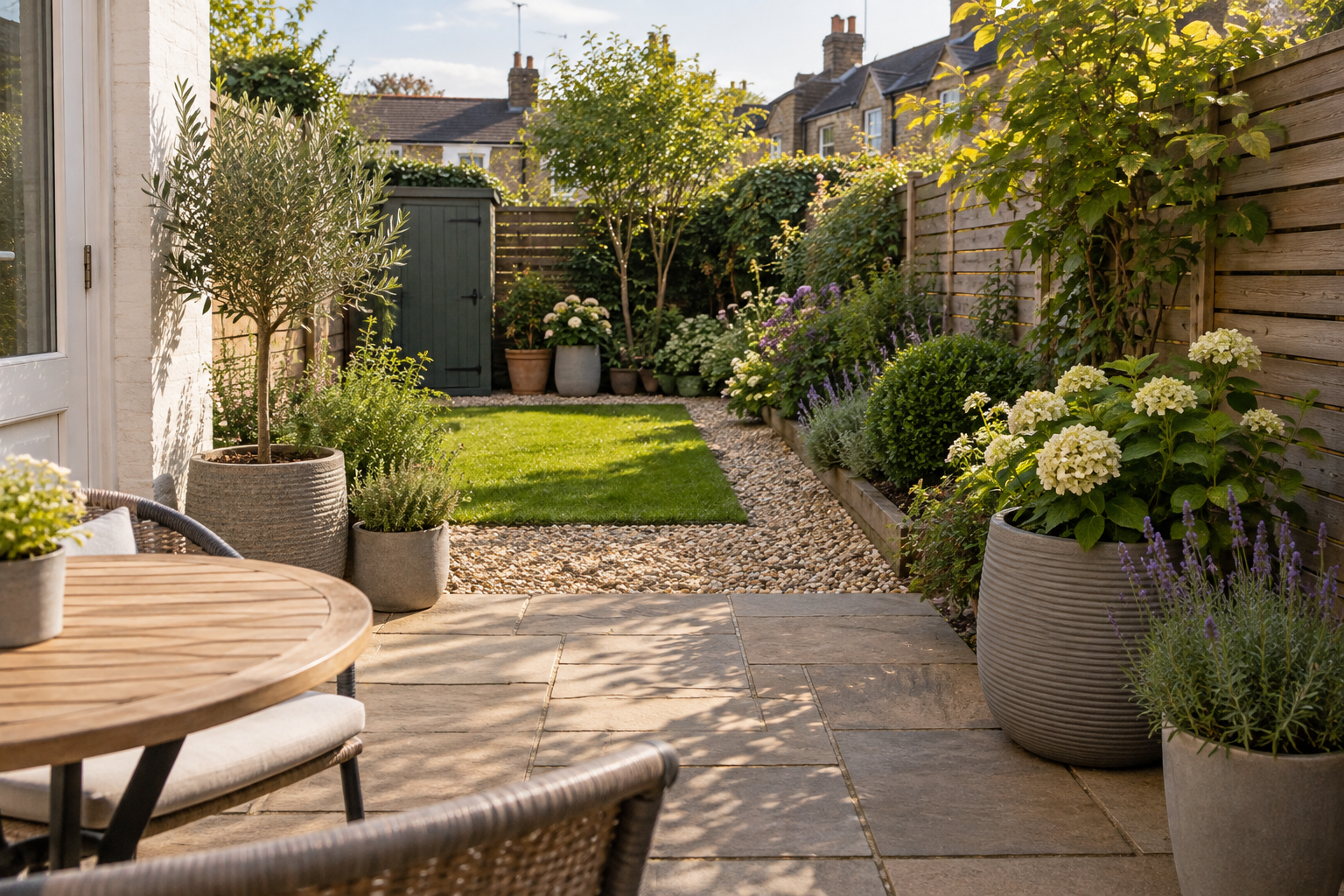
A small garden might have less ground to look after, but that doesn’t automatically make it low maintenance.
A tiny patch of lawn still needs mowing. A collection of little pots can need frequent watering through warm weather. Overcrowded borders need cutting back, while plants that aren’t suited to their surroundings can quickly become another job on the list.
This can be particularly noticeable in compact UK gardens, where a small patio, lawn, borders, bins, furniture and storage may all be competing for the same limited space.
Creating a lower-maintenance garden isn’t about removing every plant and covering the entire space with paving. It’s about being more selective with what you put into the garden in the first place.
Choose plants that suit the conditions. Reduce jobs you don’t enjoy. Use materials that are straightforward to look after, and avoid filling a compact garden with more than you realistically want to maintain.
No garden is completely maintenance-free, but a few sensible choices can make a small outdoor space considerably easier to manage.
Here are 15 practical low-maintenance small garden ideas for UK homes.
What Makes a Small Garden Low Maintenance?
Before changing anything, think about which garden jobs take up most of your time.
For many people, it’s a combination of:
- mowing
- watering
- weeding
- pruning
- replacing seasonal plants
- cleaning and tidying
- moving outdoor furniture and accessories
- finding somewhere to keep tools and garden equipment
A low-maintenance garden tries to reduce those recurring jobs rather than simply making the garden emptier.
| If you’re tired of… | Consider… |
|---|---|
| Mowing | Reducing or removing a very small lawn |
| Constant watering | Fewer, larger containers and suitable plants |
| Weeding | Mulching and covering bare soil |
| Constant pruning | Choosing plants that fit the available space |
| Replanting | Using more hardy perennials |
| A bare winter garden | Adding some evergreen structure |
| Garden clutter | Creating proper outdoor storage |
You don’t have to redesign everything at once.
Start with the job you dislike most and look for one change that could make it easier.
1. Reduce the Amount of Lawn
A lawn can look great in a garden, but even a very small one creates regular work.
It still needs mowing through the growing season, the edges need tidying and you’ll need somewhere to keep the mower.
In a particularly compact back garden, you may find yourself storing a relatively bulky piece of equipment simply to maintain a few square metres of grass.
That doesn’t mean every small lawn should disappear.
If you enjoy having grass, keep it. A lawn can provide useful open space and doesn’t have to be immaculate.
But if you’re mowing a tiny patch regularly and getting very little enjoyment from it, consider whether you actually need all of it.
Part of the lawn could become:
- a planted border
- a gravelled area
- a larger patio
- a simple path
- a seating area
You could also reduce the lawn rather than removing it completely.
A smaller lawn with a straightforward shape is generally easier to mow than narrow strips of grass winding around borders, furniture and planting.
The aim isn’t to remove greenery. It’s to decide whether the amount of lawn you have is worth the maintenance it requires.
2. Use Permeable Gravel Where It Makes Sense
Gravel can be useful in small gardens because it creates a practical surface without the formality or expense of paving everything.
It can work particularly well for:
- informal paths
- areas around raised beds
- small seating areas
- awkward corners
- spaces between planted areas
Choose gravel that’s comfortable enough to walk on and use suitable edging to stop it gradually spreading into neighbouring beds or across paving.
Preparation underneath matters too.
The ground needs to be suitable for the intended use, and drainage should be considered before changing an existing surface.
One advantage of loose gravel is that it can form part of a permeable surface, allowing rainwater to drain through rather than automatically directing it elsewhere. But the entire construction beneath the gravel matters, so don’t assume that simply scattering gravel over any existing surface will improve drainage.
This is particularly worth thinking about in small terraced gardens and paved back gardens where rainwater may already have relatively few places to go.
Gravel isn’t completely maintenance-free either. Leaves still land on it, weeds can occasionally establish and stones inevitably move around.
But used selectively, it can create an easy-going surface that doesn’t need mowing or regular scrubbing.
Try not to cover every available surface with gravel simply because it’s considered low maintenance. A combination of planting and practical permeable surfaces will usually make a small garden feel much more inviting.
3. Keep the Layout Simple
Small gardens can become surprisingly complicated.
A little patio leads to a strip of lawn, which leads to three tiny borders, which wraps around a collection of pots, a shed, another seating area and several different paths.
Every additional edge, corner and surface creates something else to maintain.
A simpler layout might contain:
one comfortable seating area + a clear route through the garden + a few well-planned planting areas + useful storage.
That can be enough.
This approach can work particularly well in narrow gardens behind terraced houses, where trying to squeeze too many separate zones into the space can make the garden feel smaller rather than more useful.
Simple doesn’t have to mean boring.
You can create interest through plants, pots, furniture, texture and height without dividing a compact garden into lots of separate areas.
Before adding something new, ask whether it makes the garden more useful or simply gives you another thing to look after.
4. Choose Fewer, Larger Pots
Containers are brilliant in small gardens.
They allow you to grow plants on patios and paved areas, move planting around and introduce greenery where there isn’t much usable soil.
But twenty little pots can quickly become twenty little jobs.
Smaller containers hold less compost and can dry out relatively quickly during warm weather. They may also need more frequent attention than larger containers.
Instead, consider grouping plants into a smaller number of generous pots.
Larger containers generally hold more compost and moisture, and they can make a compact garden look calmer because there are fewer individual objects competing for attention.
A couple of substantial planters beside a seating area can create more impact than a scattered collection of small pots.
Make sure containers have adequate drainage holes and are suitable for the plants you’re putting in them.
You will still need to check and water container plants, particularly during hot or dry periods, but reducing the number of tiny pots can make that routine much more manageable.
5. Choose Plants for the Conditions You Actually Have
One of the easiest ways to create unnecessary garden work is to grow the wrong plant in the wrong place.
A plant struggling in unsuitable conditions may need constant watering, feeding, moving or eventually replacing.
Before buying plants, spend some time understanding your garden.
Ask:
How much sun does this area receive?
A south-facing patio that gets sun for much of the day is very different from a shaded border beside a north-facing wall.
What is the soil like?
Does water drain quickly, or does the ground remain wet after heavy rain?
Is the garden exposed?
Some compact gardens between buildings are surprisingly sheltered, while others funnel wind through narrow spaces.
How large will the plant eventually become?
This last question is particularly important in a small garden.
A shrub that looks perfectly proportioned in a garden centre pot might eventually become much wider than the space you’ve given it.
Check the plant label and, where necessary, look up its expected mature height and spread before buying.
Choosing something naturally suited to the space and growing conditions is usually much easier than continually trying to persuade the wrong plant to behave.
6. Use Hardy Perennials Instead of Replanting Everything
Seasonal bedding can produce lots of colour, but replacing large numbers of plants every year also creates work.
If you’d prefer a garden that largely returns on its own, use more hardy perennials.
Perennials live for multiple years rather than completing their entire life cycle in one growing season.
Many die back during winter and reappear when conditions improve, while others retain varying amounts of foliage.
That means you can build a border that doesn’t need to be completely replanted every spring.
This doesn’t mean avoiding annual flowers altogether.
If you enjoy adding a few pots of seasonal colour, there’s no reason not to.
The lower-maintenance approach is simply to avoid making your entire garden dependent on plants that need replacing every year.
Use longer-lived planting as the foundation and add seasonal plants where you’ll appreciate them most.
7. Add Some Evergreen Structure
A garden made entirely from plants that disappear during winter can feel quite bare for several months of the year.
A small amount of evergreen planting can provide structure when everything else has died back.
That could be:
- a compact evergreen shrub
- an evergreen climber
- a neatly positioned container
- a small hedge
- evergreen ground cover
You don’t need lots.
In a small garden, one or two carefully positioned evergreens may provide enough permanent structure.
The important thing is choosing plants whose eventual size suits the space available.
A naturally compact shrub in the right position should be much easier to live with than a vigorous plant that needs repeatedly cutting back to prevent it taking over a path or patio.
8. Use Drought-Tolerant Plants in Sunny Areas
A hot, sunny corner can become demanding if it’s filled with plants that need consistently moist conditions.
Where the soil, drainage and aspect are suitable, plants that naturally tolerate drier conditions can reduce the amount of additional watering required once they’re established.
Depending on your particular garden, possibilities for sunny, free-draining areas might include plants such as:
- lavender
- thyme
- sedums and hylotelephiums
- some ornamental grasses
- other plants adapted to relatively dry conditions
Treat those as examples rather than a universal shopping list.
A plant described as drought tolerant can still struggle if it’s placed somewhere that doesn’t suit its other requirements.
Always check that the individual plant is appropriate for your soil, light levels, drainage and local conditions.
New plants also need appropriate watering while their root systems establish.
The benefit comes later: once established in the right place, plants adapted to drier conditions should be better equipped to cope with periods of dry weather.
9. Mulch Your Borders
Mulching is one of those garden jobs that creates a little work upfront but can reduce work later.
Mulch is simply a layer of suitable material placed over the surface of the soil.
Depending on the area and planting, options might include:
- chipped bark
- wood chips
- garden compost
- other suitable organic mulches
Mulching can help reduce moisture loss from the soil and suppress some weed growth while also giving borders a more finished appearance.
Before applying mulch, remove established weeds rather than simply burying them.
Then apply an appropriate layer around the plants, taking care not to pile material directly against stems or trunks.
Mulch won’t guarantee a weed-free garden.
Seeds can still land on the surface and establish.
But reducing large areas of exposed soil can make borders easier to manage while helping the soil retain moisture.
10. Use Ground-Cover Plants to Fill Bare Soil
Bare soil rarely stays bare forever.
If desirable plants aren’t occupying the space, weeds often will.
Ground-cover plants can help fill the lower level of a border, reducing large open patches of soil while adding greenery, texture and sometimes flowers.
The right choice depends entirely on the conditions.
Some ground-cover plants prefer shade, while others perform better in sunny, well-drained positions.
You also need to consider how vigorously they spread.
In a small garden, a plant that enthusiastically takes over everything around it can create more maintenance rather than less.
Look for plants suited to the location and give them enough room to spread naturally.
Combined with sensible mulching while the planting establishes, this can create fuller borders without leaving large areas of soil permanently exposed.
11. Make Watering Easier
Even a carefully planned garden needs water at times.
The aim is to make watering straightforward rather than turning it into a daily tour of dozens of individual plants.
Group containers together instead of scattering little pots across every corner of the garden.
Place plants that need more regular attention somewhere convenient rather than at the furthest point from the house.
If practical, collecting rainwater in a water butt can provide a useful supply for the garden.
For gardens with lots of containers or particular planting areas, you could also investigate simple irrigation or seep-hose systems.
Most importantly, check what actually needs water.
Different plants, soils and containers dry at different rates, and weather conditions make a huge difference.
Building a garden around plants suited to its natural conditions will usually do more to reduce watering work than simply trying to automate an unsuitable planting scheme.
12. Choose Outdoor Furniture That’s Easy to Live With
Outdoor furniture can quietly create a surprising amount of maintenance.
Some materials need regular treatment. Pale cushions show every mark. Large sets can be difficult to cover, while lightweight accessories may need moving whenever the weather turns.
In a small garden, choose furniture based on how you’ll actually use and maintain it.
Look for:
- weather-resistant materials
- surfaces that are straightforward to wipe clean
- removable or washable cushion covers
- furniture covers where useful
- folding or stackable pieces where space is tight
A compact table and two chairs that you use regularly are more valuable than an enormous outdoor dining set squeezed onto a small patio because it looked impressive online.
Think about winter too.
If furniture or cushions need storing indoors for several months, decide where they’ll actually go before buying them.
The easier your furniture is to live with, the more likely the garden is to remain a space you enjoy rather than another area demanding attention.
13. Give Garden Clutter Somewhere to Go
A small garden can look untidy very quickly because there’s nowhere for clutter to hide.
A watering can beside the door, a bag of compost in the corner, outdoor toys, cushions, empty plant pots and a few hand tools can easily make the entire garden feel crowded.
Storage doesn’t need to mean adding a huge shed.
Depending on what you need to keep outside, consider:
- a narrow outdoor cabinet
- a storage bench
- a compact deck box
- wall-mounted tool storage
- shelving inside an existing shed
- storage underneath suitable outdoor furniture
Start with what you actually own and choose storage around it rather than buying the biggest unit you can fit into the garden.
If storage is one of the biggest problems in your outdoor space, our guide to 15 Small Garden Storage Ideas That Keep Clutter Under Control looks specifically at ways to add useful storage without overwhelming a compact garden.
Keeping everyday equipment organised won’t reduce the amount of gardening itself, but it can make maintaining the space considerably easier.
14. Limit the Number of Different Materials
A small garden doesn’t need five types of paving, three different edging materials, decorative gravel, decking and several styles of planter.
Using too many materials can make a compact space feel visually busy.
It can also create more maintenance.
Different surfaces may need different cleaning methods. Numerous joins and edges create places for debris and weeds to collect, while repairing something later can be harder if you’re trying to match several different finishes.
Choose a restrained selection of materials and repeat them around the garden.
For example, you might use:
one main paving material + timber furniture + a consistent style of planter + planting.
That’s enough to create variation without turning the garden into a catalogue of different surfaces.
Repeating materials can also help a narrow or compact garden feel calmer and more cohesive.
15. Leave Room for the Garden to Grow
One of the easiest mistakes to make when planting a new garden is trying to make it look completely finished on day one.
Young plants often look small.
That empty soil between them can be tempting, so another plant gets squeezed into the gap.
Then another.
A couple of growing seasons later, everything is competing for the same space and you’re constantly pruning, dividing or moving plants.
Check the expected mature size when planting and give things room to develop.
A border might look slightly sparse initially, but that doesn’t mean it has been badly designed.
Use mulch to keep exposed soil looking tidy while plants establish.
A little patience at the beginning can prevent overcrowding from becoming another recurring maintenance job later.
Low Maintenance Doesn’t Mean No Maintenance
There isn’t really such a thing as a completely maintenance-free garden.
Plants grow. Leaves fall. Weeds appear. Furniture gets dirty and containers need attention.
The difference is how often those jobs need doing and how difficult they are when they come around.
A well-planned garden might need an occasional session of pruning and tidying rather than something demanding attention every weekend.
You might still find weeds, but well-planted and mulched borders can make them easier to manage.
You’ll still need to keep an eye on containers during dry weather, but a smaller collection of sensibly sized pots is easier to deal with than dozens scattered around the garden.
The goal isn’t to eliminate gardening.
It’s to create an outdoor space where the amount of work feels reasonable for the enjoyment you get from it.
A Simple Low-Maintenance Small Garden Plan
If you’re starting with a relatively blank small garden, you don’t need an elaborate design to make it useful.
A straightforward layout could look something like this:
Near the house:
Create a practical seating area that’s easy to reach from indoors.
Around the seating area:
Use two or three generous containers rather than filling the patio with small pots.
Along one boundary:
Create a simple planted border using plants suited to the light, soil and available space. Include some perennial planting and a little evergreen structure.
Across bare soil:
Use an appropriate mulch to help retain moisture and reduce weed growth.
Through the garden:
Keep a clear, uncomplicated route rather than creating lots of narrow paths.
At the side or far end:
Give tools, cushions and gardening supplies a defined storage area.
This isn’t a template every garden needs to follow.
The point is that a compact garden can provide seating, planting, storage and an attractive outlook without being divided into lots of complicated little areas.
Reducing unnecessary complexity often reduces maintenance at the same time.
Start With the Garden Job You Dislike Most
You don’t have to completely redesign your garden to make it easier to look after.
Start with the thing that annoys you most.
Hate mowing?
Consider reducing the lawn or simplifying its shape.
Fed up with watering?
Replace collections of tiny pots with fewer, larger containers and choose plants better suited to the conditions.
Always pulling weeds?
Reduce unnecessary bare soil, improve planting coverage and add mulch where appropriate.
Constantly pruning?
Check whether some of the plants are simply too large for the spaces they’ve been given.
Tired of garden clutter?
Give tools, cushions and outdoor equipment somewhere practical to live.
Small changes can have a much bigger effect than trying to transform the whole garden at once.
And if maintenance isn’t the main problem but you’re struggling to fit everything you want into a compact outdoor space, our guide to 13 Small Garden Ideas That Make the Most of Limited Space has more practical ways to make a small garden work harder.
A low-maintenance garden doesn’t have to be empty, paved over or devoid of personality.
It simply needs to work with the amount of time you realistically want to spend looking after it.
Choose carefully, keep the layout manageable and allow the garden to develop rather than trying to fill every available corner.
The result should be an outdoor space that gives you more time to actually sit in it — and less time feeling as though there’s always another job waiting.