
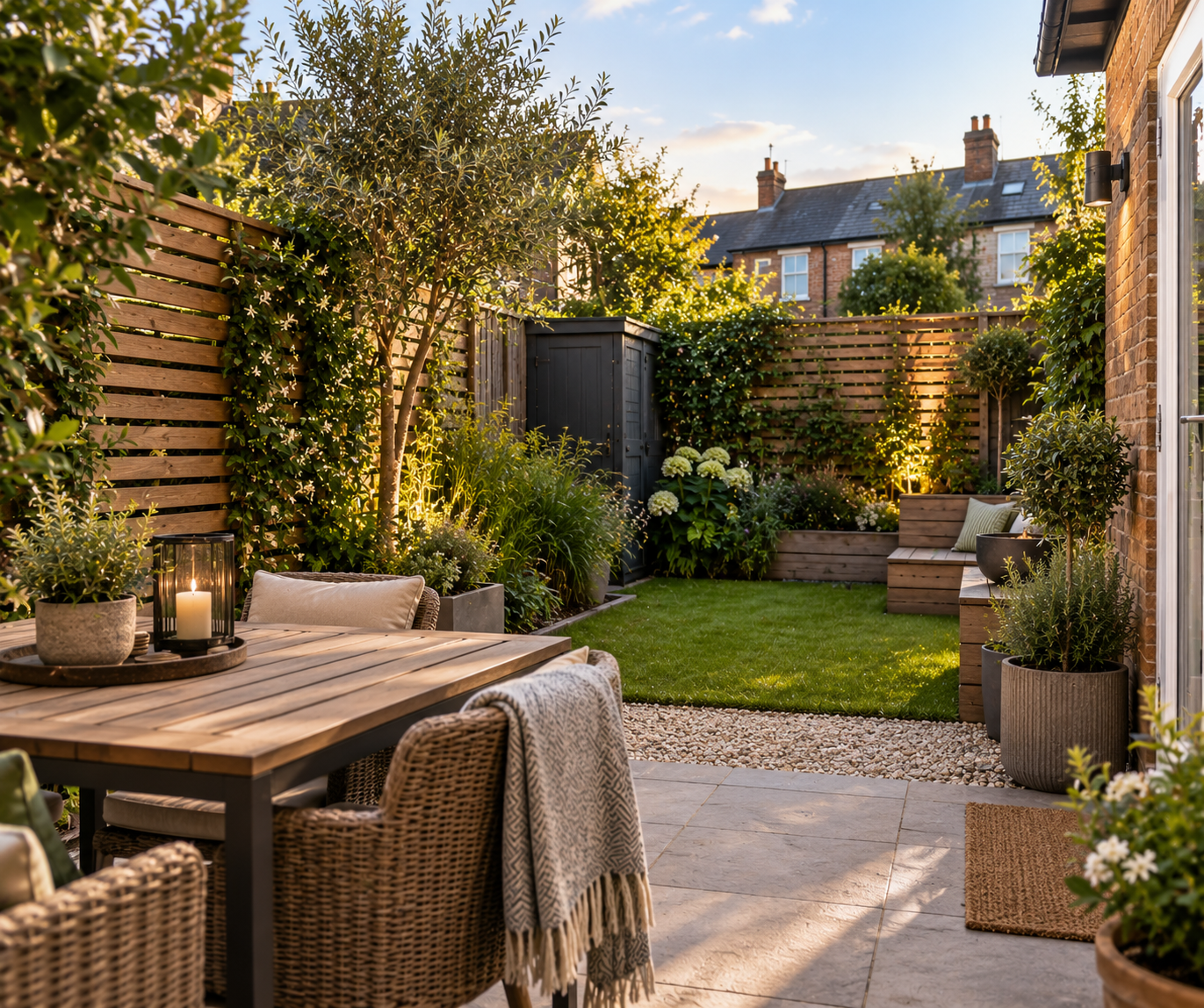
A small garden can be a brilliant extension of your home, but it can be difficult to fully relax outside when you feel as though you’re constantly overlooked.
In many UK gardens, the problem isn’t necessarily the boundary itself. It might be an upstairs window looking directly towards your patio, a neighbouring extension overlooking your seating area or a clear sightline across a low fence.
The obvious solution can be to make every boundary taller, but that isn’t always the best approach in a compact garden. Too much solid screening can block valuable light and make a small outdoor space feel enclosed.
Instead, start by working out exactly where the unwanted view is coming from.
A strategically positioned trellis, planter, tree or pergola may provide more useful privacy than surrounding the entire garden with tall fencing.
Here are 15 practical small garden privacy ideas for creating a more secluded outdoor space without unnecessarily sacrificing light or space.
1. Work Out Where You’re Actually Overlooked From
Before buying screens, plants or fence panels, stand in the areas of the garden you use most and work out where the overlooking actually comes from.
You might discover that only one or two sightlines are causing the problem.
Perhaps your patio can be seen from a neighbour’s upstairs bedroom window, while the rest of the garden already feels relatively private. Or maybe a gap between two buildings creates a direct view towards your seating area.
In those situations, screening the entire boundary could be unnecessary.
Look at the garden from:
- your main seating position
- the patio
- the back door
- anywhere children regularly play
- other areas where you spend significant time
Try this both standing and sitting down.
A screen that seems too low when you’re standing may provide perfectly adequate privacy when you’re seated.
It’s also worth noticing whether the unwanted view comes from the side or from above.
A fence or trellis may deal with a neighbouring patio, but it may do very little about a first-floor window looking down into the garden.
Once you understand the actual sightline, you can choose a solution designed for that particular problem.
2. Create Privacy Around the Seating Area First
You don’t necessarily need complete privacy across the whole garden.
Sometimes creating one comfortable, secluded area is enough.
If your patio or outdoor table is where you spend most of your time, concentrate your screening around that area.
A strategically positioned screen beside a table can interrupt a direct view without needing to extend fencing around every boundary.
Planting can work in the same way.
A large container positioned near the corner of a patio could hold a suitably sized shrub or small tree, helping to create separation exactly where you need it.
This approach is particularly useful in long, narrow gardens where attempting to screen the entire perimeter could make the space feel boxed in.
Think of privacy as something you can create around the activity, rather than something that always has to happen at the edge of the garden.
3. Add Trellis Along a Boundary
Trellis can provide additional screening without feeling as heavy as a completely solid panel.
Because there are gaps, light and air can still pass through.
It can be particularly useful where an existing fence provides enough privacy at ground level but the garden feels more exposed higher up.
Trellis also gives climbing plants somewhere to grow, allowing a functional screen to gradually become part of the planting.
You don’t necessarily need to cover every fence.
A section positioned beside a patio or opposite a troublesome sightline may be enough.
Before increasing the height of an existing boundary, however, check whether the proposed change is allowed. Fence, wall and gate heights can be subject to planning restrictions, and adding trellis doesn’t automatically avoid those rules.
We’ll look at this in more detail later in the guide.
You don’t always need an expensive landscaping project to make an overlooked garden work better. Our small garden ideas on a budget guide includes more low-cost ways to improve a compact outdoor space.
4. Grow Climbers Up Trellis or Fencing
Climbing plants are particularly useful in small gardens because they allow you to add greenery and screening without sacrificing much ground space.
Instead of planting a wide shrub that gradually spreads across a border or path, you can encourage a climber upwards along a suitable support.
Depending on the plant, climbers can be trained across:
- trellis
- fences
- walls
- pergolas
- arches
- freestanding supports
Choose the plant for the conditions rather than simply buying the fastest-growing option you can find.
Consider sunlight, soil, available root space, eventual size and the support the plant will need.
Maintenance matters too.
Some climbers need regular pruning and training, and a vigorous plant in a small garden can quickly create more work than expected.
If keeping ongoing garden jobs manageable is important to you, our guide to 15 Low-Maintenance Small Garden Ideas for UK Homes looks at more ways to choose planting and layouts that are easier to live with.
Climbers won’t usually provide instant privacy, but over time they can turn a bare screen into something much softer and greener.
5. Use Tall Planters as Flexible Screens
Not every privacy solution needs to be permanently attached to a fence or wall.
Large planters can help create flexible screening, particularly around patios and seating areas.
A generous container with an appropriately sized upright plant can interrupt a sightline while still allowing you to change the garden layout later.
This can be useful if:
- you’re renting
- you don’t want to alter a boundary
- you only need privacy around one area
- you expect the garden layout to change
- you want to soften an existing fence or screen
There are a couple of practical considerations.
Large containers filled with compost become extremely heavy, so decide where you want them before planting.
Containers also need appropriate drainage and regular attention during dry weather.
Stability is important too. Tall plants can catch the wind, so use suitably sized containers and position them somewhere secure.
Done well, two or three substantial planters can provide useful screening without creating a permanent wall around the garden.
6. Choose Slatted Screening Instead of a Solid Wall
If you want to create separation without completely closing off the garden, slatted screening can be a useful compromise.
Rather than creating one solid surface, gaps between the slats allow some light and air through.
The viewing angle matters.
From some positions, a slatted screen can interrupt a direct sightline surprisingly effectively while still feeling much lighter than a solid fence.
This can be especially useful close to a seating area.
Instead of making an entire boundary taller, you might position a screen beside the patio to block the particular angle from which you’re overlooked.
Think carefully about the spacing between the slats.
Very wide gaps may provide little privacy, while extremely narrow spacing starts to behave more like a solid panel.
The goal is to interrupt the unwanted view without unnecessarily turning a compact garden into an enclosed box.
7. Use a Pergola for Privacy From Above
Boundary screening works well when the unwanted view comes from the side.
But what if you’re overlooked from an upstairs window?
Making the fence taller may do very little.
This is where a pergola can be useful.
A pergola creates structure above a seating area, giving you the opportunity to introduce partial overhead screening where it’s actually needed.
That doesn’t mean building a completely solid roof.
Strategically positioned beams, suitable screening elements or planting can help break up views from higher windows while keeping the seating area relatively open.
In a small garden, scale matters.
A large pergola placed in the wrong position can dominate the space, so consider concentrating it over the main patio or seating area rather than trying to cover most of the garden.
Check any relevant planning requirements before installing a substantial structure.
The advantage of this approach is that you’re dealing with the real problem: the angle from above, rather than simply making the side boundaries increasingly tall.
8. Train Plants Over a Pergola
Once you have a pergola or similar structure, climbing plants can soften it and gradually provide additional screening.
They can be trained along posts and across the overhead structure, creating a greener canopy around a seating area.
Think about how much coverage you actually want.
Dense planting can provide more privacy but may also reduce the light underneath and require more pruning.
Lighter planting can interrupt a view without creating heavy shade.
Seasonal changes matter too.
A deciduous climber may provide plenty of foliage during summer when you’re most likely to use the garden, then lose its leaves during winter.
An evergreen option can provide more consistent screening but may create more shade throughout the year.
Neither is automatically better.
Choose according to when you need privacy, how much light you want and how much maintenance you’re prepared to do.
9. Plant a Narrow Hedge Where Space Allows
Hedges can provide effective natural screening, but they need careful consideration in small gardens.
The problem isn’t necessarily height.
It’s width.
A hedge that gradually extends into a narrow garden can consume a surprising amount of usable space.
Before planting, check the expected mature height and spread and think about how regularly the hedge will need trimming.
Avoid choosing something excessively vigorous and assuming you’ll simply keep it permanently small with pruning. That can turn your privacy solution into one of the most demanding parts of the garden.
If you have enough room, however, a sensibly chosen hedge can soften a boundary and create a greener backdrop than a continuous run of solid fencing.
You don’t have to hedge every boundary either.
Use it where you genuinely need screening and keep other areas simpler.
10. Use a Small Tree for Higher-Level Privacy
Sometimes the most awkward view doesn’t come through the fence.
It comes over it.
A carefully positioned small tree can help interrupt a sightline from a neighbouring upstairs window or extension without creating a solid barrier across the entire garden.
You may only need one.
Positioning a tree between your seating area and the overlooking window can be more effective than planting several indiscriminately along the boundary.
Before choosing one, consider:
- eventual height
- eventual spread
- whether it’s deciduous or evergreen
- available root space
- proximity to buildings and boundaries
- the amount of shade it may eventually create
Don’t judge a tree by the size it is in the garden centre.
Check its expected mature dimensions and make sure those dimensions suit the garden.
Also think about what’s beneath the ground as well as above it. Trees need to be positioned responsibly around buildings, drains and other structures.
A correctly chosen tree can provide useful higher-level screening while also bringing greenery, seasonal interest and height into a compact garden.
11. Consider Pleached Trees for High-Level Screening
Pleached trees are often described as a hedge on stilts.
Their lower stems are kept relatively clear while the upper branches are trained into a narrow framework.
That makes them particularly interesting where you want screening at a higher level without filling all the ground space beneath with a conventional hedge.
They can work well along a boundary or behind a seating area.
However, this isn’t the cheap or maintenance-free option.
Ready-trained specimens can be expensive, while training trees yourself requires considerably more time and skill.
They also need ongoing pruning to maintain their shape.
Pleached trees therefore won’t suit every small garden or every budget.
But where high-level privacy is the main problem and ground space is limited, they’re a useful option to know about.
12. Create Layers Instead of One Huge Screen
Privacy doesn’t have to come from one enormous barrier.
Small gardens can often benefit from a layered approach.
Imagine an existing fence along the boundary.
Instead of making that fence considerably taller, you might combine it with:
a climber on part of the fence + a large planter near the patio + a strategically positioned small tree further into the garden.
Each element interrupts a different part of the view.
Together, they can create a greater sense of privacy without one huge structure dominating the garden.
Layering also tends to look more natural.
You see planting, depth and different textures rather than a single flat wall.
This approach is particularly useful if you’re overlooked from several slightly different angles.
Instead of trying to solve every problem at the boundary, bring some of the screening closer to the places where you actually spend time.
13. Use a Freestanding Screen for Flexible Privacy
A freestanding outdoor screen can be one of the simplest ways to create privacy around a specific area.
It could sit:
- beside an outdoor table
- behind a bench
- at the edge of a patio
- around a particularly exposed corner
- between two functional areas
Because it doesn’t necessarily form part of the boundary, you have more freedom over where the screening goes.
This may also appeal to renters who don’t want to make significant permanent changes, although you should still check your tenancy agreement before fixing anything or altering the garden.
The biggest practical consideration is stability.
An outdoor screen presents a large surface to the wind.
Anything you use should therefore be suitable for outdoor conditions and properly secured or supported.
A flimsy decorative screen that repeatedly blows over isn’t going to make the garden more relaxing.
Used appropriately, however, freestanding screening lets you target one troublesome view without redesigning the whole garden.
14. Reposition Your Furniture Before Building Anything
Before spending money on screening, try moving your furniture.
It sounds almost too simple, but changing the position or angle of a seating area can sometimes remove the direct sightline that’s making you uncomfortable.
Instead of positioning chairs directly opposite a neighbouring window, rotate the seating so the view runs diagonally across the garden.
Or move the table slightly closer to an existing wall, hedge or planted area where you already have some natural screening.
Even a relatively small change in position can alter the viewing angle.
This is particularly worth trying if you’re planning a larger garden redesign.
Live with the furniture in its new position for a few days before building anything permanent.
If you’re struggling with the overall layout as well as privacy, our guide to 13 Small Garden Ideas That Make the Most of Limited Space has more ways to arrange a compact outdoor area without overcrowding it.
Sometimes the simplest change is enough.
15. Screen the View Without Blocking All the Light
The best privacy solution isn’t necessarily the tallest or most solid.
In a small garden, light matters.
Surround a compact space with tall, opaque barriers and you may solve the overlooking problem while creating another one: a garden that feels gloomy and enclosed.
Instead, think about targeted screening.
Block the view where you need to block it and keep other areas more open.
You might combine:
- slatted screens
- climbers on trellis
- a small tree positioned in one important sightline
- partial overhead planting
- a screen beside the seating area
- layers of planting at different heights
You don’t need to make the garden invisible from every possible direction.
The aim is to create enough separation that the areas you actually use feel comfortable and private.
What About Fence and Screening Height?
Before increasing the height of a fence, wall or gate, check whether the work you’re planning requires permission.
In England, the general Planning Portal guidance says you normally won’t need to apply for planning permission for a new or altered fence, wall or gate if it stays within the relevant limits and the other conditions are met.
In general, that means no more than:
- 1 metre high when next to a highway used by vehicles, or the footpath of such a highway
- 2 metres high elsewhere
However, those figures shouldn’t be treated as the only thing you need to check.
Different requirements can apply where a property is listed or within the curtilage of a listed building, where the boundary involves a neighbouring listed building, or where permitted rights have been restricted by an Article 4 direction or planning condition.
Conservation areas can introduce additional considerations too.
Adding trellis or another permanent extension to the top of a boundary shouldn’t therefore be assumed to provide a way around the height rules.
And because those particular Planning Portal rules relate to England, don’t assume the same requirements apply unchanged elsewhere in the UK.
If you’re unsure, check the current guidance for your location or contact your local planning authority before carrying out substantial work.
A Simple Privacy Plan for a Small Overlooked Garden
If your garden is overlooked from several directions, it can be tempting to tackle every boundary at once.
Instead, map the actual problem.
Imagine a typical compact back garden with a patio beside the house, a planted or lawned area beyond it and neighbouring properties on either side.
You might identify four different issues.
Neighbour’s upstairs window overlooking the patio:
Consider targeted higher-level screening such as a suitably positioned small tree or partial screening around a pergola.
Direct view across a side boundary:
Trellis with a climber, slatted screening or carefully positioned planting could interrupt the sightline.
Exposed seating area:
Bring screening closer to the patio with a freestanding screen, substantial planter or planting.
Remaining boundaries:
If they aren’t causing a privacy problem, leave them alone.
That final point is important.
You don’t need to screen something simply because it’s a boundary.
Keeping parts of the garden relatively open can preserve light and prevent a compact space from feeling enclosed.
Start With the View That Bothers You Most
A private garden doesn’t need to be completely hidden from the outside world.
It needs to feel comfortable enough that you can actually enjoy using it.
Start with the sightline that bothers you most.
If it’s a neighbour’s upstairs window, concentrate on higher-level screening.
If it’s the patio next door, create privacy around your seating area.
If it’s a low or open boundary, trellis, planting or an appropriately designed screen may be enough.
Before building anything substantial, try the simplest changes first.
Move the furniture. Test the position of a large planter. Look at the garden while you’re sitting down rather than only while standing at the boundary.
Work out precisely what needs screening — and what doesn’t.
Then build your privacy gradually.
A small garden will usually benefit far more from a few carefully positioned screens and plants than from being surrounded by one enormous barrier.
The goal isn’t to shut the world out.
It’s to create a garden that feels like your own.