
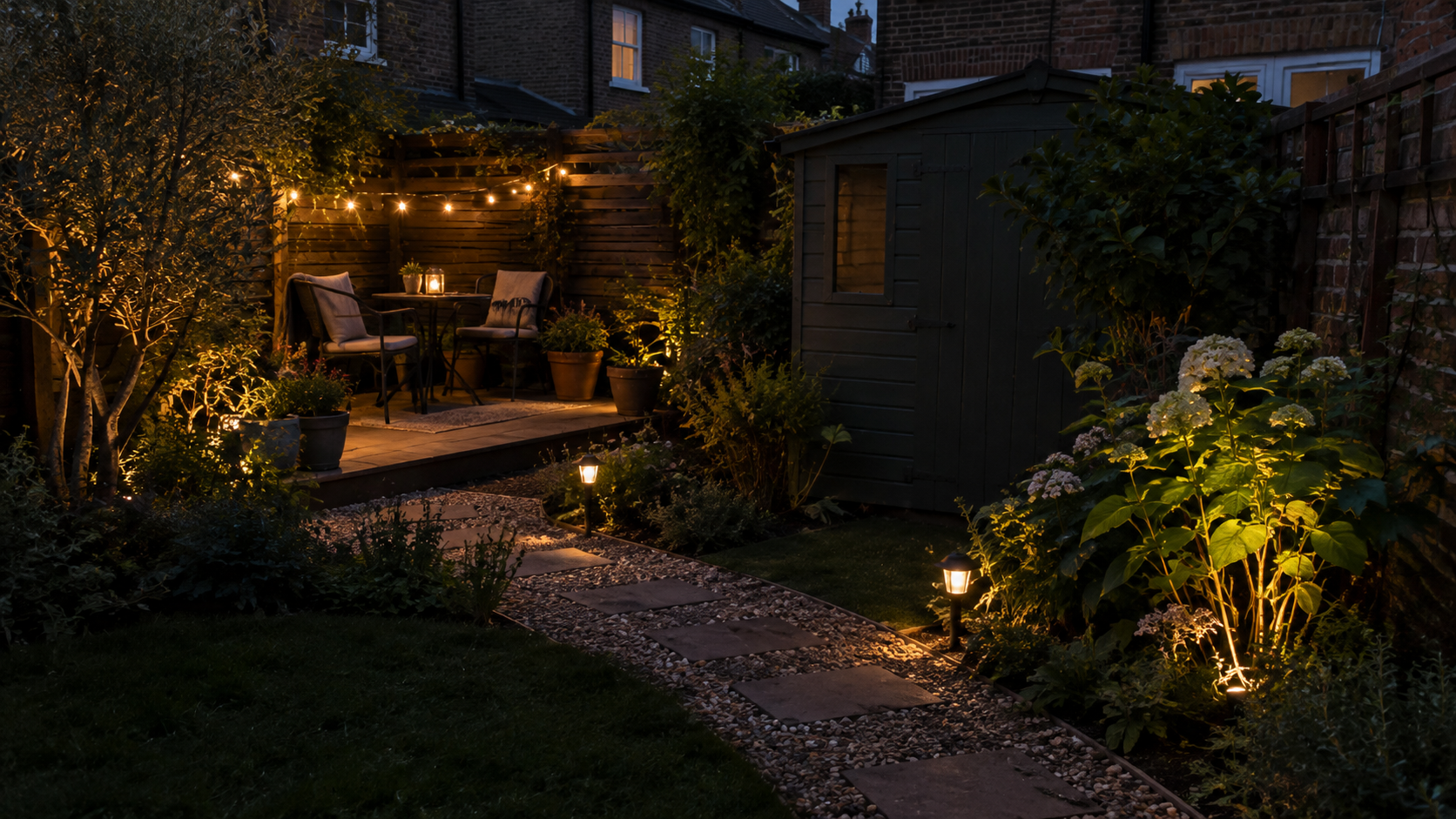
Garden lighting can completely change how a small outdoor space feels after dark.
A patio that disappears once the sun goes down can become somewhere you actually want to sit. A dark path can become easier to use, while a few carefully positioned lights can bring out planting, walls and garden features that would otherwise disappear into the background.
The key is not to light everything.
In a compact garden, too many bright fittings can quickly make the space feel harsh, cluttered and overdone. Unnecessary lighting can also disturb neighbours and garden wildlife.
A better approach is to decide where light is genuinely useful, where it adds atmosphere and where darkness should simply be left alone.
Here are 15 practical small garden lighting ideas for UK homes.
1. Start With the Areas You Actually Use After Dark
Before buying any lights, think about how you use the garden in the evening.
You probably don’t need every corner illuminated.
Instead, identify the places where light would make the biggest difference.
That might include:
- the back door
- the main seating area
- steps
- a short path
- the route to a gate or shed
- one attractive section of planting
It helps to separate practical lighting from decorative lighting.
Practical lighting helps you move around safely.
Decorative lighting creates atmosphere or draws attention to something worth seeing.
Keeping those two purposes clear makes it much easier to avoid filling a small garden with unnecessary fittings.
Start with what you actually need to see.
Everything else is optional.
2. Use Warm Lighting Around Seating Areas
The colour of the light matters almost as much as the fitting.
Very cool or blue-white lighting can feel harsh around a patio or outdoor table.
Warmer light generally creates a softer atmosphere and is better suited to the relaxed feeling most people want from a garden in the evening.
It can work particularly well around:
- patios
- benches
- dining areas
- pergolas
- sheltered seating areas
You don’t need huge amounts of light.
A compact seating area often feels more inviting when it’s gently illuminated rather than brightly lit like an indoor room.
Warmer, lower-intensity lighting is also a more considerate choice for garden wildlife than intense cool-white or blue-toned light.
Think atmosphere rather than brightness.
3. Add Low-Level Lighting Along Paths
Paths are one of the places where lighting can be genuinely useful.
Instead of tall fittings throwing light in every direction, consider low-level lights that direct illumination towards the surface.
This can help you see where you’re walking without making the entire garden bright.
Path lighting can be particularly useful beside:
- gravel paths
- stepping stones
- narrow side access
- routes between the house and shed
- paths through planting
Keep the spacing restrained.
You don’t necessarily need a light every metre.
A few fittings positioned at turns, obstacles or changes in direction may be enough.
The goal is to help someone understand where the path goes rather than outlining every centimetre of it.
4. Light Steps Carefully
Steps deserve particular attention because changes in level can become difficult to judge in poor light.
The aim is to make the surface and edges visible without creating glare.
Depending on the garden, that might mean:
- a low wall light beside the steps
- a downward-facing fitting
- discreet recessed lighting
- lighting positioned to one side
Light that falls gently across the step is often more useful than a bright fitting shining directly towards you.
Pay attention to shadows too.
Poorly positioned lighting can sometimes make a change in level harder to understand rather than easier.
This is one area where function should come before decorative effect.
5. Use Solar Lights Where Wiring Isn’t Practical
Solar lighting is convenient because it doesn’t require a wired electrical supply.
You can position it quickly, move it easily and experiment with different locations without committing to a permanent installation.
It can work particularly well for:
- gentle path markers
- decorative lanterns
- planters
- subtle feature lighting
- low-level ambience
The important thing is to keep expectations realistic.
Small solar lights are generally better suited to atmosphere and basic orientation than strong task or security lighting.
Performance also depends on the product, battery condition and how much daylight reaches the solar panel.
A light sitting in a deeply shaded corner may struggle after several dull winter days.
Place solar panels where they can receive useful daylight and treat the lights as an easy decorative layer rather than a guaranteed replacement for stronger permanent lighting.
If you’re trying to improve the garden without spending heavily, our guide to 17 Small Garden Ideas on a Budget for UK Homes includes more practical ways to make a compact outdoor space work better for less.
6. Keep Festoon Lights Around One Area
Festoon lights can create a relaxed atmosphere around a patio or outdoor dining area.
But in a small garden, less is usually better.
Rather than running strings around every fence and boundary, concentrate them around the part of the garden where you actually spend time.
You might position them:
- beneath a pergola
- across a seating area
- along a suitable wall
- between secure fixing points over a patio
This gives the lighting a clear purpose and helps avoid the garden looking overly decorated.
Choose lighting specifically designed for outdoor use and install it according to the manufacturer’s instructions.
If the lights need plugging in, make sure the supply, cable and connectors are suitable for outdoor conditions and appropriately protected.
7. Add a Practical Light Beside the Back Door
The back door is one of the most useful places to have proper lighting.
A well-positioned fitting can help when you:
- unlock the door
- carry food outside
- bring things back indoors
- see nearby steps
- check the garden after dark
Choose a fitting that sends light towards the area where it’s needed rather than spreading brightness in every direction.
If your back door is close to neighbouring homes, also check where the beam travels.
A light that’s comfortable from your patio can become annoying if it points directly towards someone else’s window.
A motion sensor can work particularly well here because the light only needs to come on when somebody approaches.
8. Hide Small Lights Among Planting
You don’t always need to see the light fitting itself.
In fact, hiding the source can create a much better effect.
A discreet low-level light positioned within or just behind planting can illuminate leaves, grasses or stems while keeping the fitting out of sight.
This helps create depth.
Instead of seeing a row of lamps, you see selected parts of the garden appearing from the darkness.
Plants with interesting texture can work particularly well, including those with:
- fine leaves
- architectural foliage
- attractive stems
- grasses that move in the breeze
Use the technique sparingly.
One softly lit patch of planting can be more effective than trying to illuminate every border.
9. Highlight One Interesting Plant
If you have a plant with a strong shape or interesting texture, a small amount of carefully positioned light can turn it into a focal point after dark.
Ornamental grasses can work particularly well because light catches their leaves and seed heads.
You could also highlight:
- a small tree
- an architectural shrub
- interesting bark
- a large container plant
Try to keep the source of the light discreet.
The aim is to notice the plant rather than the fitting.
Be restrained with upward-facing lighting.
Strong uplighting can contribute to light pollution and disturb nighttime wildlife, particularly when it shines into tree canopies or beyond the garden.
A subtle effect close to ground level is usually enough.
10. Light One Feature Rather Than the Whole Garden
You don’t need to illuminate everything to make a garden interesting after dark.
Choose one feature instead.
That could be:
- a large pot
- a small tree
- a textured wall
- a planted corner
- a sculpture
- an attractive screen
Lighting one focal point gives the eye somewhere to settle and can make a small garden feel deeper.
It also creates contrast.
If every wall, path and plant is equally bright, the garden can start to look flat.
Keeping much of the background dark allows the areas you do light to feel more effective.
It also means fewer fittings, less cost and less unnecessary light.
11. Use Lanterns for Flexible Lighting
Lanterns are useful because they can move with you.
You might place one on the garden table while eating, then move it beside a chair later in the evening.
Rechargeable and solar lanterns can be particularly convenient where you don’t want cables running across a patio.
Useful positions include:
- outdoor dining tables
- coffee tables
- beside a bench
- a sheltered seating corner
You only need light where you’re actually spending time.
That makes portable lanterns particularly well suited to small gardens where permanent lighting in every area would be unnecessary.
If you’re using candles or another open flame, keep them stable and well away from children, pets, dry planting and anything flammable.
Rechargeable alternatives can provide a similar atmosphere without an exposed flame.
12. Add Lighting to a Pergola or Trellis
Pergolas and trellis can provide useful places for subtle decorative lighting.
A small amount of warm light around these structures can help define a seating area without needing to illuminate the whole garden.
You might use:
- outdoor festoon lights
- discreet string lights
- small downlights
- rechargeable lanterns suspended securely from suitable hooks
Keep the arrangement simple, particularly if the structure already has climbing plants growing across it.
Too many lights mixed with dense planting can become visually busy.
Pergolas and trellis can also help create privacy.
If overlooking is one of the main problems in your garden, our guide to 15 Small Garden Privacy Ideas for Overlooked UK Gardens looks at using climbers, screens, planters and higher-level structures without making a compact garden feel enclosed.
13. Use Timers or Motion Sensors
Not every garden light needs to stay on throughout the evening.
Timers and motion sensors can be particularly useful for practical lighting that’s only needed occasionally.
Good places might include:
- the back door
- side access
- gates
- steps
- the route to a shed
A motion sensor can provide light when somebody enters the area and switch it off again afterwards.
Timers can also stop decorative lighting remaining on long after everyone has gone indoors.
That reduces unnecessary electricity use and helps limit disturbance to neighbours and wildlife.
If there’s nobody outside enjoying the garden, there is usually little reason for decorative lighting to remain on all night.
14. Keep Some Areas of the Garden Dark
One of the most useful lighting decisions you can make is to leave some of the garden unlit.
Artificial light at night can disrupt the behaviour of insects, birds, bats and other wildlife.
That doesn’t mean you can’t enjoy lighting outdoors.
It means using it selectively.
Where possible, retain darker areas around:
- hedges
- dense planting
- wildlife-friendly corners
- quieter boundaries
- areas you don’t use after dark
Avoid unnecessarily illuminating ponds and other wildlife-rich areas too.
If light is needed, keep it low, aim it towards the surface that actually needs illuminating and switch it off when it isn’t being used.
Darkness isn’t a failure of the lighting scheme.
It’s part of it.
15. Use Fewer Lights, Better Positioned
If there’s one principle worth keeping throughout the whole garden, it’s this:
a small outdoor space usually needs fewer lights than you think.
A simple scheme might consist of:
one practical light beside the back door
a couple of low-level lights where a path or steps need them
one softly illuminated plant or feature
a lantern or short run of festoon lighting around the seating area
That may be enough.
Too much lighting can flatten a garden because everything becomes equally visible.
A few carefully positioned pools of light create contrast, depth and a calmer atmosphere.
They also make it easier to retain dark areas.
If you prefer a garden that’s straightforward to manage rather than filled with unnecessary fittings and features, our guide to 15 Low-Maintenance Small Garden Ideas for UK Homes has more ideas for keeping a compact outdoor space practical.
How Much Lighting Does a Small Garden Actually Need?
There isn’t a fixed number of lights every garden should have.
A tiny courtyard and a long narrow garden behind a terraced house have very different needs.
Instead of counting fittings, think about three layers.
Practical Lighting
Start with anything required for safe movement.
That might include:
- back doors
- steps
- paths
- changes in level
This lighting has a genuine job to do.
Seating Lighting
Next, consider the area where you actually spend time.
A lantern, wall fitting or short run of festoon lights may provide all the atmosphere you need.
Feature Lighting
Finally, choose one thing worth seeing after dark.
That could be a tree, planter, interesting wall or planted corner.
You don’t necessarily need all three layers.
If the seating area already receives enough useful light from the house, adding more fittings may achieve very little.
The best scheme solves the practical problems first and stops before the garden becomes unnecessarily bright.
Solar, Plug-In or Mains Garden Lighting?
The right type of lighting depends on what you want it to do.
Solar Lighting
Solar lighting is usually the easiest option to introduce.
There’s no mains wiring to install, and most fittings can be repositioned easily.
It’s particularly useful for:
- decorative path markers
- planters
- lanterns
- gentle feature lighting
The main compromise is consistency.
Output can vary according to the quality of the product, battery condition, season and amount of daylight available for charging.
Plug-In and Low-Voltage Lighting
Outdoor plug-in or low-voltage lighting can provide more consistent illumination than many small solar products.
It can work well for decorative lighting and some path or feature schemes.
Any electrical equipment used outside should be intended for outdoor conditions.
Use outdoor-rated cables, connectors and extension leads where required, keep them protected from water and damage, and make sure outdoor electrical equipment has appropriate RCD protection.
Don’t run indoor extension leads or improvised connections into the garden.
Permanent Mains Lighting
Permanent mains lighting can make sense around entrances, garden buildings or where reliable fixed lighting is important.
Outdoor electrical installations need to be suitable for the environment and correctly designed and installed.
If you’re installing new permanent mains wiring or you’re uncertain about the existing outdoor supply, use a suitably qualified electrician rather than improvising.
Water, weather and outdoor electricity are not a combination to take chances with.
Garden Lighting Mistakes to Avoid
A lighting scheme can go wrong just as easily through excess as through lack of light.
Making Everything Too Bright
More light isn’t automatically better.
Excessively bright fittings can make a small garden feel harsh and remove the contrast that gives nighttime lighting its atmosphere.
Using Cool, Blue-White Light Everywhere
Very cool light can feel clinical around seating areas and can be more disruptive to wildlife.
Warm, lower-intensity lighting is generally the better starting point for a garden.
Shining Lights Towards Neighbours
Always look beyond the fitting.
Where does the beam actually go?
A light that seems well positioned from your patio may point straight towards a neighbour’s bedroom window.
Lighting Ponds Unnecessarily
A pond doesn’t need to become a glowing garden feature at night.
Keeping ponds and other wildlife-rich areas dark reduces unnecessary disturbance.
Leaving Lights On All Night
Decorative lighting usually doesn’t need to remain on when nobody is outside.
Timers and motion sensors make it easier to keep light limited to the periods when it’s actually useful.
Expecting Decorative Solar Lights to Provide Security Lighting
Small solar stakes and lanterns can create atmosphere, but that doesn’t make them suitable for every practical lighting job.
Use products designed for the level and reliability of illumination you actually require.
Using Indoor Electrical Equipment Outside
Outdoor conditions introduce moisture and a greater risk of electrical damage.
Use products designed for outdoor use, suitable outdoor connections and RCD protection.
If you’re uncertain about an electrical installation, get professional advice.
Start With One Area
You don’t need to design the whole garden lighting scheme in one go.
Start with the area you use most.
Perhaps that’s the patio.
Add enough light to make it comfortable and practical after dark.
Then look towards the rest of the garden.
Does the path genuinely need another light?
Would one feature plant benefit from subtle illumination?
Is there a step that needs to be easier to see?
If the answer is no, leave that part dark.
For broader ideas on making a compact outdoor area work harder throughout the day as well as after dark, see our guide to 13 Small Garden Ideas That Make the Most of Limited Space.
A well-lit small garden shouldn’t feel like a showroom.
It should feel comfortable, useful and calm.
Use light where it improves the space.
Keep it warm and restrained.
And remember that sometimes the most effective part of a garden lighting scheme is the darkness you leave around it.