
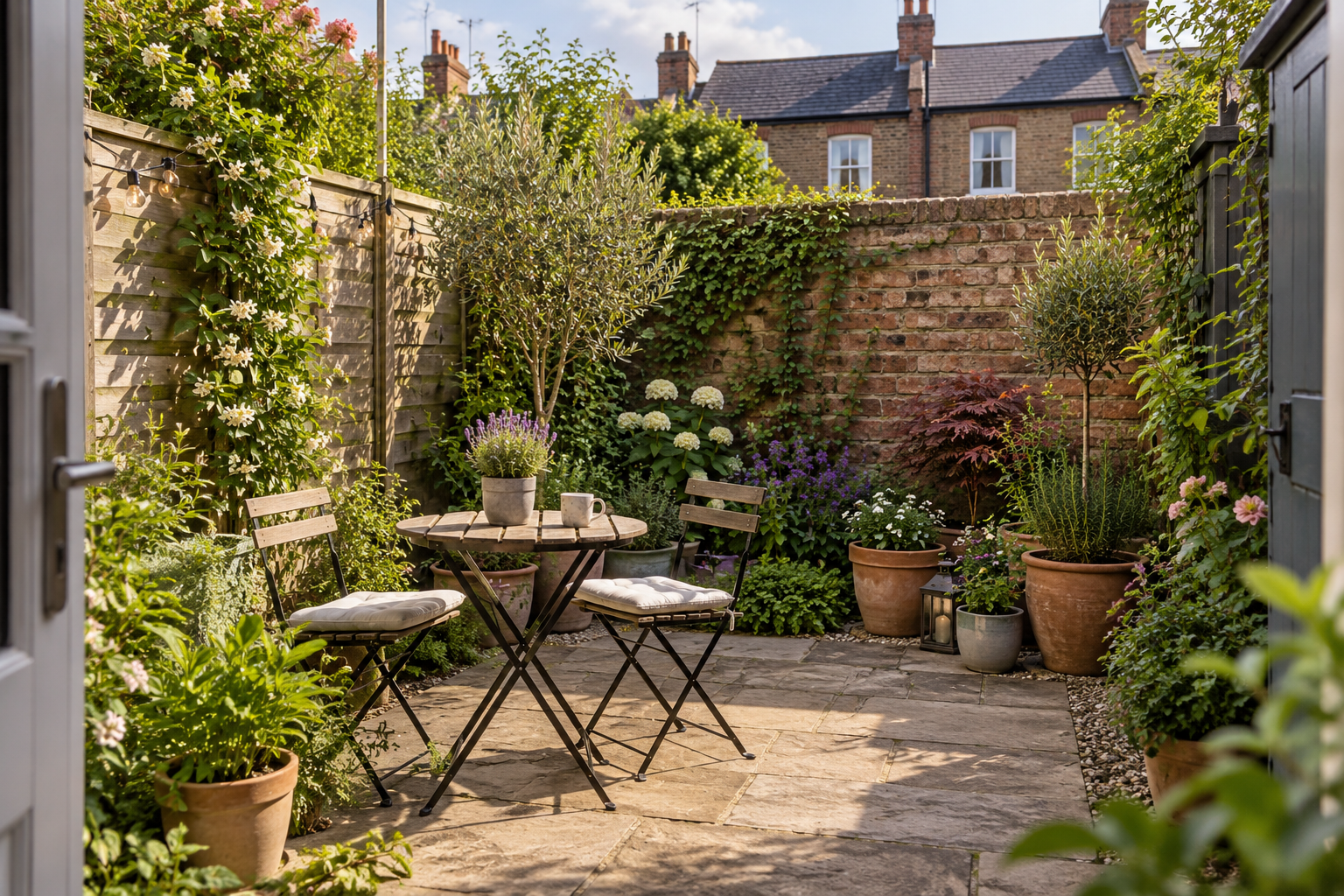
A small garden can be one of the most enjoyable parts of a home — but it can also be surprisingly difficult to get right.
When outdoor space is limited, every addition has an impact.
A table that’s slightly too large can dominate a patio. Too many small pots can make the garden feel cluttered. A badly positioned screen might provide privacy while also blocking valuable light.
The answer isn’t necessarily to squeeze more into the space.
It’s to decide what you actually want your garden to do, then make the available space work towards that purpose.
For one household, that might mean somewhere comfortable to sit outside with a morning coffee. For another, it could mean growing herbs and vegetables, creating a safe place for children, encouraging wildlife or simply having somewhere green to look at from the kitchen window.
You don’t need a large budget or an elaborate landscaping project to make a small garden better.
Thoughtful furniture, well-chosen planting and better use of boundaries can make even a modest patio, courtyard or terraced-house garden feel considerably more useful.
This guide looks at 13 practical ways to make more of a small garden without trying to fill every available corner.
Quick answer: Start by deciding what matters most to you. Keep the layout relatively simple, choose furniture that fits comfortably, use walls and fences for vertical growing, group containers rather than scattering them around, and select plants for the conditions they will actually grow in. In a small garden, leaving some space empty can be just as important as deciding what to put in it.
Before you buy anything, decide what the garden needs to do
It’s easy to start planning a small garden by looking at furniture, plants and accessories.
Start with a piece of paper instead.
Write down the two or three things you would most like to do in the garden.
Perhaps you want somewhere to eat outside.
Maybe you’d rather have plenty of planting, somewhere to grow herbs or vegetables, a little privacy from neighbouring properties or an area where children can play.
Trying to accommodate everything is often where a small garden starts to become difficult.
A compact patio probably can’t simultaneously provide a large dining area, outdoor sofa, barbecue station, extensive container garden, children’s play area and generous amount of open space.
Something has to take priority.
Once you’ve decided what matters most, look at the garden you actually have.
Notice where the sun reaches at different times of day, which areas remain shaded, where people naturally walk, which doors and gates need clear access and where practical necessities such as bins, drains or washing lines already occupy space.
Don’t forget the view from inside the house either.
In a small property, the garden is often visible from a kitchen or living room throughout the year. Something as simple as placing attractive planting where it can be seen through a window may provide more enjoyment than squeezing another chair onto the patio.
Measure the space before buying furniture, planters or storage.
Then, rather than asking “What can I fit in here?”, ask a better question:
“What would make me use this garden more?”
The answer gives you somewhere sensible to start.
Nookcroft tip: Give your small garden one main job and a couple of supporting ones. Designing around three priorities usually creates a more useful space than trying to include every garden idea you’ve saved online.
1. Give different parts of the garden a purpose
Once you’ve decided what matters most, start giving individual areas of the garden a job.
You don’t need a large garden to create different zones.
In fact, a little structure can make a compact outdoor space easier to use.
A paved area close to the house might become somewhere to sit and eat, while the sunniest boundary could be reserved for plants that need more light. A narrow strip alongside a fence might provide space for herbs, containers or vertical growing.
Even a very small courtyard can have a simple distinction between somewhere to sit and somewhere to plant.
You don’t necessarily need physical dividers between these areas.
Changes in planting, furniture placement or surface materials can be enough to suggest that one part of the garden has a different purpose from another.
Keep circulation in mind as you plan.
You should still be able to reach gates, sheds, washing lines and other regularly used areas without squeezing between furniture or stepping around containers.
This is particularly important in narrow terraced-house gardens, where the route from the back door to the end of the garden can easily become obstructed.
Try arranging what you already own before buying anything new.
Move the table. Group a few pots together. Experiment with where you naturally want to sit at different times of day.
You may find that the garden needs a different layout rather than more furniture.
Nookcroft tip: Use the garden for a week before making major purchases. Pay attention to where you naturally sit, where the sun falls and which routes you use. The garden itself can tell you a surprising amount about the layout it needs.
2. Keep the centre relatively open
When space is limited, it’s tempting to use every available patch of ground.
But filling the middle of a small garden with furniture, pots and decorative features can make the whole space harder to move through.
Where the layout allows, try keeping at least part of the centre relatively open and concentrating more of the planting and storage towards the boundaries.
That doesn’t mean every small garden needs a lawn.
The open area might be paving, gravel or simply enough uncluttered space around a table and chairs to move comfortably.
Planting along fences and walls can provide colour and texture without repeatedly interrupting the usable area.
The same principle applies to furniture.
Before buying a large outdoor dining set or corner sofa, mark out its dimensions on the ground. You can use cardboard, string or other temporary markers to understand how much space it will actually occupy.
Then leave enough room to pull chairs out and walk around them.
Furniture dimensions on a website can seem perfectly reasonable until you realise that a 90cm table also needs space for the chairs and the people sitting in them.
Don’t assume that smaller furniture is always the answer either.
One appropriately sized table can look calmer and work better than several tiny pieces scattered around the garden.
The aim is to create breathing room.
In a small outdoor space, an empty patch of paving isn’t necessarily wasted space. It might be what allows everything around it to work properly.
Before you buy: Mark the footprint of large garden furniture on the ground first. If you’re already stepping around the outline before the furniture has arrived, it’s probably too big for the space.
3. Use fences and walls for vertical planting
When there isn’t much ground space available, start looking upwards.
Fences, walls and other boundaries can provide opportunities for planting without taking over the centre of the garden.
Climbing plants are one of the most obvious options. Depending on the conditions and the plant you choose, they can bring greenery, flowers and height to a boundary while using relatively little ground space.
The important part is choosing a plant that suits the location.
Before buying one, consider how much sun the area receives, how exposed it is and the eventual size of the plant. A climber that looks modest at the garden centre may eventually need considerably more room and support.
Check how the particular plant climbs too.
Some plants naturally cling to suitable surfaces, while others need wires, trellis or another support structure. Whatever you use needs to be appropriate for the plant’s eventual weight and securely installed.
If you don’t want permanent planting against a boundary, containers can provide another option.
A suitably sized pot combined with a freestanding trellis can create height without planting directly into the ground. This can be particularly useful on patios and in courtyards where there may be little or no open soil.
Don’t automatically choose the smallest container because the garden is small.
Longer-term container plants need enough room for their roots, and a larger, appropriately sized pot may be easier to manage than several tiny containers that dry out quickly.
Wall-mounted planters can also work in some spaces, but think about watering, drainage and weight before attaching anything to a wall or fence. If you’re renting, get permission before installing permanent fixings.
And remember that vertical planting still needs maintaining. Don’t put plants somewhere you can’t comfortably reach for watering, pruning or general care.
Nookcroft tip: Before choosing a climber, look at the boundary throughout the day. Knowing whether you’re planting into sun, partial shade or a predominantly shady position will narrow down your choices far more effectively than choosing by appearance alone.
4. Choose furniture that fits the space
Garden furniture can make an outdoor space far more useful.
It can also overwhelm a small garden remarkably quickly.
Start with how you actually expect to use the space.
If you usually sit outside alone or with one other person, you may get more use from a small bistro table and two comfortable chairs than a six-seat dining set that occupies most of the patio.
Folding furniture can be useful where flexibility matters. Chairs or a table that can be folded away may allow the same patch of ground to serve different purposes at different times.
A bench can also be an efficient choice because it can provide several seats without requiring the clearance needed to pull individual chairs in and out.
Some benches and outdoor seats include storage, although the same rule applies here as it does indoors: only choose storage furniture if the storage itself is genuinely useful.
Check whether anything described as storage is suitable for what you intend to keep outside and offers the level of weather protection you require.
Comfort matters too.
Buying furniture solely because it’s compact can leave you with chairs nobody particularly wants to sit in. If possible, try outdoor seating before buying it or check the dimensions carefully — particularly seat height, depth and width.
Then think about what happens when the furniture is actually being used.
A table may fit perfectly when all the chairs are tucked underneath it but block the entire path once two people sit down.
Measure the available area and allow room for people to sit, stand and move around comfortably.
Finally, consider where the furniture will spend winter.
If it needs to be stored indoors or in a shed for part of the year, make sure you genuinely have somewhere to put it.
Before you buy: Don’t just ask whether the furniture fits the patio. Ask whether the patio still works when people are actually sitting on it.
5. Group pots instead of scattering them everywhere
Containers are incredibly useful in a small garden, particularly where most of the outdoor space is paved.
But lots of individual pots dotted around every available surface can quickly make a compact garden feel cluttered.
Instead, try grouping containers together.
A collection of three or four pots in one area can create a stronger display than the same pots scattered individually around the garden. It also leaves more of the surrounding space visually calm and easier to move through.
Varying the height of the planting can help the group feel more natural.
You might combine a taller plant with lower-growing varieties or position containers at slightly different levels, provided everything remains stable and easy to maintain.
You don’t need to buy a matching set.
Using a limited range of materials or colours can help unrelated pots feel connected, and existing containers can often be rearranged before you spend anything.
Think about practicalities as well as appearance.
Plants grouped together don’t necessarily have identical watering or sunlight requirements. Put containers together because their growing conditions are compatible, not simply because they look attractive next to each other.
Make sure drainage holes aren’t obstructed and avoid positioning pots where water draining from them could create a slippery surface or cause problems elsewhere.
And leave yourself enough room to reach every container.
A beautiful arrangement becomes considerably less useful when watering the plant at the back requires moving everything in front of it.
Nookcroft tip: Before buying another pot, gather the containers you already own into two or three groups. You may find that changing the arrangement makes the whole garden feel more considered without adding anything new.
6. Use larger containers where they make sense
A small garden doesn’t automatically require small pots.
In the right location, one larger container can sometimes work better than several smaller ones.
It can create a stronger focal point, provide more growing space for an appropriately chosen plant and reduce the visual clutter created by lots of individual containers.
Larger pots can also hold more compost, which generally means they won’t dry out quite as rapidly as very small containers during warm weather.
That doesn’t mean bigger is always better.
A large container filled with compost can become extremely heavy, so decide where it will live before filling it. Consider whether the patio, balcony or other surface is suitable for the load, particularly where structural weight could be a concern.
Drainage is essential too.
Use a container with suitable drainage for the plant you’re growing and make sure excess water has somewhere appropriate to go.
The plant itself should determine much of the decision.
Check its eventual size, root requirements and preferred growing conditions rather than assuming a large pot will suit everything indefinitely.
For longer-term container planting, choosing a suitably generous pot can provide more room for development and may reduce how quickly the plant becomes restricted.
But avoid jumping from a tiny pot to an unnecessarily enormous one simply because space is available. Choose the container for the plant as well as the garden.
And if you expect to move it, think carefully about weight.
Moving an empty pot is very different from moving the same container once it’s full of damp compost and an established plant.
Before you buy: Decide where a large container will live before you bring it home. If you wouldn’t want to move it once full, treat its position as effectively permanent.
7. Choose plants for the conditions, not just their appearance
It’s easy to choose plants because they look good at the garden centre or in somebody else’s garden.
The more important question is whether they’ll be happy in yours.
Before buying plants, spend some time understanding the conditions in your garden.
Notice which areas receive direct sunlight and for roughly how long. Look for permanently shady corners, exposed areas that catch the wind and places where the soil tends to remain wet or dry.
Then choose plants suited to those conditions.
This becomes particularly important in a small garden because there are fewer places to move an unhappy plant if you’ve chosen the wrong position.
Think about eventual size too.
A shrub that looks perfectly proportioned in a small pot can become considerably larger once established. Check its expected height and spread rather than judging it by the size it is when you buy it.
The same applies to climbers.
A vigorous climber may eventually provide excellent coverage, but it can also require regular pruning and a substantial support system. A more restrained variety may be easier to manage where space is limited.
Don’t feel that you need dozens of different plants to make the garden interesting.
Repeating a smaller selection in several places can create a calmer, more coherent garden and may make maintenance easier because you’re learning how to care for fewer types of plant.
It’s also worth thinking beyond summer.
Evergreen structure, bark, seed heads and plants with interest at different times of year can help a small garden remain enjoyable when the main flowering season has finished.
Most importantly, buy for the garden you have rather than the garden pictured on the plant label.
Nookcroft tip: Before visiting a garden centre, write down three things: how much sun the planting area receives, roughly how much space the mature plant can occupy and whether it’s going into the ground or a container. Those three answers can eliminate a lot of unsuitable choices.
8. Create privacy without enclosing the whole garden
Privacy can be difficult in a small garden.
Terraced and newer-build homes in particular may have neighbouring windows, gardens and seating areas relatively close by.
The instinctive response can be to make every boundary higher or cover the entire garden with screening.
That can solve one problem while creating another.
Heavy screening may block useful light, make a compact garden feel enclosed and affect neighbouring properties. There can also be planning rules and other restrictions affecting the height and position of fences, walls and other boundaries, so check what applies before making substantial changes.
Instead, work out where privacy is actually needed.
If you mainly want privacy while sitting at a table, you may only need to interrupt one particular sightline rather than screen the entire perimeter.
Strategically positioned planting can help.
A suitable shrub, small tree, climber or container planting may soften a view while still allowing light into the garden. A trellis can also provide partial screening without creating the same visual weight as a completely solid barrier.
Think about height carefully.
Sometimes moving a seating area slightly or placing planting closer to where you sit can provide more useful privacy than increasing the height of a distant boundary.
And remember that plants change.
Deciduous planting that provides excellent screening in July may offer very little privacy in January, while fast-growing plants can eventually become difficult to manage in a small space.
If year-round screening matters, make that part of the plant-selection process rather than discovering the problem during the first winter.
For renters, freestanding planters with suitable screening or planting may offer a less permanent option, provided they’re stable and appropriate for the location.
Nookcroft tip: Stand or sit where you actually want privacy and identify the specific view you’re trying to interrupt. Screening one sightline can be far more effective than enclosing the entire garden.
9. Grow herbs and edibles in small spaces
You don’t need a vegetable patch to grow something you can eat.
Many herbs and some edible crops can be grown successfully in containers, making them an option for patios, courtyards and other gardens where there is little open soil.
Start small.
If you regularly cook with herbs, growing a few that you genuinely use may be more worthwhile than trying to create an elaborate kitchen garden.
Choose plants according to the conditions available.
Different herbs have different requirements, so check how much light, water and space each one needs rather than putting everything together in the same container automatically.
The same principle applies to vegetables and fruit.
Some crops are much better suited to containers and limited spaces than others, and even compact varieties still need appropriate growing conditions and enough room for their roots.
Think vertically where suitable too.
Supports can allow certain climbing crops to grow upwards rather than spreading across valuable ground space, provided the container and support are stable enough for the mature plant.
Position edible plants somewhere you’re likely to look after them.
A pot of herbs close to the kitchen door may be used and watered more regularly than one tucked into a forgotten corner simply because that part of the garden happened to be empty.
And don’t grow something purely because it’s possible.
If nobody in the household likes a particular vegetable, dedicating a large proportion of a tiny garden to growing it probably isn’t the best use of the space.
Nookcroft tip: Start with one or two things you already buy regularly. Growing a herb you actually use in the kitchen is more rewarding than creating an impressive collection you rarely harvest.
10. Make practical things like bins less dominant
Wheelie bins aren’t usually the part of a garden anyone wants to draw attention to.
In a small garden, however, they can occupy a significant amount of space — and pretending they don’t exist won’t make them disappear.
The first priority is practicality.
Bins need to remain easy to reach, open and move to wherever they’re collected. Hiding them behind several heavy planters may improve the view temporarily but make collection day unnecessarily frustrating.
If their current position works but they’re visually dominant, consider whether you can soften the view rather than completely enclosing them.
Strategically positioned planting, a suitable freestanding screen or a purpose-built bin store may help, depending on the space available.
Before buying or building an enclosure, measure the bins themselves and the space needed to manoeuvre them.
Remember that lids need room to open and bins need to roll out comfortably. If you have multiple bins for different collections, allow for all of them rather than designing around whichever one happens to be smallest.
Ventilation, access and cleaning matter too.
An enclosure that’s difficult to keep clean or traps unpleasant smells may create more problems than it solves.
Be careful about sacrificing a large amount of useful garden space purely to hide the bins.
Sometimes changing the viewing angle is enough. A relatively modest screen positioned between a seating area and the bins can make them less noticeable without creating a bulky structure around them.
If you’re planning permanent screening or a structure close to a boundary, check any relevant restrictions and get permission where required.
Before you buy: Wheel the bins out and back again while imagining the proposed screen or enclosure in place. If the solution makes collection day considerably harder, redesign it before spending anything.
11. Use lighting to make the garden useful after dark
A small garden doesn’t stop being part of your home when the sun goes down.
A little carefully positioned lighting can make an outdoor space more pleasant to use in the evening and allow you to enjoy the garden from inside the house during the darker months.
You don’t necessarily need a complicated lighting scheme.
If you mainly use a small seating area, a modest amount of warm lighting around that part of the garden may be enough. Solar lights can work in suitable positions, while rechargeable outdoor lights offer another option where running power isn’t practical.
Whatever you choose, make sure the product is designed for outdoor use and follow the manufacturer’s instructions.
Think about where the light actually falls.
Bright lighting aimed directly across a small garden can feel harsh, while several subtle sources of light may create a more comfortable atmosphere.
Avoid unnecessarily illuminating neighbouring windows or leaving very bright lights running throughout the night.
Wildlife is another reason to use outdoor lighting thoughtfully. Artificial light at night can affect nocturnal animals, so there’s little reason to flood an entire garden with light when you only need enough to use a particular area.
Sometimes lighting a small amount of planting or a feature visible from the house can be more effective than trying to illuminate everything.
And if you want permanent mains-powered outdoor lighting installed or altered, use an appropriately qualified professional where required rather than treating outdoor electrical work as a casual DIY project.
Nookcroft tip: Light the places you use, not every corner you own. A small amount of well-positioned light can make a compact garden feel inviting without turning it into a floodlit space.
12. Leave some room for wildlife
A small garden can still provide useful habitat for wildlife.
You don’t need a pond, meadow or large collection of specialist products to make a difference.
Planting is a good place to start.
A mixture of suitable plants can provide food and shelter for insects and other wildlife, particularly when there is something of interest across different parts of the year.
Flowers can provide nectar and pollen, while shrubs and denser planting may offer shelter.
Try not to make the garden so immaculate that there is nowhere for anything else to live.
Where appropriate, allowing some seed heads to remain, leaving a small amount of natural material in a quiet area or simply avoiding unnecessary disturbance can add habitat without making the garden look neglected.
Water can also be valuable, but it needs to be introduced safely.
Even a small amount of standing water requires thought around cleanliness, access and safety, particularly where young children may use the garden. If you’re considering a wildlife pond or similar feature, research how to create and maintain it properly rather than simply leaving an open container of water outside.
Be cautious with pesticides too.
Before reaching for a treatment, identify what is actually causing the problem and consider whether intervention is necessary.
You also don’t need to buy a collection of insect hotels, feeders and wildlife accessories to make the garden worthwhile.
Often, appropriate planting and a slightly less intensive approach to tidying can achieve more than adding another product.
Nookcroft tip: Choose one wildlife-friendly improvement rather than trying to create everything at once. Adding useful planting or allowing one quiet corner to become slightly less manicured is a perfectly good place to begin.
13. Resist the temptation to fill every gap
Perhaps the most important small-garden idea is knowing when to stop.
Once you start looking for ways to improve a compact outdoor space, every empty wall, corner and patch of paving can begin to look like an opportunity.
Another pot could go there.
A storage box might fit here.
There could be another chair beside the table.
Perhaps the fence needs another planter.
Individually, each addition can seem sensible. Together, they can leave the garden feeling crowded and difficult to use.
Empty space has a purpose.
It gives plants room to be seen, allows furniture to be used comfortably and creates clear routes through the garden.
It also gives the space flexibility.
An open patch of patio might provide room for an extra chair when somebody visits, somewhere for a child to play or simply enough space to stand outside without navigating around furniture and containers.
Before adding something new, ask what problem it solves.
If the answer is simply that there was an empty space available, leave the space empty for a while.
The same applies to plants.
Remember that the garden you plant today isn’t the garden you’ll have in three years. Shrubs grow, climbers spread and young plants begin to fill the spaces around them.
Leaving room for that growth can create a better garden than trying to make everything look completely finished on day one.
A small garden doesn’t need to demonstrate how cleverly you’ve managed to fit things into it.
It needs to be somewhere you actually want to spend time.
Nookcroft tip: When you think the garden needs one more thing, wait a week. If you still know exactly what problem that addition will solve, consider it. If you’ve forgotten about it, the empty space was probably doing its job.
Make the garden work for the way you live
A small garden doesn’t have to do everything.
It just needs to do the things that matter to you well.
That might mean having a comfortable place for two people to sit, a few herbs near the kitchen door and enough planting to make the view from inside the house feel greener.
For somebody else, growing food, creating privacy or encouraging wildlife might be more important.
Start with those priorities.
Then use the space you have carefully. Look upwards when ground space is limited, choose plants for the conditions they’ll actually grow in and make sure furniture leaves enough room for people to move around comfortably.
Most importantly, don’t measure the success of a small garden by how much you’ve managed to fit into it.
A little open space can make the planting around it look better. Fewer, well-chosen containers can be more effective than dozens of small pots. One comfortable seating area can be more useful than trying to accommodate several.
Your garden will change too.
Plants will grow, your priorities may shift and ideas that seemed important when you first moved in may become less relevant once you’ve actually lived with the space.
Let the garden evolve rather than trying to finish it all at once.
The aim isn’t to make a small garden feel full. It’s to make every part of it feel worth having.