
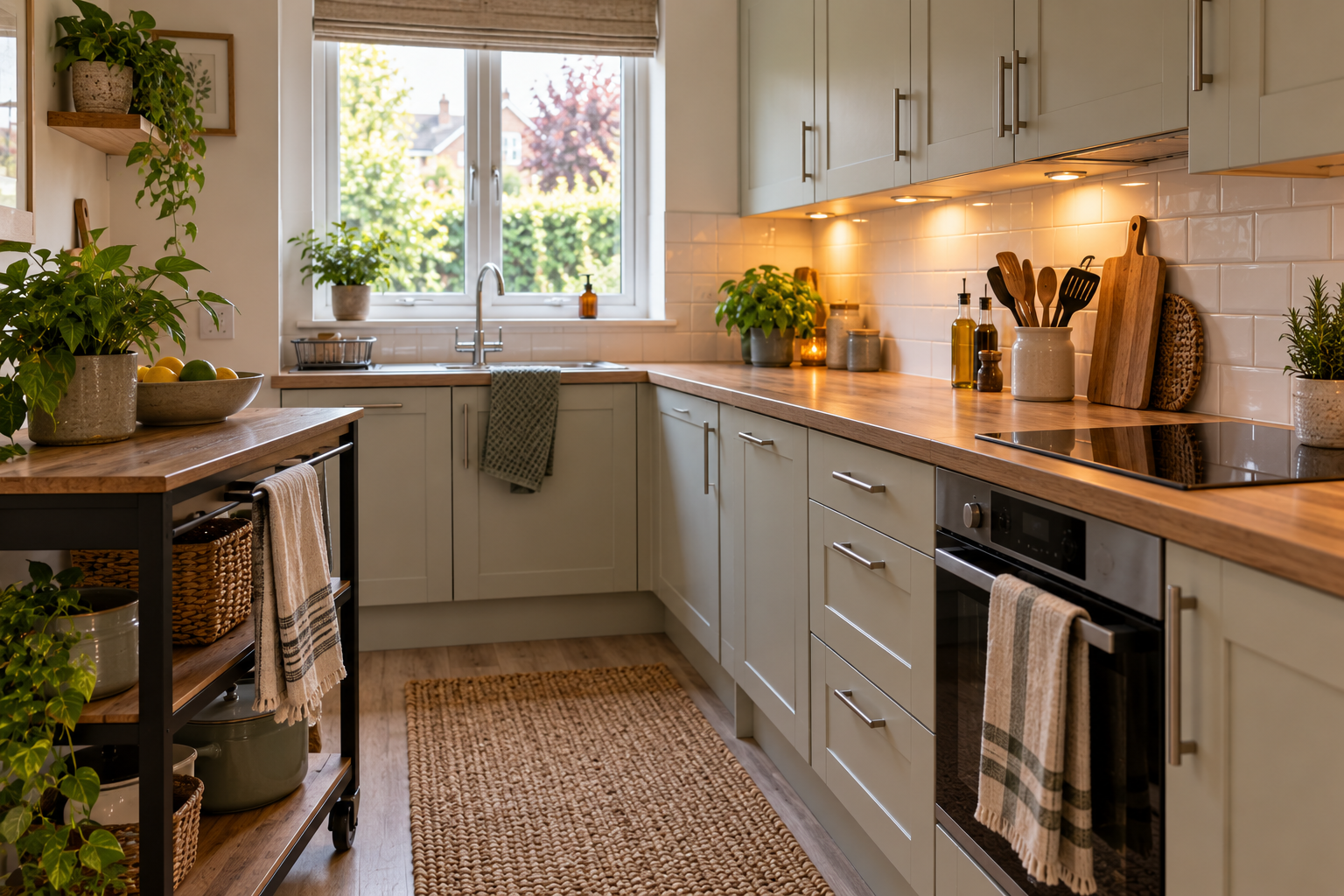
A rented kitchen isn’t always a kitchen you’d have chosen for yourself.
The cupboards might be a colour you don’t love. The lighting may be harsh, storage can be limited and the whole room can feel temporary even after you’ve lived there for months.
The difficult part is knowing what you can realistically change.
Replacing cabinets or worktops probably isn’t an option, and even apparently simple alterations such as drilling into walls, painting surfaces or changing fittings may require permission.
That doesn’t mean you have to live with a kitchen that feels completely impersonal.
The best renter-friendly kitchen ideas work around what is already there. They improve lighting, organisation, colour and how the room functions without relying on major permanent alterations.
Before making changes, check your tenancy agreement and get permission where required. Products described as removable aren’t guaranteed to leave every surface untouched, so test them carefully before committing to a large area.
With that in mind, here are 13 practical ways to make a rented kitchen feel better without turning your deposit into part of the renovation budget.
1. Start With What Your Tenancy Actually Allows
Before buying removable tiles, adhesive hooks or paint, find out what you’re allowed to change.
Tenancy agreements can differ considerably.
One landlord may be happy for you to redecorate as long as the original finish is restored before you leave. Another may require written permission before you make even relatively small alterations.
Check specifically for rules around:
- decorating
- drilling holes
- adhesive products
- changing handles or fittings
- attaching things to walls or cabinets
- altering flooring
- electrical work
If something isn’t clear, ask.
For changes that affect the property itself, get any agreement in writing rather than relying on a casual conversation.
Shelter England advises tenants to check their tenancy agreement and obtain permission before making improvements where required. Changes made without permission can lead to requests to put things back or deductions from the deposit.
It’s also worth taking photographs before making temporary alterations.
The safest renter-friendly improvement is one you know you can reverse without damaging the property.
2. Improve the Lighting Without Rewiring
Poor lighting can make even a reasonably good kitchen feel gloomy.
Fortunately, you don’t necessarily need to replace the ceiling fitting or alter any wiring to improve it.
Start by identifying where the room actually feels dark.
Perhaps the ceiling light is adequate overall but your body casts a shadow across the worktop when you’re preparing food.
Or maybe one end of a galley kitchen gets very little natural light.
Depending on the room, temporary options might include:
- rechargeable lamps
- removable rechargeable lights
- small lamps in appropriate dry areas
- battery-operated accent lighting
Avoid introducing trailing cables across preparation areas or using lighting where it could easily come into contact with water or excessive heat.
And don’t solve a lack of sockets by overloading extension leads with multiple kitchen appliances.
Electrical Safety First warns that kitchens combine water, hot surfaces and high-powered electrical appliances, making sensible cable and socket use particularly important.
The aim is simply to add light where it genuinely makes the kitchen easier to use.
3. Add Removable Under-Cabinet Lighting
The underside of wall cabinets is often one of the most useful places to add temporary lighting.
A small rechargeable light can illuminate the worktop directly without changing the fixed electrical installation.
This can be particularly helpful where wall cabinets block some of the ceiling light.
Rechargeable options also avoid having cables running down towards sockets.
Before sticking anything to a cabinet, check how the mounting system works and whether the manufacturer says it’s suitable for that surface.
Even products marketed as removable can behave differently depending on:
- the surface finish
- the adhesive
- how long they’re left in place
- heat
- moisture
- the age and condition of the cabinet
Test a discreet area first where possible.
Don’t position temporary lights where they interfere with ventilation or sit too close to a hob or another strong heat source.
You want brighter preparation space, not another problem to repair when you move out.
4. Use a Temporary Splashback Carefully
A plain or dated splashback can make a rented kitchen feel tired, which is why peel-and-stick tiles and removable films are so popular.
They can work well in the right situation.
But this is one renter-friendly idea that deserves caution.
A product being described as “removable” doesn’t guarantee it will come away cleanly from every tile, painted wall or surface finish.
Before covering a large area:
check your tenancy agreement, follow the manufacturer’s guidance and test the material somewhere discreet.
Be particularly cautious around:
- painted walls
- damaged tiles
- loose grout
- textured surfaces
- areas exposed to significant heat
- finishes that are already lifting
Anything positioned near a hob or heat source must also be suitable for that location.
If you’re uncertain, it may be better to leave the fixed splashback alone and introduce colour through things you can take with you.
A temporary makeover stops being a bargain if removing it damages the landlord’s original finish.
5. Add Colour Through Things You Can Take With You
You don’t need to change the cabinets to change how the kitchen feels.
Colour can come from things that belong to you.
For example:
- tea towels
- storage canisters
- trays
- plant pots
- a fruit bowl
- cookware kept on display
- artwork placed somewhere suitable
- a washable runner
- a kettle or toaster you already need
The advantage is that all of these can move with you.
This is especially useful if the kitchen has a strong fixed colour you wouldn’t have chosen.
Instead of fighting it, choose a small palette that works alongside it.
A plain white kitchen might feel warmer with timber boards, muted green accessories and a few darker accents.
An older wood-effect kitchen may look calmer with simple neutral accessories rather than more competing colours.
You don’t need every object to match.
The aim is simply to make the room feel more intentional.
For more ways to personalise a rented home without major permanent changes, see our guide to 15 Renter-Friendly Decorating Ideas That Make a Rental Feel Like Home.
6. Use Freestanding Storage Instead of Fixed Units
When kitchen storage is limited, adding wall shelves can seem like the obvious solution.
But drilling isn’t your only option.
If floor space allows, freestanding storage can provide extra capacity without permanently altering the room.
Depending on the kitchen, that might mean:
- a slim trolley
- a narrow shelving unit
- a small freestanding cupboard
- a compact kitchen island
- a vegetable rack
- a baker’s rack
Measure carefully before buying.
Small kitchens often have less spare floor space than they appear to, and even a narrow unit can make a walkway frustrating if it’s badly positioned.
Also think about what you actually need to store.
If dry ingredients are overflowing from cupboards, shelving might help.
If bulky appliances are the problem, make sure the unit is stable and capable of safely supporting their weight.
If you mainly need more preparation space, a trolley with a usable top may solve two problems at once.
For more storage ideas that don’t depend on drilling into walls, see 15 No-Drill Storage Ideas for Renters That Won’t Damage Your Walls.
7. Add a Washable Runner Where It Makes Sense
Kitchen floors in rented homes can be difficult to change.
A washable runner can sometimes soften the look without altering anything permanent.
This works particularly well in galley kitchens or along a plain stretch of flooring.
Choose something:
- easy to clean
- appropriately slip-resistant
- low enough not to create a trip hazard
- suitable for the room
- positioned so doors can still open properly
Think carefully about where it goes.
A loose textile directly beside a hob or somewhere that’s regularly wet may create more problems than it solves.
But in a suitable position, a runner can introduce colour and pattern while making a hard floor feel less stark.
It also has one of the biggest advantages a renter can ask for:
you can simply roll it up and take it with you.
8. Use Removable Hooks Carefully
Unused vertical surfaces can sometimes provide useful storage without permanent fixings.
Removable hooks may work for lightweight items such as:
- tea towels
- oven gloves
- measuring spoons
- lightweight utensils
- small cleaning accessories
But always check the manufacturer’s stated weight limit and surface requirements.
A hook designed for a tea towel shouldn’t suddenly become storage for a heavy frying pan because it happened to survive the first few days.
Adhesives can also behave differently on tiles, paint, laminates and cabinet finishes.
Test where practical and avoid attaching them to damaged or fragile surfaces.
For heavier equipment, use a freestanding solution or an approved fixed one rather than asking adhesive products to do a job they weren’t designed for.
Our guide to 17 Renter-Friendly Storage Ideas That Won’t Damage Your Walls has more ideas for adding useful storage around a rented home without reaching immediately for the drill.
9. Make the Worktop Work Harder
A small worktop can quickly disappear beneath objects that don’t actually need to live there.
Before buying more storage, clear the worktop and decide what deserves to go back.
Things used every day probably belong within easy reach.
Things used once every few weeks probably don’t.
You can then group what remains into simple zones.
For example:
Cooking zone: oil, salt and the utensils you genuinely use.
Hot drinks zone: kettle, tea or coffee and nearby mugs.
Preparation zone: keep as clear as possible.
Boards, trays and shallow baskets can help contain frequently used items and make the surface look more organised.
They also make it easier to clear the whole area quickly when you need extra preparation space.
If limited cupboards and crowded surfaces are the main problem rather than the appearance of the room, our guide to How to Organise a Small Kitchen Without Adding More Cupboards goes much deeper into making existing storage work harder.
10. Make Open Storage Look More Intentional
Open shelves and glass-fronted cupboards can be useful, but they also mean everything inside becomes part of the room.
You don’t need matching containers for every ingredient.
Start by reducing visual clutter.
Group similar things together.
Keep frequently used ingredients close to one another.
Put less attractive packaging inside simple baskets or boxes where practical.
Move rarely used items away from the most visible shelves.
You may find that one basket solves the problem more effectively than transferring twenty different foods into expensive matching jars.
If you do use containers for food, make sure they’re appropriate for food storage and keep important information such as use-by dates available where needed.
The aim isn’t to turn an ordinary kitchen into a perfectly styled pantry.
It’s simply to make visible storage feel calmer and easier to use.
11. Add Plants or Herbs Where the Conditions Suit Them
A little greenery can soften a kitchen filled with hard surfaces.
If you have enough natural light, consider adding one or two plants rather than filling every windowsill.
Herbs can be particularly useful because they’re both decorative and practical.
Depending on the conditions, you might try:
- parsley
- chives
- mint
- basil at suitable times of year
But the kitchen has to suit the plant.
A dark corner isn’t improved by putting a struggling herb there.
Likewise, don’t place plants where they’re exposed to excessive heat, constantly knocked while cooking or interfering with food preparation.
If natural light is poor, skip this idea.
Renter-friendly design should work with the room you actually have, not a photograph of somebody else’s kitchen.
12. Create One Useful Coffee or Cooking Station
Sometimes a kitchen feels cluttered because everything is spread across the worktop.
Creating one small station can bring some order without buying much at all.
A coffee or tea station could contain:
- kettle or coffee machine
- tea or coffee
- mugs
- sugar if you use it
- one tray to contain everything
Or create a cooking station with:
- oil
- salt
- regularly used utensils
- one board or tray beneath them
The tray does a lot of the visual work.
Instead of several unrelated objects scattered across the worktop, they become one group.
It also makes cleaning easier because you can lift the whole collection out of the way.
Don’t create a “station” just because it’s fashionable.
Build it around something you already do every day.
13. Make the Kitchen Feel Better Without Trying to Hide Everything
There’s a point where renter-friendly upgrades can become another form of clutter.
Every cupboard gets covered.
Every wall gets hooks.
Every surface gets baskets, plants, lamps and decorative trays.
You don’t need to disguise the fact that you’re renting.
Instead, choose the two or three things that bother you most.
If the room feels dark, improve the lighting.
If storage is poor, introduce one useful freestanding solution.
If it feels impersonal, add colour through things you can take with you.
If the worktop is constantly cluttered, improve the organisation before decorating it.
Working with the room is usually more successful than trying to temporarily remodel every visible surface.
A rental kitchen can still feel like your kitchen even if the cabinets and worktops ultimately belong to somebody else.
Renter-Friendly Kitchen Changes to Be Careful With
Some popular rental makeover ideas sit somewhere between genuinely reversible and potentially expensive to undo.
They’re not necessarily bad ideas.
They just deserve more thought.
Peel-and-Stick Products
Temporary tiles, vinyl and adhesive films can transform a surface quickly.
But removing them can sometimes affect paint, coatings or finishes underneath.
Check the manufacturer’s guidance and test first.
Changing Cabinet Handles
Changing handles can seem completely reversible.
Sometimes it is.
But the replacement handles need to fit the existing holes correctly, and careless removal can damage cabinet fronts.
Get permission where required, store the original handles safely and refit them before leaving unless you’ve agreed otherwise.
Painting
Don’t assume that because paint is cosmetic you can change the colour without asking.
Check your tenancy agreement and get permission where required.
If you’re expected to restore the original colour before leaving, factor that work and cost into your decision.
Shelter specifically advises tenants to obtain permission for improvements where required and to keep agreements in writing.
Drilling Into Tiles
A hole in a tile isn’t easily reversed.
Unless you have permission, this is exactly the type of small alteration that can become difficult at the end of a tenancy.
Use freestanding or genuinely reversible alternatives where practical.
Electrical Work
Don’t alter fixed wiring, sockets or electrical fittings as part of a rental makeover.
If electrical changes are genuinely needed, speak to the landlord or managing agent.
Electrical Safety First warns against overloading sockets and extension leads and advises that signs such as scorching, buzzing, crackling or repeated tripping shouldn’t be ignored.
Blocking Ventilation
Don’t cover extractor outlets, air vents or other intentional ventilation because they interfere with the appearance of the room.
They have a practical purpose.
A decorative improvement should never stop the kitchen functioning properly.
A Simple £50–£100 Rental Kitchen Refresh
You don’t need to replace half the kitchen to make it feel noticeably better.
Imagine a fairly ordinary rented kitchen with plain cabinets, limited storage and one dark stretch of worktop.
Rather than trying to disguise everything, you could concentrate the budget on four things.
Improve the Worktop Lighting
Add one or two suitable rechargeable under-cabinet lights where food preparation currently feels dark.
Add One Useful Storage Piece
That might be a slim trolley or freestanding rack for things currently cluttering the worktop.
Introduce a Small Amount of Colour
A couple of tea towels, one plant pot or a runner in a suitable location may be enough.
Use a restrained palette rather than buying lots of unrelated accessories.
Organise One Everyday Zone
Use a tray to bring coffee-making equipment or cooking essentials together.
The exact cost depends on what you already own and where you shop, so £50–£100 shouldn’t be treated as a guaranteed shopping list.
The point is prioritisation.
Spend on a few changes that solve real problems rather than buying lots of small decorative items.
What If the Kitchen Actually Needs Repairing?
There’s an important difference between improving a rental kitchen and dealing with something that’s broken.
A damaged cupboard hinge, faulty socket, leaking sink, broken extractor or unsafe appliance supplied with the property isn’t simply a styling problem.
Report repair issues to the landlord or managing agent through the appropriate route and keep a record of what you’ve reported.
Landlords are responsible for most repairs, while improvements are treated separately.
If you notice electrical warning signs such as burning smells, scorching, buzzing or crackling sounds, hot sockets or unexplained circuit-breaker trips, don’t simply work around them with another extension lead. Electrical Safety First advises treating those as warning signs that need attention.
A cosmetic problem is yours to work around.
A genuine repair or safety issue needs to be treated as one.
Avoid Solving a Storage Problem With More Clutter
One of the easiest mistakes in a rented kitchen is buying storage before working out what the real problem is.
You buy another shelf because the cupboards feel full.
Then a trolley because the worktop feels crowded.
Then baskets to organise the trolley.
Suddenly the kitchen contains more furniture and storage products but doesn’t feel any bigger.
Before adding anything, reorganise the storage you’ve already got.
Move rarely used items away from prime positions.
Store similar things together.
Use removable organisers only where they genuinely solve a problem.
Then identify what’s still missing.
Good storage should make the kitchen easier to use.
If you’re constantly squeezing around the storage solution itself, it probably isn’t helping.
Make Every Change Easy to Undo
A useful test for any rental kitchen idea is to imagine moving out.
Could you remove the change without damaging the property?
Do you still have the original fittings?
Would you remember where everything belonged?
Have you kept written permission for anything that required it?
For reversible changes such as swapped handles or removable fittings, keep the landlord’s original items together in a labelled box rather than scattering them around cupboards.
Take photographs before making changes.
And don’t leave the restoration until the evening before handing the keys back.
Some adhesive products become more difficult to remove over time, and even apparently simple alterations can take longer to reverse than expected.
Planning the exit at the same time as the improvement makes temporary changes much less stressful.
Start With the Problem That Annoys You Most
You don’t need to transform the whole kitchen.
Start with whatever makes the room frustrating to use.
If the worktop is dark, improve the lighting.
If everything is permanently on display, tackle the storage.
If the room feels bland, introduce colour through things you can take with you.
If there’s nowhere comfortable to prepare food, clear and organise one proper preparation area before buying another decorative accessory.
Then live with the change for a while.
You may discover that solving one irritating problem makes the whole kitchen feel considerably better.
A rented kitchen doesn’t have to feel temporary simply because you can’t renovate it.
The aim isn’t to pretend you own the cabinets.
It’s to make the room practical, comfortable and recognisably yours while you’re living there — and straightforward to return when it’s time to move on.