
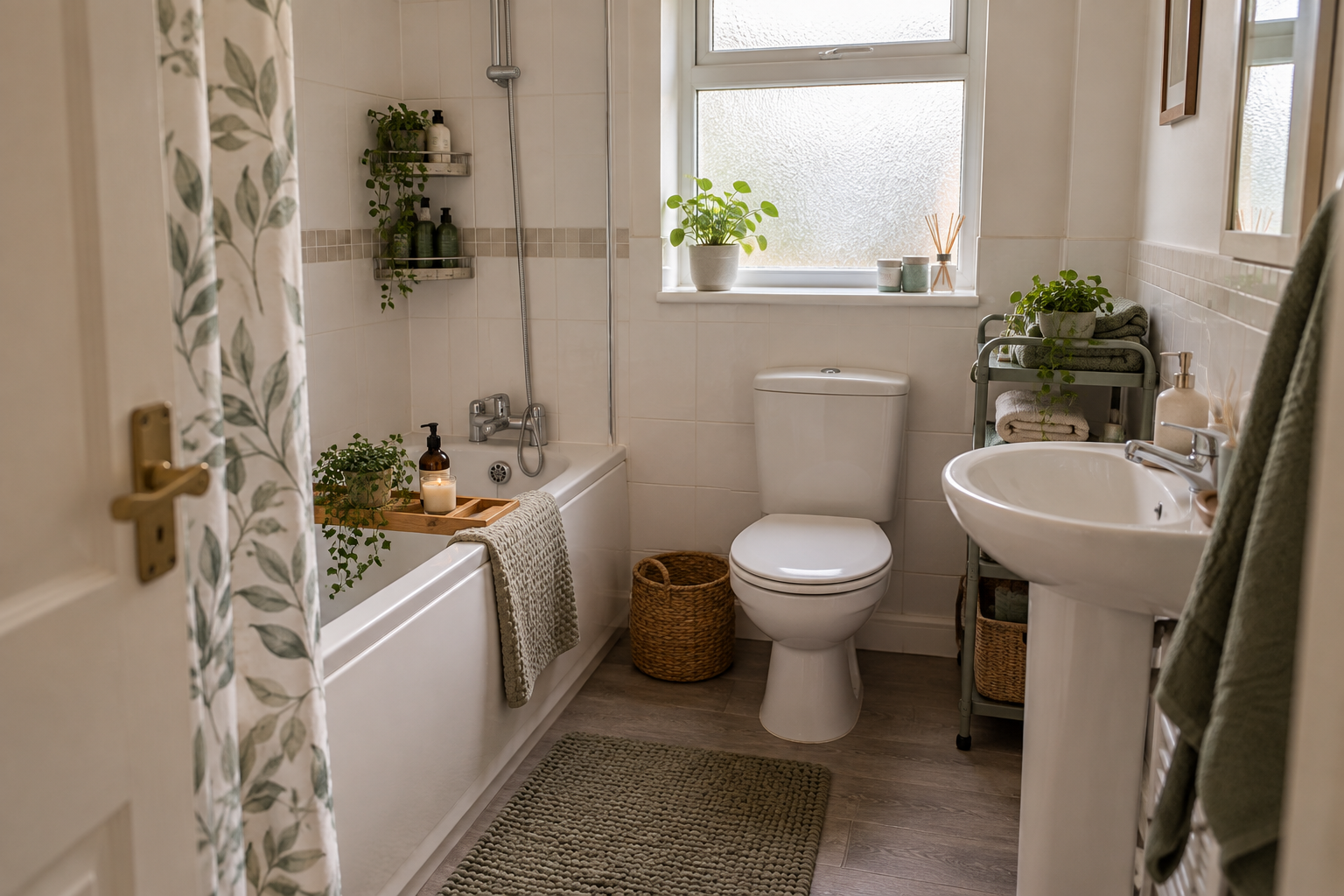
A rented bathroom can be one of the hardest rooms in the home to make feel like your own.
You may be dealing with plain tiles, limited storage, awkward lighting and fittings you wouldn’t have chosen yourself. Unlike a bedroom or living room, there are also fewer things you can simply move around.
Drilling into tiles may be off limits. Replacing taps, flooring or lighting probably isn’t realistic, and even products described as removable can behave differently after months in a warm, humid room.
That doesn’t mean the bathroom has to feel temporary.
The best renter-friendly bathroom ideas work around the fixed features rather than trying to disguise all of them. Better textiles, useful freestanding storage, improved organisation and a few carefully chosen accessories can make an ordinary bathroom feel much more considered.
Before making changes, check your tenancy agreement and get permission where required.
Here are 13 practical ways to make a small rented bathroom feel better without treating it like a renovation project.
1. Check What You’re Allowed to Change First
Before buying adhesive shelves, removable film or replacement fittings, check what your tenancy agreement actually allows.
The bathroom is not the best room for experimenting first and asking questions later.
Look for any conditions relating to:
- decorating
- drilling
- adhesive products
- changing fittings
- flooring
- electrical work
- alterations to tiles or sanitary fittings
If something isn’t clear, ask your landlord or managing agent.
For any change that affects the property itself, get the agreement in writing.
Shelter England advises renters to get permission before making improvements where required. If changes are made without agreement, a landlord may ask for the property to be returned to its previous condition or seek deductions from the deposit.
It’s also worth taking photographs before making temporary changes.
A useful rule for a rented bathroom is:
if you can’t confidently explain how you’ll return it to its original condition, think twice before changing it.
2. Swap the Shower Curtain
If your bathroom has a shower curtain rather than a fixed screen, changing it is one of the simplest ways to alter the appearance of the room.
A curtain occupies a large amount of visual space, so a new colour or pattern can make more difference than several small accessories.
You might choose:
- plain white for a brighter look
- a warm neutral
- a muted colour
- a simple stripe
- a subtle botanical pattern
If the curtain has a strong pattern, keep the rest of the room relatively simple.
Practicality matters too.
Choose something intended for bathroom use and follow its washing and care instructions so it doesn’t quickly become stained or develop mildew.
If the property came with a usable curtain, keep it.
Wash and dry it if appropriate, then store it somewhere clean so you can return it when you move if necessary.
It’s a simple, portable change that doesn’t require touching the tiles, plumbing or fixed fittings.
3. Add a Better Bath Mat
Bathroom flooring is another fixed feature renters usually have little control over.
A good bath mat can soften the look without changing the floor itself.
Choose something that:
- can cope with regular washing
- dries reasonably quickly
- has appropriate grip
- doesn’t obstruct the door
- fits the scale of the room
In a very small bathroom, one properly sized mat often looks better than several little mats crowded around the bath, toilet and sink.
Colour can help too.
If the room contains lots of white or grey, a warmer neutral or muted colour can make the space feel less clinical.
Just keep safety in mind.
Bathroom floors are more likely to become wet, so anything you add should remain stable underfoot and shouldn’t bunch up around doorways or the edge of a shower.
4. Use Freestanding Storage Around the Sink
A bathroom with a pedestal sink or very little built-in storage can quickly become cluttered.
But you don’t necessarily need to fix shelves to the wall.
Depending on the layout, freestanding options might include:
- a slim drawer unit
- a narrow trolley
- a compact shelving unit
- an organiser designed to fit around the sink plumbing
- a small freestanding cabinet
Measure carefully before buying anything.
Bathrooms often have less usable floor space than they initially appear to, and a unit that projects too far into the room can make everyday movement awkward.
Think about moisture too.
Anything kept permanently in the bathroom needs to cope reasonably well with humidity and occasional splashes.
You also don’t need to store every spare product in the room itself.
Bulk toiletries, extra towels and cleaning supplies may be better kept elsewhere if storage is limited.
For more ways to add useful storage without immediately drilling into walls, see our guide to 15 No-Drill Storage Ideas for Renters That Won’t Damage Your Walls.
5. Use the Back of the Door
The back of the bathroom door is often overlooked storage space.
An over-the-door organiser or set of hooks can provide extra capacity without making holes in a wall.
Depending on the product, it could hold:
- dressing gowns
- towels
- lightweight baskets
- hair accessories
- cleaning cloths
Check the fit carefully before buying.
There needs to be enough clearance between the top of the door and the frame, and the organiser shouldn’t stop the door closing properly.
Some hooks are thicker than they appear and can rub against the frame or damage paint if the door is forced shut.
Used carefully, though, the back of the door can be one of the easiest places to gain a little extra storage in a compact bathroom.
6. Use Suction or Removable Hooks Carefully
Tiles can seem like the perfect surface for suction hooks and removable organisers.
In the right situation, they can be useful for lightweight items such as:
- flannels
- shower accessories
- lightweight baskets
- cleaning tools
- small towels
But not every removable product works on every bathroom surface.
Suction products generally need a smooth, clean surface to form a reliable seal.
Textured tiles, grout lines and uneven finishes may not work particularly well.
Adhesive products also deserve caution.
Heat, steam, moisture and the condition of the original finish can all affect how well they stay attached — and how cleanly they eventually come away.
Follow the manufacturer’s instructions and respect the stated weight limit.
Don’t hang something heavy above a bath or toilet simply because the hook has stayed attached for a few days.
For more ideas beyond the bathroom, our guide to 17 Renter-Friendly Storage Ideas That Won’t Damage Your Walls looks at non-permanent storage throughout a rented home.
7. Make Better Use of the Space Under the Sink
The area beneath a bathroom sink is easy to waste.
Plumbing interrupts the space, the available height can be awkward and toiletries gradually accumulate around the pipes.
Rather than trying to fit one huge container underneath, organise around the plumbing.
Depending on the cupboard or sink design, you might use:
- shallow baskets
- small stackable drawers
- divided containers
- a simple freestanding shelf
- a cleaning caddy
Keep products you use regularly where they’re easy to reach.
Move bulk replacements elsewhere if space is tight.
Avoid packing the area so densely that you wouldn’t notice moisture or a plumbing leak.
The best under-sink organisation makes the space easier to inspect as well as tidier.
8. Improve the Room Without Changing the Fixed Electrics
Bathroom lighting isn’t something to improvise with.
Wet conditions increase electrical risk, and bathrooms are subject to specific electrical safety requirements.
As a renter, changing fixed bathroom lighting shouldn’t be treated as a decorative DIY project.
Instead, improve the brightness of the room without touching the electrical installation.
You might:
- keep mirrors clean so they reflect more available light
- avoid blocking the window
- use lighter-coloured textiles
- choose a brighter shower curtain
- keep window areas free from unnecessary clutter
If the fixed light or extractor is faulty, report it rather than trying to work around it.
Electrical Safety First recommends using a registered electrician for bathroom installation work and specifically warns against bringing extension leads into bathrooms to power electrical appliances.
So skip the plug-in lamps and improvised lighting.
This is one room where working with the existing fixed lighting is the sensible renter-friendly option.
9. Add Removable Window Film for Privacy
Bathrooms often need privacy without sacrificing all their natural light.
If the window doesn’t already provide enough privacy, removable window film can sometimes be a useful solution.
Frosted film can obscure a direct view while still allowing daylight into the room.
Before applying it, check:
- whether the product is designed to be removable
- whether it’s suitable for your type of glass
- how it’s applied
- whether your tenancy permits it
Static-cling products may offer a more easily reversible option than strongly adhesive films, depending on the product and surface.
You don’t automatically need to cover the entire window either.
If privacy is only an issue at the lower level, treating that portion alone may retain more light.
Make sure any film doesn’t interfere with the operation of a window you rely on for ventilation.
The aim is to improve privacy without making the room darker or less functional.
10. Add a Freestanding Towel Rail
If the bathroom doesn’t have enough places for towels to dry, a freestanding towel rail can be easier than adding permanent hooks or drilling into tiles.
A slim rail might sit:
- beside the bath
- near the shower
- alongside a wall
- behind the door where there’s enough clearance
Choose one that fits the room rather than simply buying the largest option.
Towels need enough airflow to dry properly, so don’t cram several wet towels onto a tiny decorative ladder.
A freestanding rail also has the advantage of moving with you.
If the bathroom layout changes or you move home, you’re not committed to the position of a permanent fitting.
Just make sure it remains stable and doesn’t become another obstacle in an already narrow room.
11. Use Trays and Baskets to Calm Countertop Clutter
A small bathroom doesn’t necessarily need more furniture if the real problem is that everything is spread across the sink or vanity.
Start by removing anything you don’t use regularly.
Then group what remains.
A small tray might hold:
- soap
- toothbrushes
- everyday skincare
- frequently used toiletries
A basket can contain less attractive packaging or spare products.
The idea isn’t to decant every bottle into matching containers.
It’s to make several individual objects read visually as one group.
This also makes cleaning easier.
Instead of moving six bottles one by one, you can lift the tray, wipe underneath and put everything back.
In a small bathroom, reducing visual clutter can sometimes make as much difference as adding more physical storage.
12. Add Plants Only Where the Conditions Suit Them
A plant can soften a bathroom dominated by tile, glass and other hard surfaces.
But bathrooms aren’t automatically suitable environments for every houseplant.
Ask:
- is there enough natural light?
- how warm does the room stay?
- is the location suitable for that particular plant?
- is there somewhere stable to put it?
If the bathroom has a bright windowsill, you may have several options.
If it has no natural light, don’t assume humidity alone will keep a plant healthy.
And don’t clutter a tiny sink with plants simply because they look good in photographs.
One healthy plant in the right place is more useful than several struggling ones.
Keep plants away from areas where they’re likely to be knocked over, interfere with ventilation or make everyday cleaning harder.
13. Improve the Room Without Trying to Cover Every Surface
Renter-friendly bathroom makeovers can go too far.
The floor gets temporary tiles.
The walls get adhesive panels.
Every surface gets a basket.
Every fixture gets covered by something removable.
At that point, you’ve created almost as much work as a renovation — except you still need to reverse all of it when you leave.
Instead, decide which two or three things bother you most.
If it’s clutter, improve the storage.
If it’s colour, change the shower curtain, towels and bath mat.
If privacy is poor, deal with the window.
If the sink area feels chaotic, organise the things you actually use.
You don’t need to disguise every tile or fitting.
The aim is to make the bathroom calmer and more useful while accepting that some of its fixed features belong to the property rather than to you.
For broader ideas on personalising a rental without major permanent alterations, see our guide to 15 Renter-Friendly Decorating Ideas That Make a Rental Feel Like Home.
Bathroom Changes Renters Should Be Careful With
Some popular rental bathroom ideas sit somewhere between genuinely reversible and potentially expensive to undo.
They’re not necessarily bad ideas.
They simply deserve more consideration before you start.
Peel-and-Stick Tiles and Flooring
Temporary tiles and vinyl can look convincing online.
But bathrooms expose materials to moisture, warmth and repeated cleaning, and removal may not leave every underlying surface untouched.
Large areas also create much more work to restore later.
Check the product guidance, your tenancy agreement and the original surface before committing.
Drilling Into Tiles
A hole in bathroom tile isn’t easily reversed.
It may crack the tile or damage whatever is behind it.
If you don’t have permission, use appropriate freestanding, suction or over-door alternatives instead.
Replacing Taps or Fixed Shower Fittings
Changing plumbing components isn’t the same as replacing a shower curtain.
Poorly fitted plumbing can cause leaks and property damage.
If a fixed fitting is faulty, report it.
If you simply dislike its appearance, decide whether changing it is worth getting permission and potentially paying for appropriate professional work.
Electrical Changes
Don’t alter fixed bathroom wiring or electrical fittings as part of a cosmetic makeover.
Electrical Safety First says bathrooms are higher-risk electrical environments and recommends registered electricians for electrical installation work.
If a light, extractor or other fixed electrical fitting is faulty, report it.
Blocking Ventilation
Don’t cover vents or obstruct windows that help ventilate the room simply because you don’t like how they look.
Bathrooms produce a large amount of moisture.
Any decorative change should leave the room able to ventilate as intended.
A Simple £50–£100 Rental Bathroom Refresh
You don’t need to change everything to make the bathroom feel noticeably better.
Imagine a small rented bathroom that’s functional but plain and short on storage.
With a modest budget, you might concentrate on four things.
Change the Textiles
A new shower curtain, bath mat and perhaps a couple of coordinated towels can change much of the visible colour in the room without touching a fixed surface.
Add One Useful Storage Piece
Choose one slim trolley, freestanding unit or over-door organiser based on what you genuinely need to store.
Organise the Sink Area
Use one small tray or basket rather than buying lots of separate organisers.
Improve Privacy if Needed
If the window is the main problem, suitable removable privacy film could make the room more comfortable without adding a bulky blind or curtain.
The exact cost will depend on what you already own and where you shop.
The point isn’t that £100 guarantees a complete bathroom makeover.
It’s that several targeted changes will usually have more impact than the same money spent on lots of little decorative accessories.
What If the Bathroom Actually Needs Repairing?
There’s an important difference between a bathroom that looks dated and a bathroom with something genuinely wrong with it.
A leaking basin, faulty sanitary fitting, electrical problem or defective plumbing isn’t something you should simply disguise with renter-friendly décor.
In England, landlords are responsible for repairs to things including basins, sinks, baths and other sanitary fittings, pipes and drains, as well as electrical wiring.
Report repair problems promptly and keep a record.
This is particularly important with water.
A small leak can become a much larger problem if it’s hidden behind storage or ignored.
Mould deserves a similarly sensible approach.
Bathrooms naturally generate moisture, so use existing ventilation appropriately and avoid unnecessarily obstructing windows or extractor systems.
But if mould keeps returning, there’s persistent damp, ventilation equipment appears faulty or you suspect the problem is connected to the property itself, report it to the landlord rather than repeatedly treating the appearance alone. GOV.UK advises tenants to contact their landlord if the property needs repairs or has mould.
A decorating issue can often be worked around.
A repair or safety problem should be reported.
Don’t Solve a Small Bathroom With Too Much Storage
Storage products can become part of the problem.
You add an over-door organiser.
Then a trolley.
Then an under-sink unit.
Then baskets on top of the trolley.
The bathroom technically has more storage, but there’s now less room to move.
Before buying anything, reduce what is stored in the room.
Dispose of empty or unwanted products appropriately.
Move bulk replacements somewhere else if you have the space.
Keep daily items in the easiest positions and less-used things further away.
Then decide whether you still need another storage unit.
A small bathroom generally benefits from less visible stuff, not simply more places to put it.
Make Every Change Easy to Reverse
When you’re deciding whether a renter-friendly bathroom idea is worthwhile, imagine removing it again.
Will the adhesive come off?
Have you kept the original items?
Could the product mark the tile or paint?
Will it take hours to remove just before moving?
Have you kept written permission for anything that required it?
Take photographs before making changes.
Store any original items together and label them.
And don’t assume everything described as removable will still be effortless to remove after a long period in a warm, humid bathroom.
Planning the exit at the same time as the improvement makes temporary changes considerably less stressful.
Start With the Thing That Makes the Bathroom Hardest to Use
You don’t need to transform the whole room.
Start with the biggest frustration.
If towels have nowhere to dry, solve that.
If the sink is permanently cluttered, reorganise it.
If the bathroom feels bland, change the textiles.
If storage is the problem, introduce one appropriate unit rather than five little organisers.
Then live with the change.
Often, solving one practical problem makes the room feel considerably better without touching the tiles, plumbing or fixed fittings.
And if you’re working through other rented rooms as well, our guide to 13 Renter-Friendly Kitchen Ideas That Won’t Risk Your Deposit takes the same practical approach to improving a rented kitchen without turning it into a renovation project.
A rented bathroom doesn’t need to feel like a temporary stopgap.
It needs to work well, feel comfortable and contain enough of your own choices that it feels like part of your home.
You can achieve that without drilling into every tile or covering every surface.
Sometimes the best rental makeover is knowing what to change — and what to leave alone.