
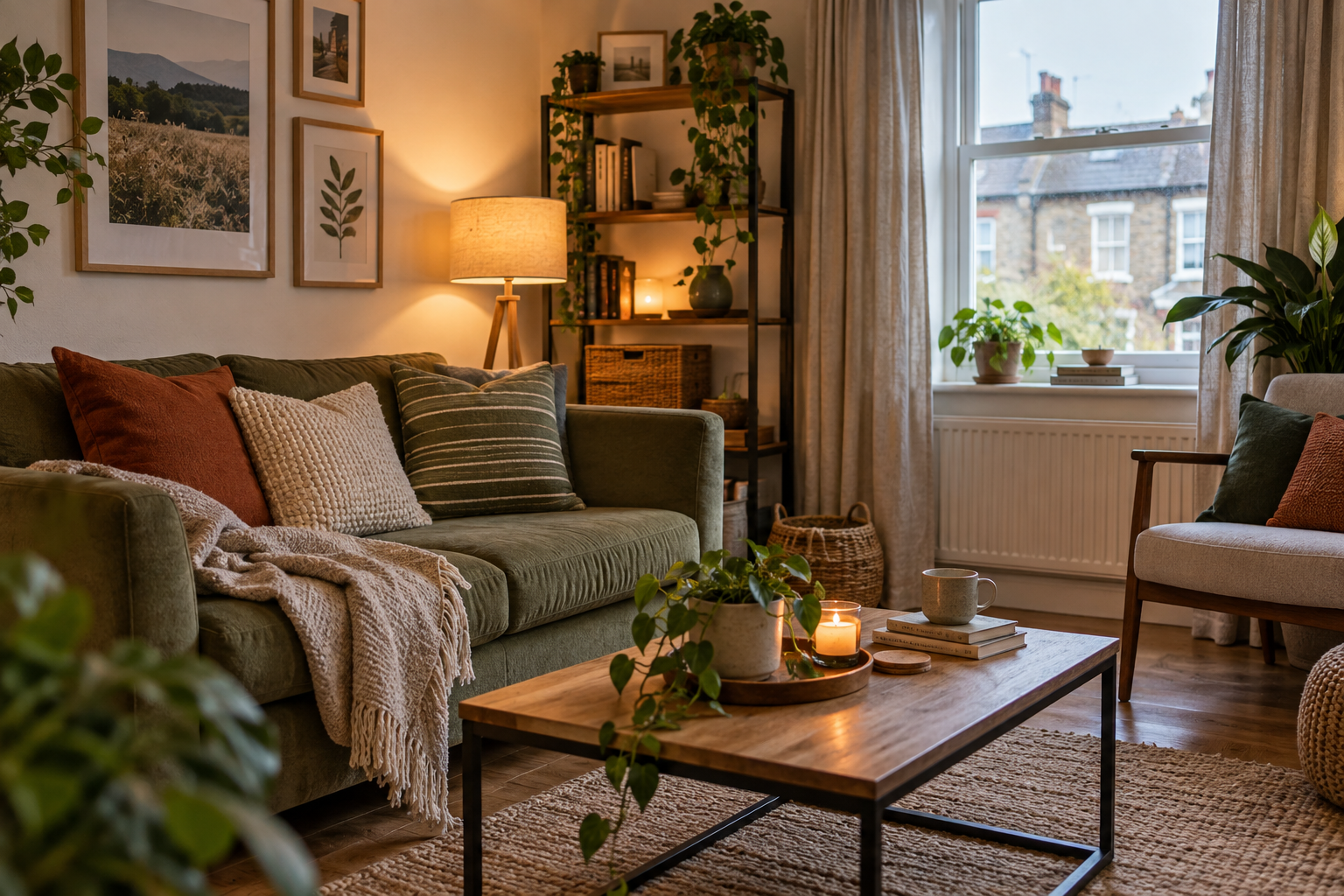
Living in a rented home can sometimes make decorating feel more complicated than it should.
You might dislike the wall colour, wish the lighting felt warmer or have rooms that still feel as though they belong to somebody else. But when painting, drilling or making permanent changes isn’t an option, it can be tempting to simply leave everything as it is.
Fortunately, making a rental feel like home doesn’t have to mean changing the parts of the property you don’t own.
Some of the most effective improvements are surprisingly simple: rearranging furniture, introducing colour through textiles, changing the way a room is lit or finding better ways to display the things you already own.
And unlike a new kitchen or a freshly painted wall, many of these changes can come with you when you eventually move.
The key is to concentrate on reversible changes that improve how your home looks and feels without making unnecessary alterations to the property itself.
Here are 15 renter-friendly decorating ideas for creating a home that feels more personal, comfortable and considered — even when there are limits on what you can change.
Before You Start: Check What You’re Allowed to Change
Before buying removable wallpaper or reaching for a packet of picture strips, it’s worth checking exactly what you’re allowed to do.
Start with your tenancy agreement. It may contain specific conditions covering decorating, painting, putting fixings into walls or making other alterations to the property.
If you’re unsure about a particular change, ask your landlord or letting agent before going ahead. This is especially worthwhile for anything involving paint, drilling, fixtures or adhesive products that will remain in place for a long time.
It’s also useful to keep photographs of the property’s condition when you move in. Your check-in inventory or condition report can provide another record of how walls, floors, fittings and furniture originally looked.
Be careful with anything described as “removable”
Removable doesn’t necessarily mean risk-free.
Picture strips, adhesive hooks, vinyl and peel-and-stick wallpaper can all be useful in a rented home, but the result depends on the surface underneath them. Older paint, poorly prepared walls or delicate finishes may lift when an adhesive is removed.
Before using one across a visible area, follow the manufacturer’s instructions and test it somewhere inconspicuous where possible.
The same principle applies throughout this guide:
If you’re not sure whether a decorating idea is suitable for your particular rental, check first rather than assuming that “renter-friendly” means it will be appropriate for every property.
With that out of the way, we can concentrate on the enjoyable part — making the home feel more like yours.
1. Start With the Furniture Layout
Before buying anything new, look at what you can change for free.
Furniture placement has a surprisingly large effect on how a room feels. A sofa pushed against a wall simply because that’s where the previous tenant placed it isn’t necessarily the best arrangement for you.
Think about how you actually use the room.
Where do you naturally walk? Which chair gets the best daylight? Is a large piece of furniture making the entrance feel cramped? Could moving a table create a clearer route through the room?
In a small rental, even shifting a few pieces of furniture can make the space feel noticeably more comfortable.
Try creating a little breathing room around larger pieces rather than filling every available wall. If the room allows it, pulling furniture slightly away from the edges can sometimes make the arrangement feel more intentional.
You can also experiment before committing to anything. Move a chair to another corner for a few days, turn a rug around or swap a side table between rooms.
The aim isn’t to find a perfect interior-design layout.
It’s to make the room work for the way you live in it now, rather than accepting the arrangement you inherited when you collected the keys.
And because nothing has been attached, painted or permanently changed, you can keep adjusting it until it feels right.
2. Use a Rug to Change the Character of the Room
Flooring can have an enormous influence on how a room feels, but it’s one of the parts of a rental you’re least likely to be able to change.
A rug gives you another option.
It can introduce colour, pattern and texture while helping a room feel more finished. It’s particularly useful if you’re working with a carpet, laminate or flooring that wouldn’t have been your first choice.
Rather than choosing a small rug simply because the room is small, think about how it relates to the furniture around it.
In a living room, a rug that reaches beneath at least some of the main furniture can help visually connect the seating area. A very small rug floating in the middle of the floor can sometimes make the room feel more fragmented instead.
Rugs can also help define different areas in an open-plan rental. One beneath a dining table, for example, can make the dining area feel separate from the living space without adding a physical divider.
There is a practical side to consider too.
Make sure the rug doesn’t create a trip hazard or interfere with doors, and use a suitable rug underlay or non-slip solution where necessary. If you’re placing one over carpet, check that it remains stable rather than gradually bunching or moving.
The advantage is that when you move, the rug moves with you.
Instead of spending money improving somebody else’s floor, you’re buying something you can potentially use in your next home too.
3. Bring Colour In Through Textiles
If painting the walls isn’t possible, bring colour into the things that aren’t attached to them.
Cushions, throws, bedding, curtains and other textiles can change the atmosphere of a room without altering the property itself.
You don’t need to replace everything at once.
Start by choosing a small palette of colours you genuinely like and repeat them in a few places around the room. A muted green cushion might pick up the colour of a plant, for example, while a warm neutral throw could connect with wood furniture or a natural-fibre rug.
This tends to feel more considered than introducing lots of unrelated colours simply because individual items look attractive in the shop.
Textiles are also useful for changing a room with the seasons.
Heavier textures and warmer tones can make a room feel cosier through autumn and winter, while lighter bedding or cushion covers can freshen things up when the weather gets warmer.
And if storage is limited, don’t feel you need an entire cupboard of seasonal accessories. A couple of cushion covers take up far less room than storing several complete cushions.
Work with the rental rather than fighting it
You might not love the existing carpet, curtains or wall colour, but trying to disguise every part of the property can quickly become expensive.
Instead, look for colours that work alongside what is already there.
If the walls are a warm cream, for example, earthy greens, terracotta, brown or natural linen tones might work with them rather than making the cream feel like something that needs to be hidden.
The goal isn’t to pretend the rental is a different property.
It’s to make the existing space feel more like your version of it.
4. Improve the Lighting With Lamps
Lighting is one of the easiest things to overlook when decorating a rental.
Many rooms rely almost entirely on a single ceiling light. It does the practical job of illuminating the room, but it doesn’t necessarily make the space feel particularly comfortable in the evening.
Adding a couple of lamps can make a surprisingly large difference.
A floor lamp beside a sofa, a small lamp on a side table or a bedside lamp creates smaller pools of light around the room. This can make the space feel warmer and give you more control over the atmosphere than simply switching the main light on or off.
Think about where you actually need light.
If you read on the sofa, put a lamp nearby. If one corner feels particularly dark, consider whether a floor lamp could make that part of the room more useful. In a bedroom, softer bedside lighting can be much more relaxing than relying on the ceiling fitting.
You don’t necessarily need lots of lamps either.
One well-positioned lamp can be more useful than several decorative lights that don’t serve a purpose.
Pay attention to the bulb as well as the lamp
The colour and brightness of the bulb can change how the room feels just as much as the lamp itself.
For living rooms and bedrooms, many people prefer a warmer light in the evening rather than a very cool, bright white.
Just make sure any bulb you use is suitable for the fitting and within its specified limits.
If the rental already contains lamps or light fittings belonging to the landlord, store anything you temporarily remove safely and put it back when required.
Lighting is a good example of a renter-friendly improvement because you can enjoy it every day without making a permanent alteration — and take most of it with you when it’s time to move.
5. Lean Artwork Instead of Hanging Everything
Bare walls can make a rental feel unfinished, but not every picture needs to be attached to one.
Leaning artwork is a simple alternative that works particularly well on sideboards, chests of drawers, shelves, desks and other pieces of furniture you already own.
It also gives you more freedom to change things around.
A framed print leaning behind a lamp or a couple of smaller pictures layered together can create a relaxed display without requiring you to decide exactly where something should live for the next few years.
Larger artwork can sometimes work well from the floor too, particularly in a living room or bedroom where there is enough space for it to sit safely against a wall.
Just be sensible about stability. Large or heavy frames shouldn’t be left somewhere they could easily fall, especially around children or pets. Where furniture or objects need securing for safety, follow the appropriate safety guidance rather than avoiding fixings simply because you’re renting.
Display things you already own
Artwork doesn’t have to mean buying expensive prints.
Photographs, postcards, maps, illustrations, record sleeves and other meaningful items can all become part of the room when framed or displayed thoughtfully.
This can make a rental feel far more personal than filling every wall with generic decoration.
If you’re working with a small home, resist the temptation to cover every available surface.
A few things you genuinely like usually have more impact than lots of objects competing for attention.
And when it’s time to move, you can simply pack the display away and recreate it somewhere else.
6. Use Removable Picture Strips Carefully
Sometimes you really do want something on the wall.
Removable picture-hanging strips can be useful in a rental because they may allow lightweight frames and decorations to be displayed without drilling holes.
But this is one area where the phrase “renter-friendly” needs a little caution.
An adhesive product is only as reliable as the surface it’s attached to.
Paint that is old, poorly bonded or already beginning to flake may come away when the strip is removed. Recently painted surfaces can also require time before adhesive products should be applied.
That means it’s worth checking both your tenancy agreement and the manufacturer’s instructions before using them.
Where appropriate, test the product somewhere inconspicuous first.
Don’t improvise the removal process
How you remove an adhesive strip matters.
Follow the manufacturer’s removal instructions rather than pulling the strip directly away from the wall. A product designed to release in a particular direction can cause damage if it’s removed incorrectly.
It’s also important to stay within the stated weight limit.
If a picture is heavy, valuable or positioned somewhere that could cause injury if it fell, a removable adhesive strip may simply not be the right solution.
For lighter frames, however, they can provide another way to introduce photographs and artwork without reaching immediately for a drill.
Think of them as one possible tool rather than a guarantee of damage-free decorating.
7. Add a Freestanding or Leaning Mirror
Mirrors are particularly useful in smaller rented homes because they can do more than decorate an empty wall.
Placed carefully, a mirror can reflect daylight, brighten a darker part of the room and make the space feel more open.
And you don’t necessarily need to attach one to the wall.
A freestanding floor mirror can work well in a bedroom or dressing area, while smaller mirrors can be placed on dressing tables, shelves and other furniture.
A larger leaning mirror can also create a strong focal point without changing the wall behind it.
Think about what the mirror reflects
Before deciding where it goes, look at what you’ll actually see in it.
A mirror opposite or adjacent to a window may help move natural light further into the room. One facing a cluttered shelving unit may simply make that clutter twice as noticeable.
You can use this deliberately.
Position the mirror where it reflects something you enjoy looking at — daylight, a plant, artwork or a calmer part of the room.
In a narrow hallway, a carefully positioned mirror can also add useful light and give you somewhere to check yourself before leaving the house.
If your entrance is particularly tight, our guide to small hallway storage ideas looks at practical ways to organise shoes, coats, bags and everyday clutter without making a narrow hallway harder to use.
Make sure larger mirrors are safe
A heavy mirror shouldn’t be left precariously balanced against a wall just to avoid making a fixing.
If a mirror needs securing to prevent it tipping, safety comes first. Check the manufacturer’s instructions and discuss appropriate fixing with your landlord or letting agent where necessary.
For smaller or properly designed freestanding mirrors, though, this can be one of the easiest ways to make a rented room feel more considered.
And like the rugs, lamps and artwork we’ve already covered, it’s something you can take with you to the next home.
8. Use Curtains to Soften the Room
Curtains can have a much bigger effect on a room than their practical purpose might suggest.
They introduce colour, texture and softness to an area that is otherwise dominated by hard lines — the window frame, walls and surrounding furniture.
If your rental already has a curtain pole or suitable track, changing the curtains can be a relatively simple way to make the room feel more like yours.
Just keep anything belonging to the landlord somewhere clean and dry so it can be put back when you leave.
You don’t necessarily need bold colours or patterns.
Natural-looking fabrics, warm neutrals or a colour already used elsewhere in the room can help bring everything together without making the window the main feature.
In a bedroom, curtains can also make the space feel noticeably cosier, while in a living room they can help soften an otherwise plain rental.
Work with the window you have
Before buying anything, measure carefully.
Check the width and drop you need, how the existing curtain pole or track works and whether doors, radiators or furniture underneath the window affect the available space.
It’s easy to buy curtains because you like the fabric and only discover afterwards that they don’t work particularly well with the window.
If there isn’t already a suitable fitting, don’t assume you need to install one.
There may be alternatives that work with the existing setup, but anything involving drilling or attaching new hardware should be checked against your tenancy agreement first.
The important thing is that you’re changing something you can easily take away again, rather than redesigning the window itself.
9. Make Plants Part of the Room
Plants can introduce colour and life into a rental without requiring much decorating at all.
A plant on a windowsill, a larger pot beside a piece of furniture or a small collection on an existing shelf can make an otherwise plain room feel much more settled.
They can be particularly useful when you’re working with neutral walls because the greenery provides colour without needing paint, wallpaper or additional wall decoration.
But you don’t need to turn every available surface into a miniature jungle.
A few plants positioned where they genuinely suit the room will usually work better than filling a small space with pots simply because an empty corner exists.
Choose the position before the plant
Look at the conditions in the room first.
How much natural light does it receive? Is the windowsill particularly hot or cold? Is there actually enough room for the plant once it grows?
Different plants have different requirements, so choose something suited to the conditions you can provide rather than buying a plant first and trying to find somewhere for it afterwards.
It’s also worth thinking about the surface underneath.
Use appropriate saucers or planters and be careful when watering plants on wooden furniture, windowsills, carpets or other surfaces that could be damaged by moisture.
If maintaining houseplants isn’t something you enjoy, there’s nothing wrong with skipping this idea entirely.
A renter-friendly home should reflect how you actually want to live, not a checklist of things an interior is supposed to contain.
10. Choose Freestanding Shelving and Storage
One of the most useful principles when furnishing a rental is to favour things that can move with you.
Freestanding storage does exactly that.
A bookcase, shelving unit, small cabinet or storage trolley can give you somewhere for both practical belongings and decorative objects without requiring permanent built-in storage.
It can also help make a room feel more personal.
Instead of treating shelving purely as somewhere to fit as much as possible, leave some breathing room. A mixture of books, useful storage, a lamp, plant or a few meaningful objects can make an ordinary shelving unit feel like part of the room rather than simply another place for clutter to accumulate.
If you’re renting a particularly small home, furniture that combines storage with another purpose can be even more useful.
An ottoman can provide seating and hidden storage. A bedside table with drawers gives you a useful surface without wasting the space underneath. A narrow console can provide storage in an entrance without requiring a fitted unit.
Before buying anything, though, measure the space properly.
A storage unit isn’t particularly helpful if it solves one problem while making the room harder to move through.
Look for storage you can use somewhere else
Renters don’t always know what their next home will look like.
That makes highly specific furniture slightly more difficult to justify.
Where possible, choose versatile pieces that could work in another room later. A slim shelving unit used in the living room today might eventually become bedroom storage, office shelving or even useful kitchen storage in another property.
That flexibility makes the purchase much easier to carry from one home to another.
If storage is one of the main challenges in your rental, our guide to 17 renter-friendly storage ideas covers more ways to organise your belongings without relying on permanent fitted storage or unnecessary changes to the property.
There’s an important safety exception here too.
Tall or potentially unstable furniture may need securing to prevent it tipping over, particularly in homes with children. Follow the manufacturer’s safety instructions and, where wall fixing is required, discuss the appropriate approach with your landlord or letting agent.
The aim isn’t to avoid every fixing at any cost.
It’s to choose furniture and storage that gives you as much flexibility as possible while still using it safely.
11. Make Existing Furniture Feel More Intentional
Not every piece of furniture in a rental will be something you would have chosen yourself.
If you’re renting furnished or partly furnished, you may have inherited tables, shelving, chairs or cabinets that have to remain in the property.
Even in an unfurnished rental, you might be using furniture collected gradually from previous homes, family members or second-hand finds.
It doesn’t all need to match.
Instead of replacing perfectly usable furniture, look at how the pieces work together.
Sometimes a room feels mismatched simply because there isn’t anything visually connecting the furniture.
A lamp, rug, cushion, basket or a few repeated colours can help create that connection.
You can also change what sits on the furniture.
A cluttered sideboard might feel completely different once unnecessary items are removed and the remaining objects are grouped more deliberately. A simple tray can bring together smaller everyday items, while a lamp and a couple of books can make an otherwise plain surface feel more considered.
Don’t style every available surface
There is a point where decorating becomes more clutter.
This matters particularly in small rented homes, where worktops, tables and shelves are often needed for everyday life.
You don’t need a decorative arrangement on every surface.
Leaving some areas deliberately clear gives you somewhere to put down a cup of tea, prepare food, work from home or deal with the collection of things that inevitably arrives through the front door.
Before buying something decorative, ask yourself a simple question:
Do I actually have somewhere sensible to put it?
If the answer is no, leaving it in the shop may improve your home more than bringing it back with you.
12. Use Removable Wallpaper Cautiously
Peel-and-stick or removable wallpaper is frequently suggested as an ideal solution for renters.
And in the right circumstances, it can be useful.
A small area of pattern or colour can change the character of a room without committing to traditional wallpaper or repainting an entire wall.
But this is another renter-friendly idea where it’s worth being careful with the word removable.
Different products use different adhesives, and walls vary enormously.
The condition of the paint underneath, the type of surface, how long the wallpaper remains in place and the way it’s eventually removed can all affect the result.
For that reason, don’t assume that removable wallpaper automatically means there is no possibility of damage.
Check your tenancy agreement first and ask your landlord or letting agent if you’re unsure whether it is permitted.
Then read the manufacturer’s guidance carefully.
If the product allows it, testing a small inconspicuous area before covering a larger section can help identify obvious compatibility problems.
You don’t need to cover an entire room
If you do decide removable wallpaper is appropriate, consider using it selectively.
A small feature area can provide plenty of impact without covering every wall.
That might mean the back of an open shelving unit, a small section of wall or another suitable surface where the pattern has a reason to be there.
This also reduces the amount you’ll eventually need to remove.
And if you’re already happy with the room after changing the lighting, textiles and artwork, there’s no rule saying you need wallpaper at all.
Sometimes the most renter-friendly decorating decision is knowing when the room already feels finished.
13. Make Temporary Changes in the Kitchen
Kitchens can be frustrating rooms to personalise when you’re renting.
Cabinet doors, worktops, flooring and tiles dominate the space, yet they’re also among the things you’re least likely to be able to change.
Rather than trying to disguise the entire fitted kitchen, concentrate on the parts you control.
Start with the things that are already visible.
A wooden chopping board left neatly against the splashback, a fruit bowl, a plant suited to the room or a couple of everyday items you genuinely use can introduce colour and texture without turning the worktop into a display shelf.
Tea towels are another easy way to bring in colour, and a washable runner or mat may work in some kitchens where there is enough clear floor space for it to be used safely.
Lighting can help too.
If the kitchen feels harsh or gloomy, improving the general lighting with suitable bulbs may make more difference than trying to decorate around the problem. Any additional electrical lighting should be suitable for the location and used according to the manufacturer’s instructions.
Add useful storage rather than decorating every surface
In a small kitchen, practicality should come first.
A freestanding trolley, fruit basket or compact shelf can sometimes add both storage and personality, but only if there is genuinely room for it.
If your kitchen already feels crowded, adding more objects simply because they’re decorative is unlikely to improve it.
Our guide to organising a small kitchen without adding more cupboards covers ways to make better use of the storage you already have before bringing additional furniture into the room.
It’s also worth being cautious with popular temporary kitchen transformations.
Adhesive coverings for cabinet doors, worktops or tiles may be described as removable, but they can still leave residue or affect the surface underneath. Covering large areas can also become a much bigger job to reverse than expected.
Check what your tenancy permits before applying anything to fitted surfaces.
A rented kitchen doesn’t need to look completely different in order to feel more like yours.
Sometimes a few useful objects, less clutter and a consistent choice of colours are enough to make the room feel considered without touching the cabinets at all.
14. Use Tension Rods Where They Genuinely Solve a Problem
Tension rods can be useful in a rented home because they sit between two suitable surfaces rather than relying on screws or permanent fixings.
They’re often associated with shower curtains, but depending on the product and the space available, they can have other uses too.
A tension rod might provide a lightweight curtain across an awkward recess, help conceal an open storage area or create a simple divider inside a suitable space.
In some kitchens and utility areas, smaller tension rods can also help organise lightweight items inside cupboards.
The important word here is lightweight.
A tension rod isn’t a substitute for properly installed shelving, a clothes rail or any other fitting designed to support significant weight.
Always check the manufacturer’s stated dimensions and weight limits, and make sure the surfaces at either end are suitable.
Don’t force one into the space
Tension rods work by applying pressure between two surfaces.
That means using excessive force isn’t necessarily harmless. Delicate paintwork, plasterboard or other finishes could potentially be marked or damaged if too much pressure is applied.
Use the product as intended rather than tightening it as much as physically possible.
It’s also worth asking whether a tension rod actually solves the problem better than something you already own.
There isn’t much value in creating another storage system simply because you’ve found a clever way of installing one without drilling.
But when you have a suitable recess and a genuinely useful purpose for it, a tension rod can provide a flexible solution that is relatively easy to remove when you move.
15. Create a Simple Colour Palette Across Your Home
One of the easiest ways to make a rental feel more intentional doesn’t involve changing the property at all.
Choose a small group of colours and materials that you enjoy living with, then repeat them gently throughout the home.
You don’t need every room to match.
The aim is simply to create enough visual connection that the home feels like it belongs to the same person.
For example, you might choose warm neutrals as the base, muted green as an accent and natural wood as a recurring material.
The green could appear in a living-room cushion, a bedroom throw and a plant pot in the kitchen. Natural wood might appear through a chopping board, picture frames and a small side table.
None of those things needs to be identical.
It’s the repetition that creates the connection.
Start with what you already own
Before choosing a colour palette from a paint chart or interiors photograph, look around your home.
You may already have the beginnings of one.
Perhaps several of your favourite possessions contain similar colours. Maybe you naturally choose warm woods, black accessories or soft blues whenever you buy something for the home.
Use those clues.
Then, when you eventually need something new, you have a simple way of deciding whether it belongs.
This can also help prevent impulse purchases.
A cushion might look fantastic in a shop, but if it introduces another completely unrelated colour into an already busy room, you may decide you don’t actually need it.
Let the rental’s existing colours become part of the palette
You can’t always choose the starting point.
If the property has cream walls, grey carpet or dark kitchen units, consider treating those colours as part of the room rather than obstacles you need to hide.
You can then choose your own colours around them.
A neutral rental with cream walls might work beautifully with olive green, warm wood and terracotta, for example. A room with cooler grey flooring might suit a different combination.
Working with what’s already there is usually cheaper and easier than trying to visually cover every surface you wouldn’t have chosen yourself.
And because your colour comes primarily from possessions rather than permanent finishes, the idea can travel with you.
The next property may have different walls and flooring, but your lamps, textiles, artwork, furniture and favourite objects will still provide a familiar thread.
That’s ultimately what makes this approach so useful for renters.
You’re not trying to turn someone else’s property into your permanent dream home.
You’re using the things you control to create a home that feels recognisably yours for as long as you live there.
How to Make a Rental Feel Cohesive Without Buying Loads of Stuff
When a rental doesn’t quite feel like home, it’s easy to assume the solution is to buy more things.
Another cushion. Another lamp. Another basket for the shelf.
Individually, none of those purchases is necessarily a problem. But gradually adding things without thinking about how they work together can leave a small home feeling more cluttered rather than more personal.
Before shopping, look at what you already own.
You may find that the foundations of a comfortable home are already there — they just need arranging differently.
Move things between rooms
An object doesn’t have to stay in the room where you first put it.
A lamp that feels lost in the living room might work perfectly beside the bed. A small table from the bedroom could become useful beside the sofa. Artwork that doesn’t suit one room may make much more sense somewhere else.
Try moving things around before replacing them.
It’s free, completely reversible and sometimes enough to make an overlooked possession feel useful again.
Repeat a few colours and materials
As we covered earlier, repetition can make unrelated pieces feel more connected.
If you already own several things in similar colours, bring some of them together.
You can do the same with materials.
Warm wood, woven baskets, black metal, glass, linen or ceramics can provide a visual thread between objects that weren’t bought as a matching set.
This is particularly helpful if your furniture has been collected gradually rather than purchased all at once.
A home doesn’t need to look like a furniture showroom to feel cohesive.
In many cases, the opposite is true.
Give important things some breathing room
Personalising a home isn’t about displaying everything you own.
If shelves, tables and worktops are completely covered, the things you genuinely care about can disappear into the background.
Try removing a few objects rather than adding another one.
Give favourite photographs, books, artwork or possessions enough space to be noticed.
This can make a room feel calmer while also making it more personal.
Solve practical problems before decorative ones
Think about the things that frustrate you during an ordinary week.
Perhaps there’s nowhere convenient to put your keys when you come home. The blanket you use every evening never has a proper place. The bedroom chair has gradually become somewhere to store clothes.
Solving those small practical problems can make a home feel more settled than adding another decorative object.
This is especially true in a small rental, where every piece of furniture and every surface has to work a little harder.
A home that functions well tends to feel more comfortable too.
Changes to Check Before You Start
Some decorating ideas are easy to reverse.
Others can alter the property itself.
If you’re considering a change that affects walls, floors, fitted furniture, fixtures or other parts of the property, check your tenancy agreement and speak to your landlord or letting agent where necessary before starting.
A few areas deserve particular caution.
Painting walls
Painting can completely change a room, but don’t assume you’re automatically allowed to repaint simply because you intend to return the walls to their original colour later.
Check what your tenancy agreement says and get permission where required.
If permission is given, it’s sensible to keep a written record of what has been agreed, including any conditions about colours or returning the property to its previous appearance.
Drilling into walls
A couple of carefully positioned fixings may seem minor, but drilling still alters the wall.
Before installing shelves, curtain poles, large mirrors or other wall-mounted items, check whether permission is required.
It’s also important to remember that walls can contain electrical cables, pipes and other hidden services.
If you don’t know how to locate these or safely install a fixing, don’t guess.
Changing fixtures and fittings
Light fittings, taps, handles and other fixtures may look easy to replace, but some changes are more involved than they initially appear.
Electrical or plumbing work in particular isn’t something to treat as a casual decorating project.
Where work requires appropriate professional expertise or landlord approval, arrange it properly rather than attempting a temporary DIY transformation.
Covering fitted surfaces with adhesive products
Self-adhesive vinyl is often promoted as a quick way to transform kitchen worktops, tiles and cupboard doors.
The problem is that removing it doesn’t always return the surface underneath to exactly the condition you found it in.
Adhesive residue, lifted paint, damaged finishes or discolouration can turn a supposedly temporary change into something considerably less temporary.
That doesn’t mean these products can never be used.
It means they’re worth treating as an alteration rather than assuming they’re harmless simply because they can theoretically be peeled away.
Replacing or removing things that belong to the property
If you temporarily replace curtains, lampshades or other removable items supplied with the rental, keep the originals somewhere safe.
Don’t throw something away because you don’t like it.
Label stored items if necessary and protect them from damp, dirt or accidental damage so they can be returned when you leave.
The same applies to furniture in a furnished rental.
If something is genuinely causing a problem, speak to the landlord or letting agent rather than quietly disposing of it.
Making safety less important than avoiding a fixing
Finally, renter-friendly decorating shouldn’t mean refusing to secure something that needs to be secured.
Large mirrors, tall furniture and other potentially unstable items can present a serious risk if they’re used incorrectly.
Follow the manufacturer’s safety instructions.
If something needs attaching to the property to be used safely, discuss the appropriate solution with your landlord or letting agent rather than looking for a less secure workaround simply to avoid making a hole.
The goal of renter-friendly decorating isn’t to leave absolutely no evidence that you ever lived in the home.
It’s to make thoughtful, reversible changes where possible and get permission when a change goes beyond that.
Before You Move Out
One advantage of decorating a rental with mostly reversible changes is that moving out should be relatively straightforward.
Give yourself enough time to remove anything you’ve added carefully rather than trying to undo several years of decorating on the final evening.
Take down removable hooks, picture strips and other adhesive products according to the manufacturer’s instructions rather than simply pulling them away from the wall.
Return any curtains, lampshades, furniture or other items belonging to the property that you’ve stored while living there, and use your original inventory or check-in photographs to remind yourself how things were arranged.
If you’ve made any changes with your landlord’s permission, check what was originally agreed about returning them to their previous condition.
It’s also worth inspecting the areas where you’ve displayed or stored things. Look behind furniture, underneath rugs and around plant pots for marks, moisture or damage that might otherwise go unnoticed.
The aim is simple: leave the parts of the property you’ve changed in the condition you’re required to, and take the things that made it feel like your home with you.
Frequently Asked Questions
Can I decorate a rented property in the UK?
What you’re allowed to change will depend on your tenancy agreement and the type of alteration you want to make.
Rearranging your own furniture, adding rugs or using freestanding lamps is very different from painting walls, drilling holes or altering fitted parts of the property.
Check your tenancy agreement before making changes and ask your landlord or letting agent for permission where necessary. If permission is given for a more significant alteration, keeping a written record of what has been agreed can be useful.
Can renters put pictures on the walls?
Potentially, but don’t assume that every method is suitable for every rental.
Your tenancy agreement may contain conditions relating to fixings or alterations. Removable picture strips can provide an alternative for some lightweight frames, but adhesives can still affect certain painted surfaces.
Check the product instructions, test an inconspicuous area where appropriate and make sure whatever method you use is suitable for the weight of the item.
Alternatively, artwork can often be displayed by leaning frames on furniture or using existing shelves.
Does removable wallpaper damage paint?
It can.
Although peel-and-stick wallpaper is designed to be removable, the result depends on factors including the product, condition of the wall, paint underneath, length of time it remains installed and how it is removed.
Don’t assume a product described as removable is automatically suitable for your rental.
Check your tenancy agreement, follow the manufacturer’s instructions and test the product on an inconspicuous area where appropriate before covering a larger surface.
How can I make a rental feel homely without painting?
Start with the things you can control.
Rearrange the furniture, introduce a rug, improve the lighting with lamps, add colour through cushions and throws, display meaningful artwork and bring a few recurring colours or materials into different parts of the home.
You don’t need to disguise every neutral wall.
A room can feel personal because of the things within it rather than the colour painted behind them.
What renter-friendly decorating ideas work well in a small flat?
In a small flat, prioritise changes that don’t consume valuable floor space or introduce unnecessary clutter.
A well-positioned mirror, carefully chosen lighting, a rug, a few textiles and versatile freestanding furniture can make a noticeable difference.
Storage should also earn the space it occupies. Look for furniture that serves more than one purpose and avoid adding baskets, shelving or organisers simply because there happens to be an empty gap.
If storage is one of the main challenges in your home, our guide to small-space storage ideas for UK homes explores practical ways to use awkward spaces without filling every available corner.
Final Thoughts
Making a rental feel like home isn’t about pretending you own the property.
And it doesn’t require covering every wall, replacing every piece of furniture or spending a large amount of money on things you’ll eventually have to move.
Start with what you control.
Move the furniture until the room works for the way you live. Use lighting to make evenings feel warmer. Bring colour in through things you can take with you. Display possessions that actually mean something to you, and leave enough empty space for the home to function.
Where a change affects the property itself, check before making it.
That balance is what makes renter-friendly decorating genuinely useful: personal enough to feel like your home, but flexible enough to leave with you when your next chapter begins.
Because even if the address is temporary, the feeling of being at home doesn’t have to be.