
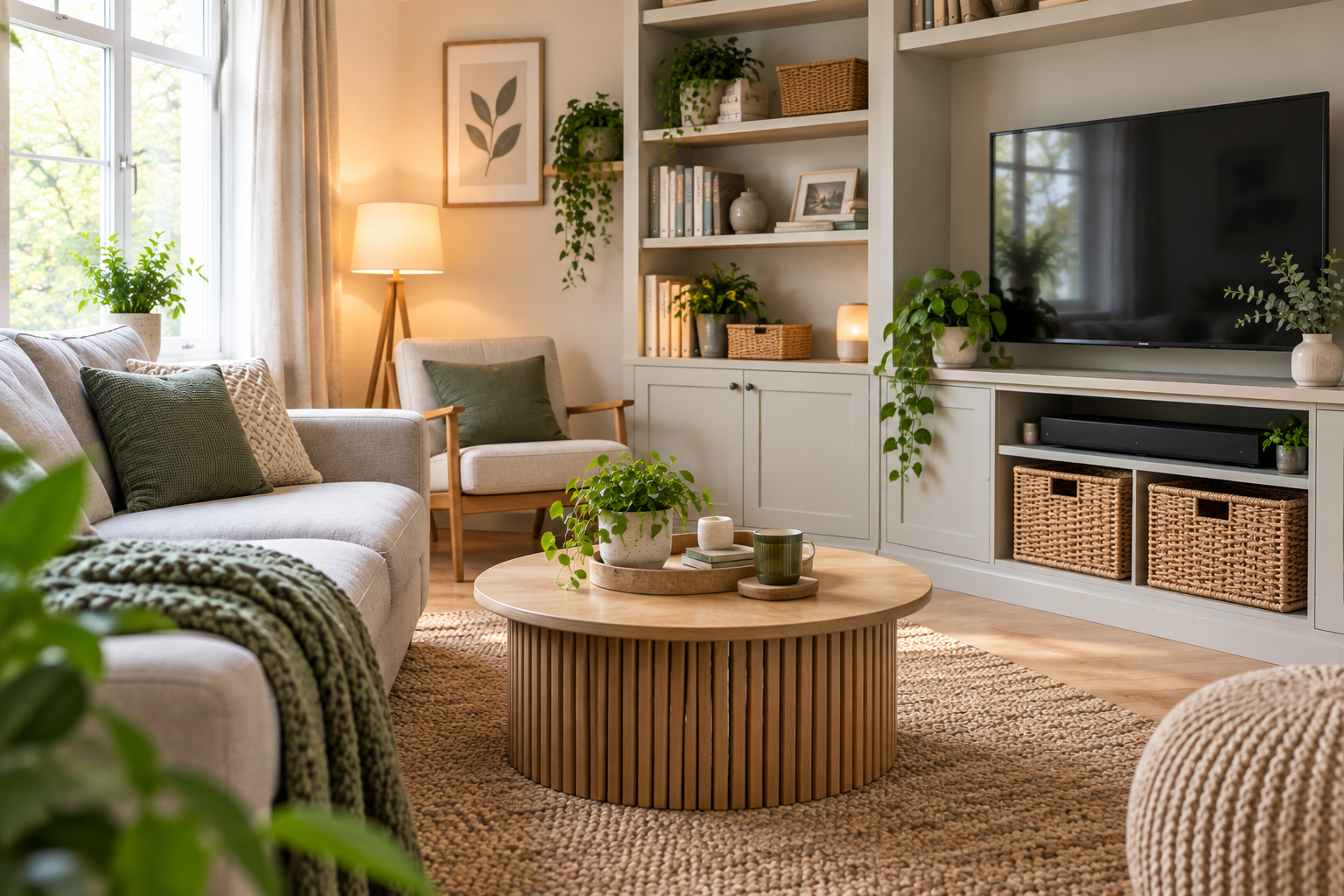
A small living room can be surprisingly difficult to keep organised.
Unlike a spare bedroom or cupboard, the living room is usually in constant use. It’s somewhere to relax, watch television, read, entertain visitors and spend time with family. In smaller homes, it might also double as a dining room, home office, play space or occasional guest room.
That means a lot of different belongings can gradually find their way into one relatively small space.
Books gather beside the sofa. Chargers appear on side tables. Throws get folded over chairs. Remote controls disappear between cushions. Paperwork arrives from elsewhere in the house, while games, toys and hobby supplies need somewhere to live too.
The obvious response is often to add more storage.
But in a small living room, that can create another problem.
Every extra cabinet, basket and shelving unit takes up space of its own. Add enough of them and you may technically have more storage while having less room to actually live in.
A better approach is to make the storage you already have work harder — and to be more selective about what deserves space in the room in the first place.
A small living room doesn’t need somewhere to store everything. It needs storage that protects the space you actually use for living.
Here are 15 practical ways to do that.
Before You Buy More Storage, Work Out What the Room Needs to Hold
Before buying another cabinet or storage basket, take a look at what is actually being stored in your living room.
Start with the things you regularly use there.
That might include:
- Remote controls
- Chargers and headphones
- Books and magazines
- Throws
- Games
- Children’s toys
- Television equipment
- Work equipment
- Hobby supplies
These are reasonable things to accommodate because they’re connected to activities that happen in the room.
Then look at everything else.
Old paperwork, unused cables, seasonal decorations, spare bedding, clothes and belongings that have simply migrated from another part of the house don’t necessarily need permanent living-room storage.
This distinction matters.
If you create storage for everything currently sitting in the room, you may simply make clutter permanent.
Remove what doesn’t belong first. Then you can see what storage problem actually remains.
If you’re reorganising more than one room, our guide to small-space storage ideas covers practical ways to find useful storage throughout a compact home.
1. Choose a Coffee Table That Earns Its Floor Space
A coffee table occupies valuable space in the middle of a small living room, so it’s worth asking it to do more than provide somewhere to put a mug.
If you’re replacing an existing table, consider one with built-in storage.
Depending on how you use the room, that might mean:
- A shelf underneath
- Drawers
- Lift-up storage
- A hinged top
- Nesting sections
The important thing isn’t simply having the largest storage compartment possible.
Think about what you actually need close to the sofa.
A shelf might be enough for a few books and magazines. A drawer can contain remotes and chargers. Hidden storage may work better for games, blankets or children’s toys.
Also consider how easily you can reach the storage.
A large lift-up coffee table might look useful until you realise that opening it means moving everything sitting on top.
Nookcroft tip
If your existing coffee table works perfectly well, don’t replace it purely to gain storage.
A simple basket underneath an open table may solve the same problem for considerably less money.
2. Use an Ottoman for Things You Want Nearby but Not Visible
An ottoman or storage footstool can be particularly useful in a small living room because it can perform several jobs without necessarily requiring another dedicated piece of storage furniture.
Depending on its size and construction, it might work as:
- A footstool
- Occasional seating
- A small table when used with a suitable tray
- Hidden storage
The best things to keep inside are usually soft or occasional items such as throws, spare cushion covers, board games or children’s toys.
Try not to treat it as somewhere to hide random clutter.
If everything gets swept inside whenever the room needs tidying, you’ll eventually end up with a box full of things you can’t find.
Give the storage a purpose and it becomes much easier to maintain.
3. Make the TV Area Do More Than Hold the Television
The area around the television can quickly become one of the busiest parts of a living room.
There may be a television, router, streaming device, games console, controllers, remote controls, cables and perhaps speakers all competing for space.
Instead of storing these things separately around the room, treat the TV area as one storage zone.
A TV unit with drawers or cupboards can keep equipment together while hiding much of the visual clutter.
Before buying anything, check the dimensions of the equipment you already own. Make sure there is suitable space around electronics, follow manufacturer guidance on ventilation, and avoid trapping or tightly bending cables behind furniture.
You don’t necessarily need a large media wall or fitted unit.
In a very small room, a simple low cabinet with a couple of useful compartments may be enough.
The goal is containment, not filling the entire wall with furniture.
4. Use the Wall Above Furniture You Already Have
When floor space is limited, the walls become much more useful.
But that doesn’t mean every wall needs shelving.
One of the easiest ways to add storage without changing the room’s footprint is to use suitable wall space above furniture that’s already there.
Possible locations include:
- Above a sofa
- Above a desk
- Above a low cabinet
- Above a television unit
A shelf can provide somewhere for books, small baskets or objects you genuinely want to display.
Just be careful with depth and positioning.
Deep shelves above seating can feel intrusive, particularly if they’re close to head height. Avoid positioning heavy or poorly secured objects where they could fall onto seating or frequently used areas.
Anything mounted to a wall also needs suitable fixings for the wall construction and the load it will carry.
Nookcroft tip
You don’t have to fill a shelf from end to end.
Leaving some empty space can make a small room feel calmer while still giving you useful storage.
5. Choose Tall Storage Before Wide Storage
A small living room may have very little spare floor space but considerably more unused height.
That’s why tall, relatively shallow furniture can sometimes work better than a long, low cabinet.
A narrow bookcase or tall cupboard can provide several levels of storage while occupying a fairly small footprint.
The important word is shallow.
A tall unit that’s too deep can still dominate the room and reduce the space available for walking past furniture.
Measure the floor area as well as the height, and check whether doors or drawers will have enough room to open comfortably.
Tall furniture may also need securing to the wall to reduce the risk of tipping. Follow the manufacturer’s instructions and use appropriate fixings for your wall type.
Where possible, put frequently used belongings within comfortable reach and reserve the highest shelves for lighter, occasional-use items.
6. Turn Alcoves Into Useful Storage Zones
Alcoves are common in many UK living rooms, particularly in homes with chimney breasts.
They can also be frustrating.
Standard furniture rarely fits the space perfectly, leaving awkward gaps at the sides or wasted room above.
Instead of treating an alcove as an inconvenient leftover space, consider giving it a clear job.
It could become:
- A bookcase
- A media area
- A small desk
- Shelving
- Closed cupboard storage
- A combination of cupboards below and shelves above
Built-in storage can make particularly good use of unusual dimensions, but it isn’t the only option.
A carefully measured freestanding bookcase or cabinet may achieve much of the same effect for less money and can move with you if you rent.
Before ordering furniture, measure the alcove at several points.
Older walls aren’t always perfectly straight, and the width at the front may differ slightly from the width at the back.
Also check for sockets, vents, radiators, skirting boards and other features that could affect how furniture fits.
7. Look Under the Sofa Before Adding Another Cabinet
Under-sofa storage isn’t possible with every sofa, but where there is enough clearance it can provide useful space without adding any new furniture.
Shallow containers can work for things such as:
- Board games
- Spare throws
- Puzzle boxes
- Children’s activities
- Occasional hobby supplies
Measure carefully before buying containers.
Check both the height beneath the sofa and the space between the legs.
It’s also worth thinking about access.
If you have to move a heavy coffee table every time you want something, the storage probably isn’t suitable for belongings you use regularly.
Make sure anything stored underneath doesn’t interfere with moving or reclining mechanisms, electrical components or the safe use of the sofa.
And don’t fill the entire area automatically.
Leaving some open space underneath furniture can make a compact room feel lighter and also makes cleaning easier.
8. Give Everyday Clutter One Easy Place to Land
Some clutter exists because an item doesn’t have an obvious home.
Remote controls are a good example.
If there isn’t a specific place to put them, they’ll end up on the sofa, windowsill, coffee table or wherever someone last used them.
The same applies to chargers, headphones, reading glasses and other small everyday belongings.
Create one easy-to-reach place for these items.
It could be:
- A coffee-table drawer
- A small tray
- A shallow basket
- A side-table drawer
- One compartment inside the TV unit
The location matters more than the container.
If people naturally use an item while sitting on the sofa, storing it on the other side of the room makes the system harder to maintain.
Good storage should make putting something away almost as easy as leaving it out.
9. Balance Open and Closed Storage
Open shelving can make a living room feel personal.
Books, photographs, plants and favourite objects can all contribute to the character of the room.
But open storage also exposes everything to view.
In a small space, shelves packed with unrelated objects can quickly create visual clutter even when everything is technically organised.
Closed storage is useful for the less attractive necessities of everyday life.
Think:
- Chargers
- Spare cables
- Paperwork
- Games
- Toys
- Technology accessories
Then use open shelves more selectively.
You don’t have to choose entirely open or entirely closed storage.
Often the most practical arrangement is a mixture of both.
A cabinet with doors below and open shelving above, for example, allows you to hide everyday clutter while keeping a smaller number of books or favourite objects on display.
10. Use Baskets to Contain Categories, Not Disguise Chaos
Baskets are one of the easiest storage solutions to add to a living room.
They’re also very easy to misuse.
Buying several attractive baskets doesn’t automatically make a room organised.
Each one needs a job.
You might have:
- One basket for throws
- One for children’s toys
- One for magazines
- One for knitting or hobby supplies
- One for gaming accessories
That makes it easy to put things away and, importantly, find them again.
Avoid creating a collection of miscellaneous baskets filled with unrelated objects.
If you can’t remember what’s inside without searching through them, the system probably needs simplifying.
A basket can hide clutter from view.
It can’t decide whether you still need the clutter.
11. Use Awkward Corners Carefully
A spare corner can look like the perfect place to squeeze in another piece of storage.
Sometimes it is.
A narrow shelving unit, small cabinet or movable trolley can turn an otherwise unused corner into useful space.
But corners also affect how you move through a room.
Before filling one, look at the routes you naturally take between the door, sofa, window and other furniture.
Storage that sticks into one of those routes may become irritating very quickly.
A useful test is to temporarily mark out the proposed furniture’s footprint with masking tape or place an object of roughly the same size in the space.
Live with it for a day or two.
If you keep walking around it, catching it or wishing it wasn’t there, a permanent cabinet probably isn’t the answer.
12. Make a Living-Room Workspace Disappear at the End of the Day
In a small flat or house, the living room may also have to function as a home office.
The challenge isn’t necessarily fitting in a desk.
It’s stopping work from gradually taking over the room.
If possible, give work equipment a defined storage space that can be closed or cleared at the end of the day.
That might be:
- A desk with drawers
- A small cabinet beside the desk
- A box for laptop accessories
- A trolley that can be moved away
- A shelf for notebooks and paperwork
Try to keep work storage close to where you actually work.
Otherwise, chargers, notebooks and paperwork are likely to migrate onto the coffee table.
If your dining table doubles as a desk, a portable box or small trolley can be particularly useful.
At the end of the working day, everything goes back inside and the table becomes part of the living space again.
That small routine can help one room perform two jobs without permanently looking like both.
13. Use Renter-Friendly Storage That Can Move With You
Renting can make living-room storage slightly more complicated.
Built-in cupboards and permanent shelving may not be realistic, while drilling or making other alterations may require permission depending on your tenancy.
Fortunately, many useful living-room storage ideas don’t need to be permanent.
Consider:
- Freestanding bookcases
- Storage ottomans
- Tall cabinets
- Trolleys
- Baskets
- Storage coffee tables
- Freestanding ladder-style shelving
If you’re considering adhesive hooks, strips or other temporary fixings, check whether they’re suitable for the surface and follow the manufacturer’s instructions.
Even products described as removable can potentially mark delicate paint or wallpaper.
Check your tenancy agreement before drilling, decorating or making other changes where permission may be required.
Our guide to renter-friendly storage ideas has more ways to create useful storage without making major permanent changes to your home.
Nookcroft tip
If you expect to move again, favour storage that isn’t dependent on the exact dimensions of one particular room.
A useful cabinet that can move with you may prove more valuable than something designed specifically for one awkward gap.
14. Rotate Things You Don’t Need All Year
Prime living-room storage should go to things you actually use.
But cupboards and drawers often become filled with belongings that only appear occasionally.
That might include:
- Heavy winter throws
- Seasonal decorations
- Occasional games
- Spare cushion covers
- Hosting supplies
If something is used once or twice a year, ask whether it needs to occupy your most convenient living-room storage all year.
You may have more appropriate space elsewhere in the home.
Seasonal rotation can help too.
A thick blanket that’s used every evening in January might deserve a basket beside the sofa.
In July, that same basket could hold something more useful while the blanket is stored somewhere clean and dry elsewhere.
Storage doesn’t have to remain identical throughout the year.
15. Decide What Doesn’t Belong in the Living Room at All
This may be the most useful storage idea in the entire list.
Not everything needs a living-room storage solution.
Sometimes the reason a room feels difficult to organise is simply because it’s being asked to hold too much.
Take a look through your cupboards, baskets and shelves.
You may find:
- Paperwork that belongs with household documents
- Clothes that belong in the bedroom
- Tools that could live elsewhere
- Unused technology
- Children’s belongings that are no longer used
- Books you’re unlikely to read again
- Decorative objects you don’t particularly like
Moving an item to a more appropriate room is sometimes enough.
Other things may be ready to donate, sell, recycle or dispose of responsibly.
This doesn’t mean creating a minimalist living room.
It’s simply about being selective.
Every item you remove is one less thing you need to find storage for.
How to Make a Small Living Room Feel Less Cluttered
Good storage isn’t only about how much you can fit into a room.
It’s also about how the room feels when you’re using it.
A few changes can make a compact living room feel noticeably calmer.
Keep the main walking route clear
Think about how you move from the doorway to the sofa and through to any adjoining rooms.
Try not to place storage furniture where it narrows these routes unnecessarily.
Even a relatively small cabinet can make a room feel cramped if you’re constantly walking around it.
Leave some surfaces partially empty
You don’t have to use every available surface for storage or display.
A coffee table with one or two objects can feel very different from one covered in remotes, books, candles, chargers and decorative accessories.
The same applies to shelving.
A little empty space gives the eye somewhere to rest.
Be cautious with lots of small furniture
Several small tables, baskets, shelving units and cabinets can sometimes make a compact room feel more crowded than one or two well-chosen pieces.
Before adding another piece, ask whether something already in the room could do the same job.
Keep frequently used things accessible
Storage systems are much easier to maintain when the things you use every day are simple to put away.
Don’t store the television remote in a difficult cupboard while giving prime drawer space to something you use twice a year.
Convenience matters.
Let some floor remain visible
Storage furniture doesn’t have to occupy every available gap.
Visible floor around and beneath furniture can help a compact room feel less packed.
Sometimes leaving a small space empty is more useful than squeezing another basket into it.
Where to Start on a Small Budget
Improving living-room storage doesn’t have to begin with buying furniture.
In fact, the cheapest first step is usually to remove everything that doesn’t need to be there.
Then identify the single storage problem causing the most frustration.
Perhaps toys are constantly spread across the floor.
Maybe the coffee table is permanently covered in chargers and paperwork.
Perhaps work equipment never gets put away.
Or you may have plenty of storage already, but it’s being used badly.
Solve that problem first.
You might be able to reorganise an existing drawer, move a basket from another room or clear a shelf without spending anything.
If you do need to buy something, measure carefully and look for one solution that addresses a genuine problem rather than several small purchases that each solve part of it.
Second-hand furniture can also be worth considering. Bookcases, cabinets, trunks and side tables are often available locally for less than buying new, although you should check their condition, stability and suitability before bringing them into your home.
The aim isn’t to create a completely new living room.
It’s to make the one you already have work better.
Common Small Living Room Storage Mistakes
Buying storage before measuring
A cabinet might look slim online but feel enormous once it’s inside a small room.
Measure the available width, depth and height.
Then consider doors, drawers, skirting boards, radiators, sockets and the space required to walk past.
Adding too many small storage pieces
One basket becomes three baskets.
Then a trolley arrives.
Then a narrow shelving unit.
Individually they may all be useful, but together they can create more visual clutter than the belongings they’re supposed to organise.
Filling every wall
Vertical storage can be extremely useful, but that doesn’t mean every wall needs shelving or cabinetry.
A room still needs visual breathing space.
Choosing furniture that’s too deep
Depth is easy to overlook.
A cabinet that projects too far into the room can have a much bigger effect on circulation than its width suggests.
Mark the footprint on the floor before buying if you’re unsure.
Treating display space as storage space
Open shelves full of objects aren’t necessarily solving your storage problem.
Ask whether you’re displaying something because you enjoy seeing it or simply because there’s nowhere else to put it.
Keeping things just because you have somewhere to hide them
Hidden storage is useful, but it can also make it easier to keep belongings you no longer need.
Occasionally empty drawers, baskets and cupboards completely and reassess what’s inside.
Storage should support the things you use and value — not simply postpone decisions about them.
Frequently Asked Questions
How do I add storage to a very small living room?
Start by making better use of space that’s already occupied.
A coffee table, ottoman or TV unit with storage can provide additional capacity without necessarily increasing the number of pieces of furniture in the room.
You can then look at underused vertical space, alcoves and carefully chosen narrow furniture.
Before adding anything, remove belongings that don’t need to be stored in the living room.
Is open or closed storage better in a small living room?
Usually, a combination works well.
Closed storage can hide visually busy items such as cables, games and paperwork, while open shelves can hold books and a smaller number of decorative objects.
Too much open storage can make a compact room feel cluttered, while entirely closed storage may not suit belongings you want to access or display.
Choose according to what you’re actually storing rather than how the furniture looks when empty.
What can I store under a sofa?
If your sofa has enough clearance, shallow containers can hold relatively flat or occasional items such as games, puzzles, spare throws or hobby supplies.
Measure the space carefully and make sure stored items don’t interfere with moving parts, electrical components or the safe use of the furniture.
Avoid storing anything that could be damaged by the conditions underneath the sofa.
How can renters add more living-room storage?
Freestanding furniture is usually the easiest place to start.
Bookcases, cabinets, storage ottomans, coffee tables, baskets and trolleys can all add storage without becoming permanent parts of the property.
If you want to attach anything to walls or make alterations, check your tenancy agreement and obtain any permission required.
For more ideas throughout a rented home, see our guide to renter-friendly storage ideas.
How do I hide clutter without making my living room feel smaller?
Rather than adding lots of separate storage containers, try to consolidate belongings into a smaller number of useful pieces.
Closed cabinets, drawers and multifunctional furniture can hide visual clutter while keeping surfaces clearer.
It also helps to leave some shelving, wall space and floor area deliberately empty.
And remember that hiding something isn’t the same as organising it.
If storage is constantly overflowing, reducing what you’re storing may be more effective than finding another place to put it.
Final Thoughts
Small living rooms have to work hard.
They’re often expected to accommodate several different activities while remaining somewhere comfortable to relax at the end of the day.
That doesn’t mean every spare corner needs a cabinet or every wall needs shelves.
Start with what you actually use.
Remove what doesn’t need to live in the room.
Then look for storage that uses the space you already have more effectively — whether that’s a coffee table with a drawer, an organised TV unit, a useful alcove or one basket that finally gives everyday clutter somewhere to go.
The most successful small living-room storage isn’t necessarily the solution that holds the most.
It’s the one that gives you more of your living room back.
And if you’re looking beyond the living room, our guide to small-space storage ideas has more practical ways to make better use of storage throughout a compact home.