
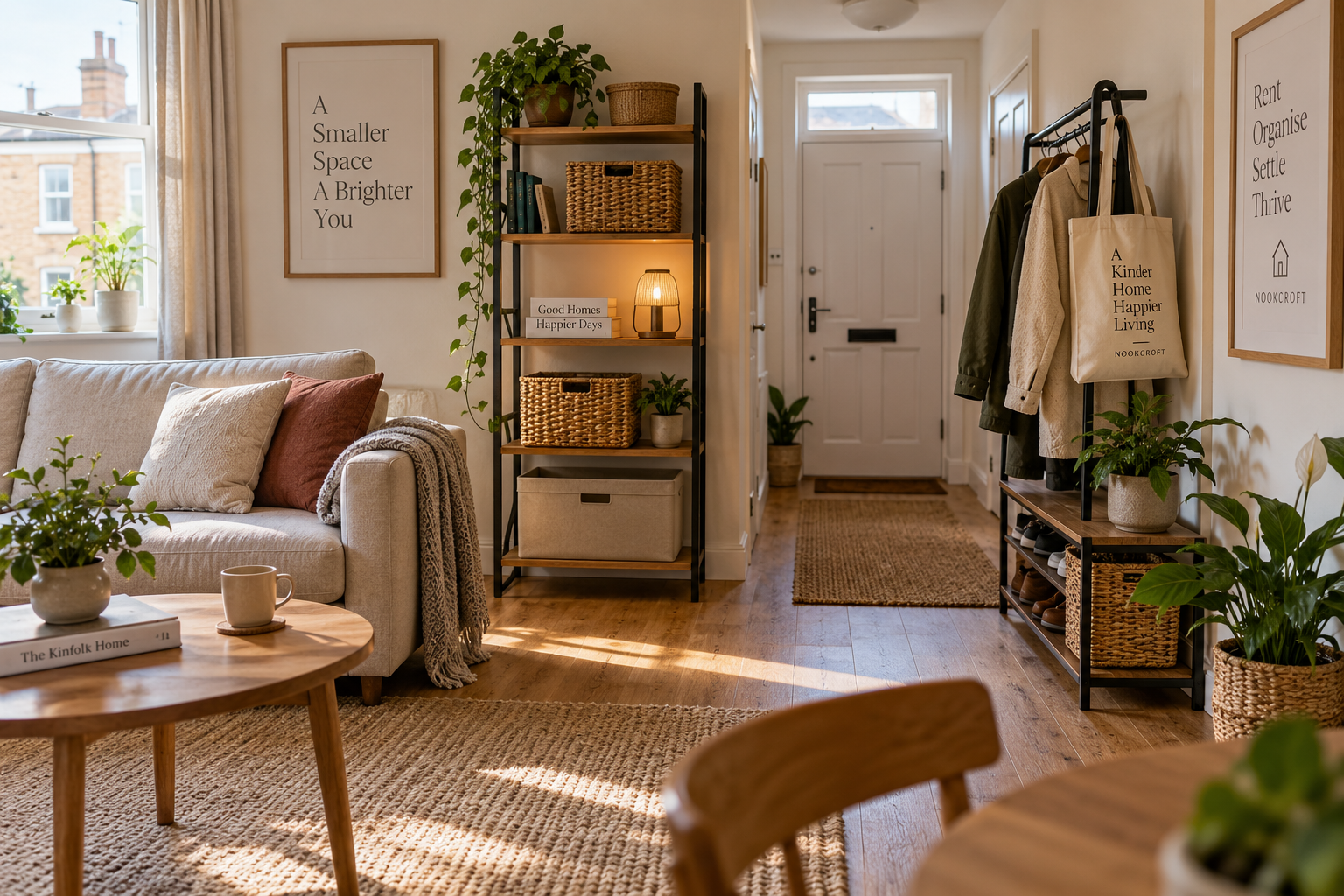
Finding enough storage in a rented home can be difficult, especially when you can’t simply put up shelves, build fitted cupboards or start drilling into walls.
For renters, a good storage solution needs to do more than create extra space. Ideally, it should be affordable, require little or no permanent alteration to the property and be something you can take with you when you eventually move.
Fortunately, creating useful storage doesn’t necessarily mean changing the building itself.
Freestanding furniture, overlooked spaces and a few carefully chosen organisers can make a surprising difference — whether you’re dealing with a small flat, a rented room or a house where storage was clearly an afterthought.
This guide looks at practical ways to create more storage in a rented home without relying on major alterations.
Quick answer: Start with storage that doesn’t need fixing to the building. Freestanding shelving, under-bed storage, over-door organisers, storage furniture and removable cupboard organisers can all create additional space without drilling into walls. Be cautious with adhesive products too — removable doesn’t always mean damage-free, particularly on older or poorly prepared paintwork.
Before you add storage, check what your tenancy allows
Before making changes to a rented home, check your tenancy agreement and any guidance provided by your landlord or letting agent.
Some landlords may allow small alterations with permission, while others may have stricter rules around drilling, decorating or attaching things to walls.
It’s also worth being careful with products marketed as removable. Adhesive hooks, strips and mounting products can be useful, but they aren’t guaranteed to come away cleanly from every surface. Older paint, wallpaper and poorly prepared walls can be particularly vulnerable.
If you’re unsure, choose storage that doesn’t rely on the building at all.
Freestanding and removable solutions have another advantage: when you move, the storage can move with you.
Nookcroft tip: Before buying something that needs drilling, sticking or mounting, ask yourself whether a freestanding alternative could solve the same problem.
1. Use freestanding shelving instead of wall-mounted shelves
Wall-mounted shelves can provide useful storage, but they aren’t always practical in a rented property.
A freestanding shelving unit can achieve much the same thing without requiring holes in the wall — and unlike fitted storage, you can take it with you when you move.
Look for shelving that makes good use of vertical space without taking up too much floor area. A tall, relatively narrow unit can be particularly useful in smaller living rooms, bedrooms and home-working areas.
Think about what you actually need to store before choosing one. Open shelves can work well for books, baskets and everyday belongings, while a unit combining open shelving with cupboards or drawers can hide items you’d rather not have permanently on display.
Measure the available floor space, height and any nearby skirting boards before buying. In an older UK property, walls and floors aren’t always perfectly straight, so measurements taken at more than one point can be useful.
Tall furniture may also need securing to reduce the risk of tipping, particularly in homes with children or pets. If a unit requires wall restraint, check the manufacturer’s safety instructions and discuss any necessary fixing with your landlord or letting agent rather than simply leaving it unsecured.
Before you buy: Consider whether the shelving would still be useful in a different room or a future home. Flexible furniture is usually a better investment for renters than something bought to fit one very specific space.
2. Make better use of the space under your bed
In a small rented bedroom, the space beneath the bed can be some of the most useful storage in the room.
It requires no changes to the property, keeps belongings out of sight and can provide a surprising amount of capacity for things you don’t need every day.
Start by measuring the clearance between the floor and the underside of the bed frame. Don’t assume that a box labelled as under-bed storage will fit — even a difference of a few centimetres can make it unusable.
Low storage boxes can work well for spare bedding, towels, seasonal clothing and shoes. Containers with lids may also help protect belongings from dust, particularly if they’re going to remain there for several months.
If the bed is particularly low, resist immediately buying bed risers simply to create more storage. Check that they’re suitable for your particular bed frame and won’t affect its stability.
It’s also worth avoiding the temptation to fill every centimetre beneath the bed. Storage is only useful if you can still reach what you’ve put there.
Items used occasionally can go towards the centre, while things you reach for more regularly should remain closer to the edges.
Nookcroft tip: Before buying under-bed containers, use a tape measure to check the height, width and depth available. Then leave yourself a little clearance so the boxes can actually slide in and out easily.
3. Add over-door storage
The back of a door can provide useful storage without taking up any additional floor space.
Over-door organisers are particularly useful for renters because many simply hook over the top of the door rather than requiring screws or permanent fixings.
Depending on the room, they can provide storage for shoes, accessories, toiletries, cleaning supplies or smaller everyday items that otherwise end up taking over drawers and cupboards.
Before buying one, check the thickness of the door and the size of the hooks. You also need enough clearance between the top of the door and the frame for the organiser to fit without preventing the door from closing properly.
Think about weight too. A lightweight fabric organiser filled with smaller belongings is very different from hanging several heavy baskets from a door. Follow the manufacturer’s guidance and avoid loading a door with more weight than the product or hinges are designed to support.
It’s also worth considering noise and movement. Hard organisers can knock against the door whenever it opens, so soft-backed or fabric designs may be more suitable for bedrooms.
Over-door storage won’t suit every door or every property, but where it works, it can turn an otherwise unused surface into genuinely useful storage.
Before you buy: Measure the door thickness and the gap above it. An over-door organiser isn’t renter-friendly if it stops the door from closing.
4. Use tension rods where appropriate
A tension rod can create useful hanging or dividing space without screws, provided it’s used in a suitable location and within the manufacturer’s limits.
Rather than being fixed into the wall, a tension rod is held between two opposing surfaces using pressure. That can make one useful in certain cupboards, wardrobes and alcoves where the dimensions allow it.
For example, a small tension rod inside a suitable cupboard could potentially hold lightweight cleaning cloths or spray bottles by their trigger handles. In a wardrobe or recessed space, a correctly rated rod may provide additional hanging space for lightweight items.
But tension rods aren’t suitable for every job.
The surfaces at either end need to be strong and appropriate for pressure, and the rod needs to be correctly sized for the gap. Too little tension may cause it to fall; excessive pressure could mark or damage a weaker surface.
Don’t use a lightweight tension rod for heavy clothing, cookware or anything that could cause injury or damage if it falls.
And, as with adhesive products, “no drilling” doesn’t automatically mean “no risk of damage.”
Nookcroft tip: Treat the weight rating as a limit, not a target. Tension storage works best for lighter items where a failure would be inconvenient rather than dangerous.
5. Choose furniture with hidden storage
When floor space is limited, furniture that performs more than one job can be particularly useful.
Instead of adding a separate storage unit, look at whether furniture you already need could provide storage as well.
An ottoman or storage bench can provide somewhere to sit while hiding spare bedding, bags or other belongings. A coffee table with drawers or an internal compartment can keep smaller living-room items out of sight, while a bed with built-in drawers can provide substantial storage without requiring another piece of furniture.
This doesn’t mean every item of furniture needs a hidden compartment.
The important question is whether the storage is genuinely useful. A large storage ottoman isn’t particularly helpful if it makes a small room difficult to move around, and complicated mechanisms can be frustrating if you need to move several things every time you want to access what’s inside.
For renters, portability matters too. Very large or heavy pieces of furniture can become difficult and expensive to move when a tenancy ends.
Before buying something new, think about the furniture you’re likely to need in your next home as well as your current one.
Before you buy: Measure the furniture itself, but also measure the space needed to open drawers, lift lids or access compartments. Storage isn’t useful if you can’t comfortably get into it.
6. Use a freestanding garment rail
If wardrobe space is limited, a freestanding garment rail can provide additional hanging space without altering the room.
This can be particularly useful in rented bedrooms with small built-in wardrobes, or in properties where a full additional wardrobe would take up too much space.
The simplest rails have a relatively small footprint and can be moved easily. Some designs also include a lower shelf for shoes or boxes, giving you two forms of storage in roughly the same area.
The downside is that everything remains visible.
An overcrowded garment rail can quickly make a small bedroom feel more cluttered, so it’s usually better used for a controlled selection of clothing rather than as somewhere to squeeze in everything that won’t fit in the wardrobe.
You could use one for the clothes you wear most often, workwear or a rotating selection of seasonal items while less frequently used clothing remains elsewhere.
Check the rail’s dimensions and weight capacity before buying, particularly if you intend to hang coats or heavier clothing.
And consider where it will stand. Leaving enough room around doors, drawers and walkways is more important than gaining a few extra centimetres of hanging space.
Nookcroft tip: If a garment rail becomes permanently packed from end to end, the problem may no longer be a lack of hanging space. It may be worth reviewing what you actually wear before adding another rail.
7. Add shelf risers inside cupboards
Cupboards often have more usable space than they first appear to.
If there’s a large gap between the top of your mugs, tins or bowls and the shelf above, a freestanding shelf riser can create an additional level without making any permanent changes to the cupboard.
This can be particularly useful in kitchens, bathroom cupboards and utility areas where smaller items otherwise end up stacked on top of one another.
Before buying a riser, check whether the existing shelves can simply be repositioned. Many kitchen cupboards have adjustable shelf supports, and moving a shelf by a few centimetres may solve the problem without adding anything at all.
If a riser would genuinely help, measure the internal width, depth and height of the cupboard rather than relying on its external dimensions.
Also think about what will sit underneath it. Creating another shelf isn’t much use if the space below becomes too cramped to access comfortably.
Because shelf risers simply sit inside the cupboard, they’re particularly useful for renters: there’s nothing to drill, stick or leave behind when you move.
Nookcroft tip: Empty the cupboard and experiment with the existing shelf positions first. Buy a riser only if you can identify exactly what will live above and below it.
8. Use removable baskets in deep cupboards
Deep cupboards can hold plenty of belongings while still being frustrating to use.
Items gradually migrate towards the back, smaller things disappear behind larger ones and eventually you forget what is actually stored there.
A simple removable basket can turn part of a deep cupboard into a basic pull-out system without installing runners or permanent fittings.
Group similar items together inside the basket so you can pull the whole category forward when you need something. This can work particularly well for packets, baking supplies, cleaning products, toiletries or other smaller items that are difficult to see when stored individually.
You don’t necessarily need specialist storage containers either. If you already own a suitably sized basket or box, try that first.
Avoid filling a basket until it becomes too heavy to lift or slide comfortably, particularly if it’s being stored above shoulder height.
And don’t sacrifice accessibility simply to fit more into the cupboard. The purpose of the basket is to make the space easier to use, not just increase the number of things you can squeeze into it.
9. Create storage above a wardrobe
The space between the top of a wardrobe and the ceiling is often overlooked, particularly in rooms where fitted storage is limited.
If your wardrobe doesn’t reach the ceiling, the top can potentially provide useful storage for belongings you don’t need regularly.
Lidded boxes or lightweight baskets can work well for seasonal clothing, spare bedding or other occasional items. Keeping similar things together also makes it easier to remember what’s actually stored up there.
Try to avoid turning the top of the wardrobe into a collection of loose belongings. Apart from looking cluttered, individual items can be awkward to retrieve and collect dust quickly.
Weight matters too.
Check that the wardrobe is suitable for anything you intend to place on top of it, and avoid storing particularly heavy objects overhead. You should also be able to retrieve stored items safely rather than balancing on unsuitable furniture to reach them.
If you need regular access to something, the top of a wardrobe probably isn’t the right place for it.
For renters, this kind of storage has an obvious advantage: nothing needs attaching to the property, and the containers can move with you.
Nookcroft tip: Use high storage for low-frequency belongings. The harder something is to reach, the less often you should need it.
10. Use narrow freestanding storage in awkward gaps
Small rented homes often contain narrow spaces that aren’t large enough for conventional furniture but are still wide enough to be useful.
You might find one beside a wardrobe, between a washing machine and a nearby unit, alongside a desk or at the end of a kitchen cabinet run.
A slim freestanding unit or narrow trolley can sometimes turn that gap into useful storage without requiring any permanent installation.
But this is one of those situations where measuring carefully matters.
Check the width at the front and back of the gap, particularly in older properties where walls may not be perfectly straight. Account for skirting boards, radiator pipes, sockets and anything else that reduces the usable dimensions.
If you’re considering a trolley or pull-out unit, make sure there is enough room in front of it to actually pull it out.
And don’t feel that every narrow gap needs filling. Sometimes leaving a little breathing room around furniture makes a small space feel better than squeezing storage into every available centimetre.
Before you buy: Measure the narrowest point of the gap and leave a little clearance. A unit that only just fits on paper can easily become wedged once skirting boards or uneven walls are taken into account.
Looking for more ways to use awkward spaces? Our guide to 12 Small-Space Storage Ideas That Actually Work in UK Homes covers under-stairs storage, alcoves, narrow gaps and other overlooked areas around the home.
11. Make better use of kitchen cupboard doors
The inside of a kitchen cupboard door can provide a small amount of useful storage without taking up additional floor or worktop space.
For renters, the key is choosing a solution that doesn’t require permanent fixing.
Over-door cupboard organisers are available for lightweight items, while some storage products simply hook over the top edge of the door. Depending on the cupboard, these might provide somewhere for cloths, lightweight cleaning equipment or smaller kitchen accessories.
Before adding anything, check the clearance inside the cupboard.
An organiser may fit perfectly on the door but still collide with shelves, pipework or the contents of the cupboard when you try to close it.
Weight is important too. Cupboard doors and hinges weren’t designed to become heavily loaded storage systems, so keep anything attached to them relatively light and follow the organiser manufacturer’s guidance.
Be particularly cautious with adhesive racks or hooks. Kitchen surfaces can be exposed to heat, moisture and grease, while removing adhesive from painted or laminated finishes may cause damage.
Sometimes the simplest solution is also the safest: if a small over-door organiser doesn’t work comfortably, use the cupboard itself rather than forcing additional storage onto the door.
For more kitchen-specific ideas: Our guide to How to Organise a Small Kitchen Without Adding More Cupboards looks at practical ways to make better use of cupboards, drawers and worktops in a compact kitchen.
Nookcroft tip: Test the door several times after adding an organiser. It should open, close and sit normally without rubbing against the frame or pushing into the cupboard contents.
12. Use rolling storage that can move with you
A small wheeled trolley can provide flexible storage in places where fitted furniture isn’t practical.
Depending on its size, one might work in a kitchen, bathroom, home-working area or utility space. The advantage is that it can be moved when you need access to something behind it — and taken with you when your tenancy ends.
In a kitchen, a trolley might hold frequently used ingredients or equipment that would otherwise occupy valuable worktop space. Elsewhere, it could provide storage for toiletries, craft supplies, paperwork or other everyday belongings.
Look carefully at the dimensions before buying one.
A narrow trolley may appear ideal for an awkward gap, but remember that you need enough room to roll it in and out. Wheels, handles and raised edges can also make the overall dimensions slightly larger than the usable shelves suggest.
Consider the floor surface as well. A loaded trolley should move safely and shouldn’t scratch or mark flooring as it’s repeatedly moved.
And avoid treating wheels as an excuse to overload it. A smaller selection of organised belongings will generally be easier to use than several shelves packed with unstable items.
For renters who expect to move again in the future, portability is a genuine advantage. Unlike fitted storage, a useful trolley can simply move to another room — or another home.
Before you buy: Ask yourself whether the trolley could serve another purpose elsewhere. The best renter-friendly furniture isn’t only movable; it’s adaptable.
13. Create a freestanding hallway drop zone
Hallways can become cluttered quickly, particularly when a rented home doesn’t have a dedicated coat cupboard or much built-in storage near the entrance.
Shoes, bags, keys, post and everyday belongings all need somewhere to go, and without an obvious home they tend to accumulate on floors, chairs and nearby surfaces.
Rather than mounting hooks or shelves to the wall, consider creating a small freestanding drop zone.
A compact shoe rack, narrow console, storage bench or freestanding coat stand can provide a defined place for the things you regularly bring into the house.
You don’t necessarily need all of these. In a particularly small entrance, a simple shoe rack with a basket for smaller belongings may be enough.
Keep the area proportionate to the space available. Hallways are routes through the home, so additional storage shouldn’t obstruct doors or make the entrance difficult to move through.
It’s also worth limiting what lives there. A drop zone works best for everyday belongings rather than becoming permanent storage for every coat and pair of shoes you own.
Nookcroft tip: Give the hallway enough storage for your normal daily routine, not your entire wardrobe. Seasonal and occasional items can usually live somewhere less convenient.
14. Use decorative baskets for open storage
Not everything in a rented home can be hidden behind cupboard doors.
When belongings need to remain visible, baskets can help turn open shelving, the space beneath a console or the top of a wardrobe into more organised storage.
They can work particularly well for things that don’t need individual compartments: spare blankets, cables, accessories, children’s belongings or other smaller items that otherwise make a room look cluttered.
Before buying a matching collection of baskets, decide exactly what each one will hold.
Storage containers take up space themselves, and several poorly sized baskets can sometimes make a shelf less efficient rather than more organised.
It’s often worth using containers you already own first. If the system works, you can replace them later if appearance matters to you.
For open storage, choose baskets that are easy to lift and access. Handles can be useful on higher shelves, while softer containers may be preferable around furniture where a rigid basket could scratch a surface.
And don’t forget what’s inside them. A basket can make clutter look tidier without actually reducing it.
Before you buy: Give the basket a job before you give it a space. Knowing what you’re storing makes it much easier to choose the right size and shape.
15. Add storage around — rather than onto — the sofa
The area around a sofa can provide useful storage without attaching anything to the walls.
A narrow side table with a shelf or drawer can give everyday items such as remote controls, chargers and books somewhere to live. If there’s enough space behind the sofa, a slim freestanding console may also provide a useful surface without taking much additional room from the living area.
Some sofas have enough clearance underneath for shallow storage too, although measure carefully before buying containers specifically for the space.
The important thing is not to surround the sofa with furniture simply because there are gaps available.
In a small living room, keeping comfortable routes around furniture is often more valuable than squeezing another storage unit into the room.
Start with the belongings that regularly create clutter around the sofa and find the smallest solution that gives those particular things a home.
Nookcroft tip: Solve the clutter first and choose the furniture second. A small side table with one useful drawer may be more valuable than a much larger storage unit.
16. Be cautious with adhesive hooks and strips
Adhesive hooks and removable mounting strips are frequently recommended to renters because they don’t require drilling.
They can certainly be useful, but “removable” shouldn’t be interpreted as a guarantee that they won’t leave a mark.
Results can depend on the product, surface, paint condition, preparation and how the adhesive is eventually removed. Older paintwork, wallpaper and previously damaged surfaces may be particularly vulnerable.
If you decide to use an adhesive product, read the manufacturer’s instructions carefully. Check which surfaces it is designed for, observe any weight limits and follow the recommended installation and removal process.
Avoid using adhesive fixings for valuable, heavy or potentially dangerous objects where failure could cause injury or significant damage.
And check your tenancy agreement before attaching things to walls, even when the product is marketed as renter-friendly.
Where you’re uncertain, a freestanding alternative removes much of that risk.
Nookcroft tip: “No nails” and “no damage” are not the same promise. Treat adhesive storage as a fixing method, not as permission to ignore the surface underneath it.
17. Invest in storage you can take to your next home
Renting often means accepting that your current home may not be your permanent one.
That makes portability one of the most useful qualities a storage solution can have.
Freestanding shelving, baskets, trolleys, storage benches and other adaptable pieces can potentially move between rooms and eventually between properties. Something bought for a bedroom today might become hallway, kitchen or office storage in a future home.
This doesn’t mean buying expensive furniture in the hope that you’ll keep it forever.
Instead, look for pieces that aren’t dependent on one very specific measurement or layout. Neutral, straightforward designs can often adapt more easily than something bought solely to fill an unusual gap in your current property.
Before spending money, think beyond the immediate storage problem.
Would you still have a use for this item if you moved next year?
If the answer is yes, it may represent much better value than a temporary solution that only works in your current home.
Before you buy: For renters, the true cost of storage isn’t only its price. Consider whether you’ll be able — and actually want — to take it with you when you move.
The best renter-friendly storage moves with you
Creating more storage in a rented home doesn’t have to mean drilling into walls or making permanent changes to the property.
Start with the space you already have.
Look beneath beds, above wardrobes, inside cupboards and at the awkward gaps that aren’t currently doing much. Then consider whether freestanding furniture, removable organisers or simply rearranging what you already own could make those spaces work harder.
Most importantly, don’t assume that every storage problem requires another product.
Sometimes removing things you no longer use, moving belongings closer to where they’re needed or reorganising an existing cupboard can make a bigger difference than adding another piece of furniture.
When you do need additional storage, look for solutions that are flexible enough to move between rooms — and eventually between homes.
That might mean a shelving unit that can serve several purposes, baskets that aren’t tied to one particular cupboard or a trolley that could work just as easily in a kitchen as it could in a home office.
And remember that renter-friendly doesn’t automatically mean damage-free. Adhesive products, tension fittings and other temporary solutions still need to be used appropriately, so check your tenancy agreement, follow the manufacturer’s instructions and ask your landlord or letting agent when you’re unsure.
A rented home may not be yours forever, but it still needs to work for you while you’re living there.
The best renter-friendly storage helps it do exactly that — without leaving you with a collection of holes, damaged paintwork or furniture you can’t use when it’s time to move