
Affiliate disclosure: As an Amazon Associate, Nookcroft earns from qualifying purchases. Some links in this article are affiliate links, which means we may earn a small commission if you make a purchase, at no additional cost to you.
A narrow hallway can quickly become cluttered with shoes. A couple of pairs of trainers by the front door might not seem like much, but add work shoes, children’s footwear and muddy boots, and suddenly there’s barely enough room to walk through.
The challenge isn’t simply finding somewhere to put everything. It’s finding shoe storage that fits without making your entrance feel cramped or creating an obstacle.
Fortunately, you don’t need a large hallway or expensive fitted furniture to keep footwear organised. From slim shoe cabinets and compact racks to simple storage trays and clever use of existing cupboards, there are practical options for different homes and budgets.
In this guide, we’ll explore 12 small hallway shoe storage ideas for narrow UK homes, explain how to measure your available space and look at solutions for renters who cannot drill into walls.
The aim is simple: keep the shoes you need accessible while making your hallway easier and safer to use.
The Best Shoe Storage for a Narrow Hallway: Quick Answer
The best solution depends on your hallway’s dimensions, how many people live in your home and whether you can install wall fixings.
Before buying anything, consider these starting points.
| Your hallway situation | Storage solution to consider |
|---|---|
| Very little floor space | Existing cupboard or shoe storage elsewhere |
| A narrow section of wall | Slim shoe cabinet, safely wall-fixed where required |
| Rented home without drilling permission | Low, stable freestanding rack where the manufacturer permits unanchored use |
| Several people sharing an entrance | Allocated spaces for everyday shoes |
| Awkward alcove or recess | Compact storage fitted within the available space |
| Room for seating | Properly rated shoe-storage bench |
| Wet shoes regularly left by the door | Shallow waterproof shoe tray |
For most narrow hallways, the priority should be reducing how many shoes need to stay by the front door, rather than trying to store your entire collection there.
If you’re looking for ways to organise coats, bags, keys and other entrance essentials too, see our broader guide to small hallway storage ideas.
Measure Your Hallway Before Buying Shoe Storage
One of the most common mistakes is choosing a shoe cabinet because it looks narrow in a photograph.
A cabinet that appears compact online can still make a small entrance awkward to use.
Taking a few measurements before buying can prevent wasted money and frustrating returns.
Measure the Narrowest Usable Width
Start by measuring the width of your hallway where you want to place the storage.
Measure from the wall to the opposite wall, or to any permanent obstruction.
If the hallway changes width, use the narrowest relevant measurement.
Next, check the depth of the proposed cabinet or rack.
For example:
- Hallway width: 120 cm
- Cabinet depth: 24 cm
- Remaining width: 96 cm
This calculation gives you an initial idea of the space left for walking.
However, 96 cm isn’t necessarily the actual usable clearance. Handles, open doors and other features can reduce it further.
There’s no single clearance measurement that makes every arrangement suitable. The safe, usable width depends on the property, its escape arrangements and the people using it.
Check Doors, Radiators and Other Obstructions
Your front door needs to open and close freely.
Before placing furniture nearby, check the full door swing, including the handle.
Also consider:
- Radiators and exposed pipework
- Skirting boards
- Electrical sockets
- Internal doors
- Stairs or changes in floor level
- Pushchairs, mobility aids or other equipment used in the household
Remember that flip-down cabinets need extra space when their compartments are open.
A unit might fit neatly when closed but become inconvenient when you’re taking shoes out.
Measure Your Shoes Too
Not all footwear fits the same storage.
A shallow cabinet that holds children’s trainers may not accommodate large adult shoes or bulky walking boots.
Measure the length and height of your largest everyday pair.
If you’re considering a flip-down cabinet, check the manufacturer’s guidance about suitable shoe sizes and storage capacity.
For an open rack, check the distance between shelves.
Tall boots may need a separate space rather than being squeezed between narrow shelves.
A Five-Minute Hallway Measuring Checklist
Before ordering shoe storage, record these measurements:
- Hallway width: The narrowest usable width where the furniture will stand.
- Maximum furniture depth: How far storage could project without obstructing movement.
- Available wall length: Space between doors, radiators and other fixtures.
- Door clearance: Whether the front door and internal doors open fully.
- Opening clearance: Additional space needed for drawers or flip-down compartments.
- Largest shoe size: Length and height of your bulkiest everyday footwear.
- Installation requirements: Whether the product needs wall anchoring.
Nookcroft tip: Use masking tape to mark the proposed furniture footprint on the floor. Walk through the hallway, open the doors and imagine using the storage every day.
This simple test can reveal problems that aren’t obvious from product photographs.
12 Small Hallway Shoe Storage Ideas That Actually Work
The following ideas cover different budgets, hallway layouts and household needs.
Some require permanent fixings, while others may work without drilling. Always check the manufacturer’s installation and safety instructions before choosing a product.
1. Choose a Slim Flip-Down Shoe Cabinet
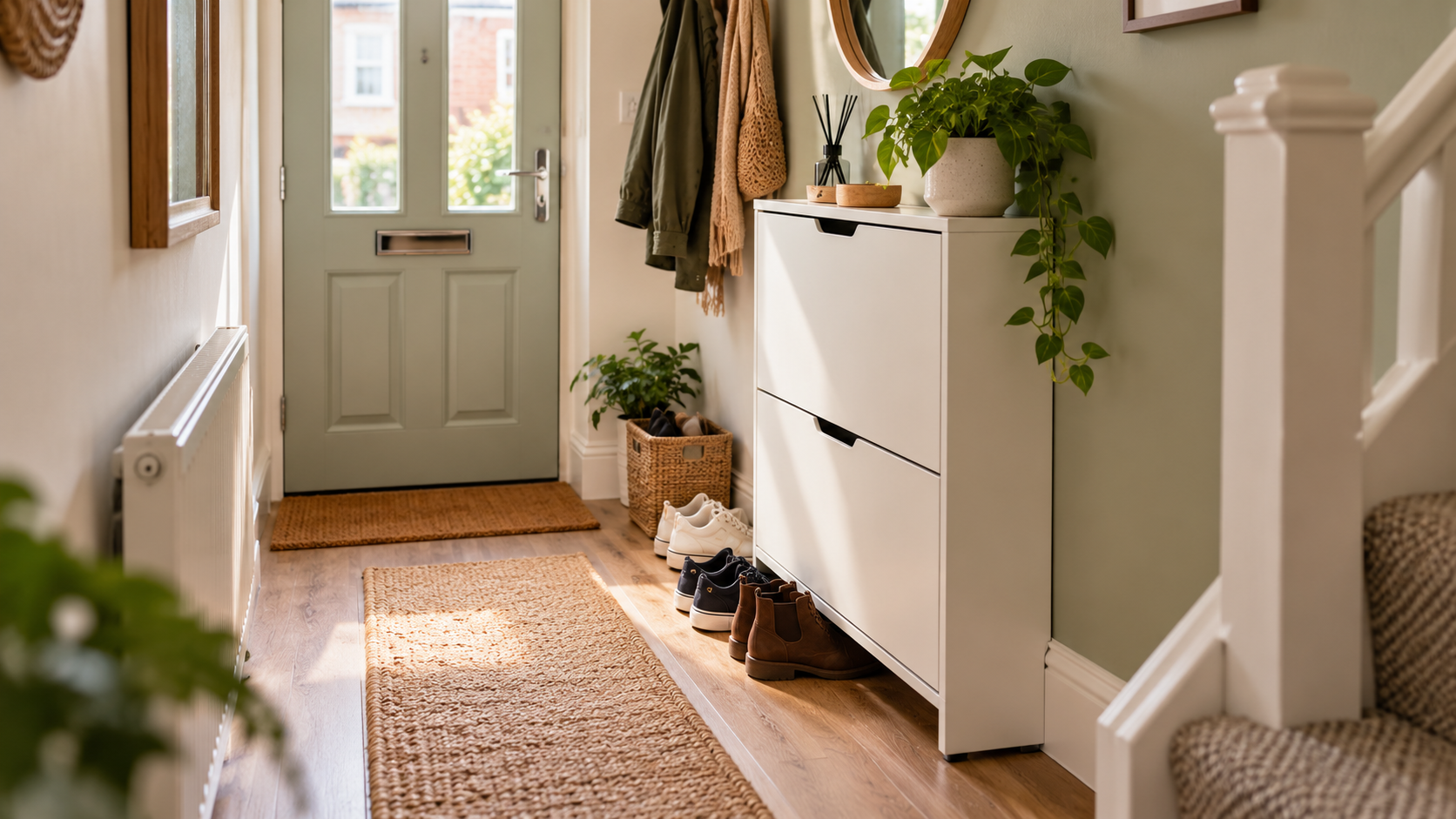
A slim shoe cabinet is one of the most attractive options for a narrow hallway because it hides footwear behind closed compartments.
Unlike a conventional cupboard, many flip-down designs store shoes at an angle, reducing the depth required.
Some models are approximately 18–25 cm deep, although dimensions vary considerably.
This makes them worth investigating when you have a narrow section of wall but limited floor space.
They also create a tidier appearance because shoes aren’t permanently visible.
However, there are important limitations.
Some cabinets won’t accommodate large trainers, bulky boots or certain adult shoe sizes.
You’ll also need room to open the compartments.
Most importantly, many slim shoe cabinets require wall fixing to prevent tipping.
For example, IKEA’s TRONES storage cabinet is approximately 18 cm deep, but its instructions require it to be fixed to the wall.
Never assume a cabinet can safely stand unsecured simply because it’s shallow.
Best for: Narrow hallways where suitable wall fixing is possible.
Product to consider: HOMCOM Ultra Slim Flip-Down Shoe Cabinet
For homeowners who prefer shoes hidden away, the HOMCOM ultra-slim flip-down cabinet offers an alternative to an open rack. Its enclosed compartments can help create a tidier entrance, particularly where floor space is limited. Check the exact cabinet depth, opening clearance and supported shoe sizes before buying. Follow all manufacturer instructions for wall anchoring; this isn’t a suitable no-drill option if the unit requires securing to the wall.
2. Use a Low Open Shoe Rack
A simple two-tier shoe rack can be an effective solution when you want something affordable and easy to access.
Open racks allow you to see your shoes immediately, which can be useful during busy mornings.
They can also provide airflow around footwear that enclosed storage may restrict.
Look for a compact design with a stable base and a depth that suits your hallway.
A low rack may be preferable to a tall unit where wall fixing isn’t possible, but you must still follow the manufacturer’s stability and anchoring requirements.
Avoid overloading shelves or stacking additional items on top.
The main disadvantage is that shoes remain visible.
To prevent the rack looking cluttered, limit it to the pairs used most frequently.
Best for: Renters and small households needing accessible everyday storage.
Product to consider: SONGMICS 2-Tier Bamboo Shoe Rack
If you’re looking for a simple way to keep everyday shoes organised, the SONGMICS two-tier bamboo shoe rack is worth considering. Its open design makes footwear easy to access and avoids the need for a bulky enclosed cupboard. Before ordering, check the rack’s full dimensions, how many pairs of your shoes will fit and whether its installation instructions suit your home. For renters, it’s particularly important to confirm that the chosen model can be used safely without wall fixings.
3. Organise Shoes Inside an Existing Hallway Cupboard
Sometimes the best shoe storage is already in your home.
If you have a cupboard near the front door, consider whether part of it could accommodate everyday footwear.
A compact internal rack, removable shelf or suitable basket may make the available space easier to use.
Before buying organisers, measure the cupboard’s internal width, depth and height.
Allow space for hinges and the door to close properly.
Avoid overfilling the cupboard or placing shoes against electrical equipment, meters or services that need access.
If the cupboard contains utility equipment or forms part of a fire-safety installation, don’t repurpose it for shoe storage.
The advantage of using a suitable existing cupboard is that you aren’t adding furniture to an already narrow hallway.
Best for: Homes with an underused entrance cupboard.
For other ways to make awkward storage spaces more useful, explore our under-stairs storage ideas.
4. Make Use of a Hallway Alcove
Older UK homes often have small recesses or awkward sections of wall that don’t seem particularly useful.
An alcove may provide enough room for a compact shoe rack or carefully measured shelving.
The advantage is that storage can sit partly or entirely within the recess instead of projecting into the walking area.
Measure the width at several heights, as older walls aren’t always perfectly straight.
Also check the depth and whether skirting boards or pipes affect the fit.
If you’re installing shelves, use suitable fixings and obtain permission where required.
Renters could consider a removable, low freestanding organiser where it fits safely and the manufacturer’s instructions allow.
Best for: Narrow entrances with unused recesses.
5. Consider a Compact Shoe-Storage Bench
A shoe-storage bench combines seating with space for footwear.
This can be helpful when putting on boots or helping children with their shoes.
However, benches are often deeper than slim cabinets and can take up valuable floor space.
Before buying one, check that the hallway remains easy to use when someone is sitting on it.
Only use a bench for seating if the manufacturer specifically rates it for that purpose.
A low shoe rack or ordinary storage cabinet shouldn’t automatically be treated as a seat.
A compact bench may work particularly well at the end of a hallway or within a wider entrance area.
Best for: Hallways with enough width for both storage and seating.
6. Use a Waterproof Shoe Tray
Not every storage solution needs to be a piece of furniture.
A shallow waterproof shoe tray can be one of the cheapest and most practical ways to organise footwear near the door.
It provides a defined place for wet trainers, muddy walking shoes or everyday boots.
Choose a tray with raised edges to help contain water and dirt.
Make sure it sits securely on the floor without curling or creating a trip hazard.
Place it away from the main walking route and clean it regularly.
A tray won’t store many pairs, but that’s often part of its appeal.
It encourages you to keep only the shoes you’re currently using near the entrance.
Best for: Very small hallways and homes where wet footwear is a frequent problem.
7. Use Vertical Shoe Storage Carefully
When floor space is limited, making use of height can seem like the obvious solution.
A narrow vertical shoe unit may hold several pairs without occupying a large area of floor.
However, taller furniture introduces additional stability concerns.
Check the manufacturer’s requirements for wall anchoring, weight limits and installation.
Don’t place heavy footwear on high shelves unless the unit is designed for it.
Avoid positioning tall storage where it could fall across the entrance or block a door.
If you rent and cannot obtain permission for required wall fixings, choose a different storage solution rather than leaving the unit unsecured.
Best for: Homes with limited floor space and a suitable location for properly secured storage.
8. Use a Suitable Internal Cupboard Door
If you have a suitable cupboard, an over-door shoe organiser might help make use of otherwise unused space.
These organisers can be particularly useful for lightweight footwear, children’s shoes or smaller accessories.
However, check that the door is suitable before fitting anything.
The organiser must not interfere with the hinges, latch or ability to close.
Avoid adding storage to fire doors or doors where it could compromise their safety function.
Don’t overload the organiser or use one that causes the door to scrape against the frame.
Some over-door organisers also require more clearance than you might expect.
Best for: Suitable internal cupboards with enough door clearance.
9. Give Boots Their Own Storage Space
Trying to store every type of footwear in the same cabinet often leads to frustration.
Tall boots, wellingtons and walking boots may be too large for shallow compartments.
Instead, consider giving bulkier footwear a separate location.
This could be a suitable cupboard, a dedicated boot tray or another storage area away from the narrowest part of the hallway.
Allow wet boots to dry appropriately before placing them into enclosed storage.
Avoid forcing them into spaces that bend or damage the footwear.
Separating boots from everyday shoes can make a surprisingly big difference to how much room remains near the front door.
Best for: Households with wellingtons, work boots or outdoor footwear.
10. Give Each Family Member a Shoe Space
In a family home, hallway clutter often happens because everyone leaves different pairs by the door.
A simple allocation system can help.
For example, each person might have space for their most frequently worn shoes, with additional pairs stored elsewhere.
This could mean one section of a rack, one suitable basket inside a cupboard or a clearly defined place on a tray.
The important thing is to allocate space based on what will realistically fit.
Avoid stacking shoes so high that they become difficult to retrieve or create a falling hazard.
For younger children, choose storage that is easy to reach and doesn’t encourage climbing.
Best for: Families and shared households.
11. Move Seasonal Shoes Out of the Hallway
One of the easiest ways to create more space is to remove footwear that doesn’t need to be near the door.
You probably don’t need summer sandals in the hallway throughout winter.
Similarly, occasional formal shoes and spare trainers may be better stored in a wardrobe, bedroom cupboard or suitable under-bed container.
Clean and dry footwear before putting it away for longer periods.
Use appropriate storage to prevent trapped moisture.
Keeping seasonal shoes elsewhere allows the hallway to function as an everyday entrance rather than a complete footwear collection.
For more ideas about using limited space efficiently, see our small-space storage ideas for UK homes.
Best for: Anyone with more shoes than hallway storage space.
12. Create a Simple Everyday Shoe Routine
Sometimes the most effective improvement doesn’t involve buying anything.
Try keeping only the shoes you expect to wear regularly near the entrance.
When you bring another pair into the hallway, move an unused pair back to its proper storage place.
This isn’t about getting rid of shoes you enjoy.
It’s about separating everyday access from longer-term storage.
A quick weekly check can prevent the hallway gradually filling with footwear again.
For a household with several people, agree on a realistic number of pairs that can remain by the door.
Best for: Any narrow hallway, especially where additional furniture would create an obstruction.
Which Type of Shoe Storage Is Best for Your Hallway?
Different storage styles offer different advantages.
The right choice depends on the space available, how often you use the shoes and whether installation is possible.
| Storage type | Main advantage | Main drawback | Rental considerations |
|---|---|---|---|
| Slim flip-down cabinet | Conceals shoes in a shallow footprint | May not fit bulky footwear | Often requires wall fixing |
| Low open rack | Affordable and accessible | Shoes remain visible | Check stability and instructions |
| Existing cupboard | Adds no hallway furniture | Capacity may be limited | Avoid service or safety cupboards |
| Shoe-storage bench | Combines seating and storage | Usually takes more floor space | Check load rating and clearance |
| Waterproof shoe tray | Inexpensive and easy to clean | Holds relatively few pairs | Generally straightforward if safely positioned |
| Tall vertical unit | Uses height rather than width | Tip-over risk | Follow anchoring requirements |
| Over-door organiser | Uses suitable unused door space | Door compatibility varies | Never compromise fire doors |
For particularly narrow hallways, a low rack or small tray may be more practical than a large cabinet.
If even these would obstruct the entrance, storing most footwear elsewhere is the better solution.
How Deep Should Hallway Shoe Storage Be?
Depth is often more important than width when choosing shoe storage for a narrow entrance.
A wide but shallow cabinet may fit better than a narrow unit that projects far into the hallway.
The following ranges are useful starting points when comparing products.
| Storage type | Approximate depth to investigate |
|---|---|
| Very shallow wall-fixed cabinet | 15–20 cm |
| Slim flip-down shoe cabinet | 20–30 cm |
| Conventional open shoe rack | 25–35 cm |
| Shoe-storage bench | 30–40 cm |
These are general shopping ranges rather than standard dimensions. Some products will fall outside them.
Always use the manufacturer’s actual measurements before ordering.
A Practical Hallway Measurement Example
Imagine your hallway is 115 cm wide.
You find a slim cabinet measuring 20 cm deep.
That leaves a theoretical 95 cm between the front of the cabinet and the opposite wall.
However, you still need to consider the cabinet’s handles, open compartments, door swings and how people move through the space.
If a pushchair or mobility aid is regularly used, the arrangement may not be practical.
The goal isn’t simply to make the furniture fit.
It’s to keep the entrance usable for everyone in the household.
Nookcroft tip: If a cabinet would make the hallway awkward to navigate, don’t buy it just because the measurements technically fit. Look for storage elsewhere in the home.
Shoe Storage Ideas for Renters Who Cannot Drill
Renting can make hallway storage more complicated, especially if your tenancy restricts drilling or permanent alterations.
Fortunately, there are options that don’t necessarily require wall fixings.
These include:
- Low shoe racks designed for freestanding use
- Suitable waterproof shoe trays
- Organisers inside existing cupboards
- Storage in bedrooms or wardrobes
- Removable baskets in suitable cupboards
However, freestanding does not automatically mean safe without anchoring.
Some furniture is sold as freestanding but still requires wall restraints under the manufacturer’s instructions.
Never ignore these requirements.
If you want a wall-mounted or wall-anchored cabinet, ask your landlord for permission before drilling.
Make sure the proposed installation is suitable for the wall construction and carried out correctly.
Don’t substitute adhesive strips for structural fixings unless the manufacturer expressly permits that installation method.
For more rental-friendly organisation ideas, explore our renter-friendly storage ideas and no-drill storage ideas for renters.
How to Store Wet Shoes and Boots in a Small Hallway
Wet shoes can create additional problems in a compact entrance.
Mud and water may damage flooring, while footwear left damp in enclosed storage can develop unpleasant odours.
A waterproof tray is a useful first step because it keeps moisture in one place.
Choose a suitable location that doesn’t obstruct the entrance.
After coming indoors, remove excess mud and allow footwear to dry according to its care instructions.
Avoid placing wet shoes directly against radiators or other strong heat sources if doing so could damage the materials.
If possible, leave some airflow around damp footwear before returning it to an enclosed cabinet.
Clean the tray regularly and dry any surrounding flooring.
For homes with several pairs of outdoor boots, consider storing them in a suitable cupboard or other area rather than filling the hallway.
How Many Pairs of Shoes Should You Keep by the Front Door?
There’s no ideal number that works for every household.
A person living alone may only need space for one or two everyday pairs.
A family with school shoes, work footwear and outdoor boots may need a different arrangement.
Rather than starting with a fixed number, ask three questions:
- Which shoes do we genuinely use most days?
- How many pairs can fit without blocking access?
- Where can occasional footwear be stored instead?
Try allocating a defined space for each household member.
Once that space is full, move less frequently used shoes elsewhere.
This prevents the entrance gradually becoming a place where every pair ends up.
Remember that easy access matters more than maximum capacity.
A cabinet that holds ten pairs but makes it difficult to find the shoes you need may be less useful than a simple rack holding four.
Common Mistakes When Choosing Narrow Hallway Shoe Storage
Even a carefully chosen product can cause problems if it isn’t suited to the space.
Buying Based on Width Alone
Depth determines how far furniture projects into the hallway.
Always measure both.
Forgetting About Opening Space
Flip-down compartments, cupboard doors and drawers need additional clearance when opened.
Test the space before buying.
Assuming Slim Cabinets Don’t Need Anchoring
Some shallow cabinets require wall fixing.
Always follow the manufacturer’s instructions, even if the unit appears stable.
Trying to Store Every Pair by the Door
Keeping your entire shoe collection in a narrow entrance can create unnecessary clutter.
Move occasional footwear elsewhere.
Ignoring Different Shoe Sizes
Large trainers, boots and children’s shoes require different amounts of space.
Check actual usable storage dimensions, not just advertised pair capacity.
Blocking an Escape Route
Shoe storage must not obstruct doors, stairs or routes people need to use to leave the home.
In blocks of flats, communal corridors, landings and staircases should be kept clear of personal belongings.
Don’t place a shoe rack or footwear outside your flat door in a shared corridor.
The London Fire Brigade’s guidance for residents in blocks of flats explains why communal areas must remain free from clutter.
Frequently Asked Questions
What Is the Best Shoe Storage for a Very Narrow Hallway?
A shallow cabinet may work where it can be safely installed, while a compact low rack or shoe tray may suit homes where drilling isn’t possible.
If the hallway is too narrow for furniture, storing shoes elsewhere is often the best option.
Can You Use a Shoe Cabinet Without Drilling?
Some shoe storage products are designed for freestanding use, but others require wall anchoring.
Always follow the manufacturer’s instructions. Don’t leave a cabinet unsecured if wall fixing is required.
How Deep Is a Slim Shoe Cabinet?
Slim cabinets vary in depth. Some very shallow models are around 18 cm deep, while other flip-down cabinets are closer to 20–30 cm.
Check the exact dimensions and whether your footwear will fit.
Where Should Shoes Go If There’s No Hallway Space?
Consider a suitable cupboard, wardrobe, bedroom storage or under-bed container.
Keep only the footwear you need regularly near the entrance, provided it doesn’t create an obstruction.
Can I Keep a Shoe Rack Outside My Flat Door?
Don’t place shoe racks or footwear in communal corridors, landings or staircases where they could obstruct escape or emergency access. Follow your building’s fire-safety arrangements and rules.
Are Shoe-Storage Benches Suitable for Narrow Hallways?
They can work in wider sections of a hallway, but many benches are deeper than slim cabinets.
Measure carefully and only use a bench for seating if it’s designed and rated for that purpose.
How Do You Organise Children’s Shoes in a Small Entrance?
Give each child a suitable, accessible space for everyday footwear.
Store occasional pairs elsewhere and avoid arrangements that encourage children to climb furniture.
Final Thoughts
A narrow hallway doesn’t need to be filled with shoe cabinets to stay organised.
Often, the most effective solution is a combination of compact storage and keeping fewer pairs near the front door.
Slim cabinets, low racks, waterproof trays and existing cupboards can all work well, depending on your available space.
The most important step is measuring carefully before buying.
Check the depth of the furniture, allow for doors and drawers, and make sure the entrance remains easy and safe to use.
For renters, choose storage that complies with the manufacturer’s installation instructions rather than assuming every freestanding unit can be left unsecured.
And if there simply isn’t room for another piece of furniture, don’t force one into the hallway.
A clear entrance with a small, practical shoe-storage system will usually work better than a larger unit that gets in everyone’s way.
For more ideas about organising the rest of your entrance, read our small hallway storage guide.