
Affiliate disclosure: As an Amazon Associate, Nookcroft earns from qualifying purchases. Some links in this article are affiliate links, which means we may earn a small commission if you make a purchase, at no additional cost to you.
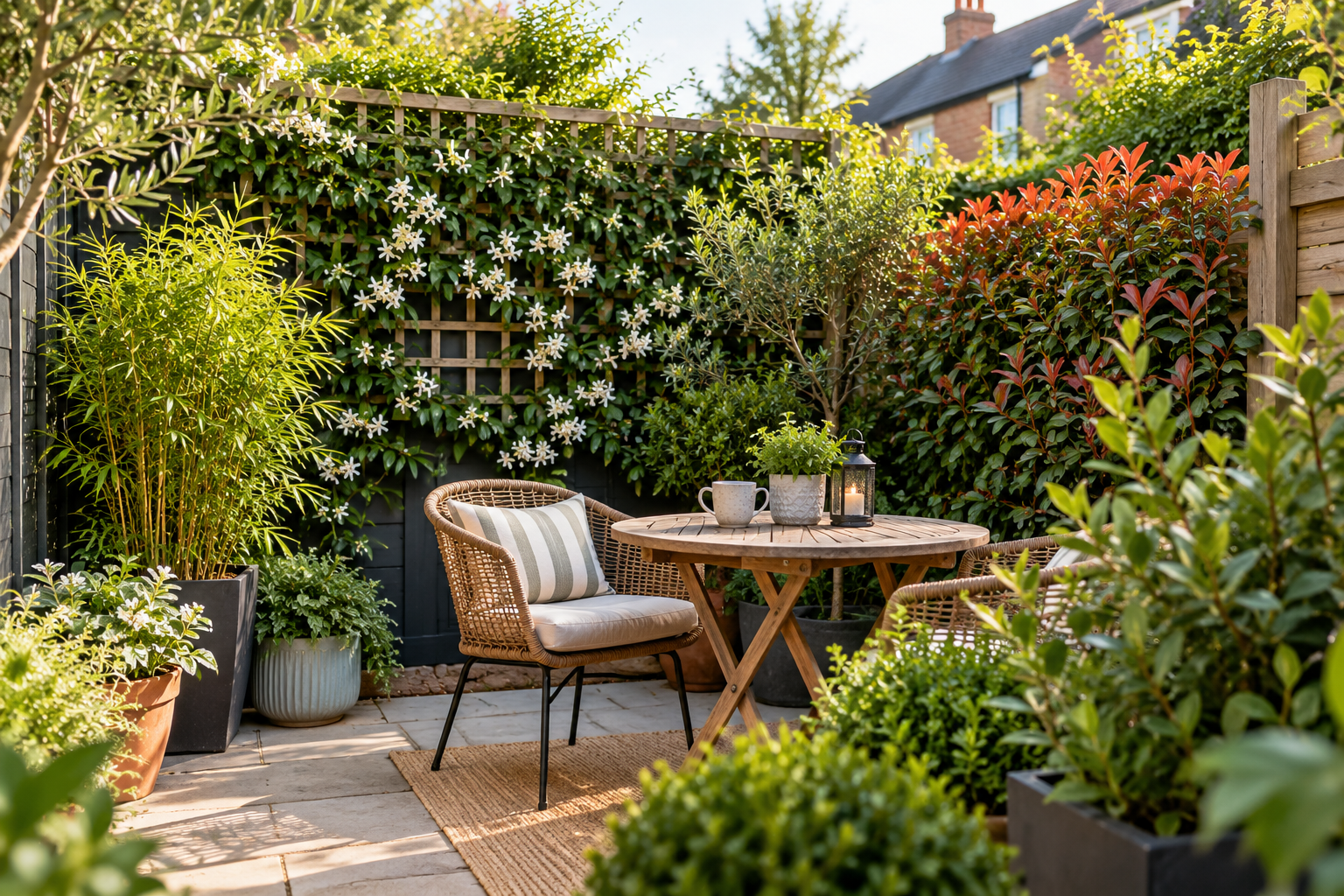
A small garden should feel like somewhere you can relax, whether you’re enjoying a morning coffee, reading outside or spending time with family. But when neighbouring windows overlook your patio or the houses behind you are close together, finding privacy can be difficult.
Plants offer a softer alternative to solid screens and tall fencing. Evergreen shrubs provide foliage throughout the year, climbers can cover a narrow trellis, and carefully positioned containers can create privacy exactly where you need it.
The challenge is choosing plants that won’t eventually overwhelm the space.
A shrub that looks compact at the garden centre may grow several metres wide. A fast-growing climber can need substantial pruning, while some attractive plants lose their leaves during winter.
In this guide, we’ll explore 12 of the best plants for privacy in a small UK garden, including their growing conditions, mature sizes, maintenance requirements and suitability for containers.
We’ll also look at evergreen versus seasonal screening, shade, pets and children, and how to create privacy without sacrificing too much of your garden.
What Are the Best Plants for Privacy in a Small Garden?
For most small UK gardens, the strongest starting points are compact evergreen shrubs, carefully managed climbing plants and upright screening plants suited to the available space.
However, the best choice depends on where you need privacy.
| What you need | Plants worth considering |
|---|---|
| Compact evergreen screening | Photinia ‘Little Red Robin’, compact Pittosporum |
| Taller evergreen hedge | Photinia ‘Red Robin’, yew, Portuguese laurel |
| Narrow vertical screen | Star jasmine, ivy on suitable support |
| Informal upright foliage | Clump-forming Fargesia bamboo |
| Privacy in large containers | Compact Photinia, selected Pittosporum, suitable Fargesia |
| Screening in partial shade | Yew, holly, ivy |
| Seasonal screening for a shady wall | Climbing hydrangea |
| Privacy above a fence | Carefully positioned pleached hornbeam |
Not all these plants are suitable for every garden.
For example, a compact Photinia may provide useful screening around a seating area but won’t necessarily block views from an upstairs window.
Similarly, a large evergreen hedge might provide excellent privacy but leave a tiny garden feeling crowded.
The best privacy plant is one that suits your available space at maturity, not simply one that grows quickly.
Five Things to Check Before Choosing Privacy Plants
Before buying anything, take a few measurements and identify the exact problem you want to solve.
1. Work out where privacy is needed
You may not need to screen the entire boundary.
Perhaps a neighbouring upstairs window overlooks one corner of your patio, or a gap between fences creates a direct view into your seating area.
Stand where you normally sit and look towards the source of overlooking.
A single well-positioned shrub or a short planted trellis may solve the problem more effectively than a continuous hedge.
If you’re considering fences, pergolas or alternative screening structures, our small garden privacy ideas guide explores those options.
2. Measure the available planting space
It’s easy to focus on height while overlooking width.
Measure the length of the area you want to screen, the depth available for roots and foliage, and the height at which privacy is required.
Also check nearby paths, doors, drains, walls and seating.
Example: Imagine a garden three metres wide with a planting border only 45 cm deep.
A large laurel hedge would need considerable ongoing pruning and may still be unsuitable. A climber trained across a properly supported trellis could make better use of the available space.
3. Check the plant’s ultimate size
A plant sold at 60 cm tall may eventually reach several metres.
Look for its ultimate height and spread, preferably using the exact botanical name and cultivar.
Also distinguish between a plant’s natural mature size and the dimensions you intend to maintain through pruning.
4. Consider sunlight, soil and exposure
A sheltered south-facing patio has different conditions from an exposed north-facing garden.
Check whether your planting area receives full sun, partial shade or deep shade.
Soil drainage matters too. A plant that tolerates cold may still struggle if its roots remain waterlogged.
5. Decide how much maintenance is realistic
Fast-growing hedges may require frequent clipping. Climbers need training, and container-grown shrubs require regular watering.
If you want a low-maintenance garden, choose plants with manageable natural growth habits rather than relying on constant pruning to control oversized varieties.
12 Best Plants for Privacy in a Small UK Garden
These 12 options cover different types of screening, from compact shrubs to trained trees.
The mature sizes mentioned are planning guides, not guarantees. Growing conditions, cultivar selection and maintenance can all affect the final result.
1. Photinia ‘Little Red Robin’ — Best for Compact Evergreen Colour
Botanical name: Photinia × fraseri ‘Little Red Robin’
‘Little Red Robin’ is a smaller version of the familiar red-tipped Photinia often used for hedging.
Its glossy evergreen leaves provide structure throughout the year, while fresh growth produces attractive red colouring.
According to the RHS, it reaches approximately 1–1.5 metres in height and spread at maturity.
That makes it a useful choice for patio-level privacy, compact borders and large containers.
It is especially attractive where you want a screen that feels decorative rather than formal.
Choose a position suited to the plant’s light and drainage requirements, and allow room for its natural spread.
Best for: Low to medium screening, small patios and decorative evergreen planting.
Main drawback: It won’t usually provide enough height to screen an upstairs window.
2. Photinia ‘Red Robin’ — Best for Taller Evergreen Screening
Botanical name: Photinia × fraseri ‘Red Robin’
The standard ‘Red Robin’ is popular because its evergreen foliage can form a dense, colourful hedge.
It also responds well to regular clipping.
However, its natural mature size is substantial. The RHS gives an ultimate height of approximately 4–8 metres and spread of 2.5–4 metres.
This doesn’t mean every maintained hedge will become that large, but it does show why ‘Red Robin’ shouldn’t automatically be described as a compact plant.
It works best where there is sufficient root space and the owner is prepared to prune regularly.
For a very narrow garden, the smaller cultivar may be more appropriate.
Best for: Taller evergreen screening where adequate space is available.
Main drawback: Regular maintenance is needed to keep it compact.
3. Fargesia Bamboo — Best for Informal Upright Screening
Botanical group: Fargesia species and cultivars
Bamboo can create a beautiful screen with its upright stems and gently moving foliage.
It works particularly well in contemporary gardens where a conventional hedge might feel too formal.
For small spaces, focus on clump-forming Fargesia rather than vigorous running bamboo.
Clump-forming varieties generally expand gradually from their base rather than sending long runners across the garden.
However, they aren’t permanently narrow.
Depending on the species and cultivar, Fargesia can reach several metres in height and develop a substantial clump.
Some varieties tolerate partial shade, although their exact requirements vary.
They can also be grown in large containers, but need sufficient root space and consistent watering.
Best for: Informal screens, modern patios and upright foliage.
Main drawback: Mature spread and watering requirements can be greater than expected.
4. Star Jasmine — Best for a Sheltered Trellis
Botanical name: Trachelospermum jasminoides
Star jasmine is an attractive evergreen climber with glossy leaves and fragrant white summer flowers.
It can provide useful privacy when trained across a suitable trellis or framework.
Its main advantage is the ability to create vertical coverage without planting a broad hedge.
However, it is a vigorous climber.
The RHS lists an ultimate height of 8–12 metres and spread of 4–8 metres in suitable conditions, so it requires careful training and ongoing management in a small garden.
It also prefers a sheltered position with suitable drainage. Cold, exposed locations may be less successful.
For renters, a freestanding support must be stable and permitted under the tenancy agreement.
Best for: Sheltered patios, sunny walls and trained evergreen screening.
Main drawback: Vigorous growth and reduced suitability for cold, exposed sites.
Product to consider: Outdoor Garden Trellis
A garden trellis can help turn climbing plants into a useful privacy screen without requiring a wide planting border. It’s particularly suitable for training star jasmine or other manageable climbers across a defined area. Choose a weather-resistant design with appropriate structural support, and check the manufacturer’s installation requirements before fixing it to a wall, fence or freestanding frame.
5. Pittosporum — Best for Decorative Evergreen Foliage
Botanical group: Pittosporum species and cultivars
Pittosporum is popular for its neat foliage and attractive colour variations.
Depending on the cultivar, leaves may be green, cream-edged, silver-toned or deep purple.
It can look particularly effective in a contemporary courtyard, either as a single shrub or as part of a carefully spaced planting arrangement.
However, Pittosporum isn’t one uniform size.
Some cultivars remain relatively compact, while others grow into large shrubs or small trees.
Many prefer sheltered conditions and can be damaged by severe frost, particularly in exposed locations.
Check the exact cultivar’s mature dimensions and hardiness before purchasing.
Best for: Decorative screening in mild, sheltered gardens.
Main drawback: Size and winter hardiness vary considerably between cultivars.
6. Portuguese Laurel — Best for a Formal Evergreen Hedge
Botanical name: Prunus lusitanica
Portuguese laurel has glossy evergreen leaves and can be trained into a dense, attractive hedge.
Its relatively neat foliage gives it a more refined appearance than some larger-leaved hedging plants.
Once established, it can provide dependable year-round screening.
However, Portuguese laurel is naturally a substantial shrub or tree.
It is best suited to gardens where there is enough space for its roots and where regular pruning is acceptable.
It is not an ideal solution for an extremely shallow border.
Laurel foliage and other plant parts can be harmful if eaten, so households with pets or children should take particular care.
Best for: Formal hedging in gardens with adequate planting width.
Main drawback: Large eventual size, pruning requirements and toxicity concerns.
7. Yew — Best for Dense Evergreen Screening in Shade
Botanical name: Taxus baccata
Yew is a traditional evergreen hedging plant with dense, dark green foliage.
It responds well to clipping, which allows established hedges to be maintained in a relatively formal shape.
It can also tolerate shade, making it useful where many sun-loving shrubs struggle.
Yew is generally slower-growing than some popular screening alternatives, although its ultimate size is very large if left unpruned.
That slower growth can be helpful for maintaining a neat hedge over time.
Important: Yew is highly poisonous if eaten, including to many animals. It may be unsuitable for households where pets or young children could chew or consume plant material.
Best for: Formal evergreen hedges and suitable shaded gardens.
Main drawback: Serious toxicity concerns and slower establishment.
8. Holly — Best for Evergreen Cover and Wildlife
Botanical name: Ilex aquifolium and suitable cultivars
Holly provides evergreen foliage and can be grown as a hedge or individual shrub.
It is also valuable for wildlife, offering shelter and, on suitable female plants, berries.
Different cultivars vary considerably in size, leaf shape and colour.
Some have sharply spined leaves, while others are less prickly.
Holly can tolerate partial shade, although growth and berry production depend on conditions and cultivar.
For a small garden, choose a manageable variety rather than assuming all hollies stay compact.
Consider where prickly leaves or berries might fall, particularly near play areas and frequently used paths.
Best for: Evergreen cover, partial shade and wildlife-friendly planting.
Main drawback: Potentially sharp leaves, berries and large mature dimensions.
9. Ivy — Best for Evergreen Vertical Coverage in Shade
Botanical name: Hedera helix
Ivy is useful for creating evergreen foliage on a suitable vertical support.
It tolerates shade and can develop dense coverage once established.
For small gardens, a properly constructed freestanding screen may offer more control than allowing ivy to climb directly across a building.
However, ivy grows vigorously and needs regular attention.
Mature growth can become heavy, so supports must be strong enough to carry it.
Avoid allowing ivy to spread into gutters, roof spaces or vulnerable masonry.
It can also cause skin irritation in some people, and plant material should not be eaten.
Best for: Shaded vertical screening where ongoing management is possible.
Main drawback: Vigorous growth and the need for regular pruning.
10. Evergreen Honeysuckle — Best for Informal Climbing Foliage
Botanical group: Selected evergreen or semi-evergreen Lonicera species
Honeysuckle can create a soft, informal screen with attractive foliage.
However, not every honeysuckle is evergreen.
Many familiar flowering varieties lose their leaves during winter, while some retain foliage only in milder conditions.
For dependable year-round privacy, check the exact species and cultivar rather than relying on the general name.
Climbing varieties need suitable support and regular training.
Some can become sparse near the base as they mature, reducing screening where it may be needed most.
Best for: Informal climbing screens where seasonal interest is important.
Main drawback: Winter foliage and mature size vary by species.
11. Climbing Hydrangea — Best for Seasonal Privacy in Shade
Botanical name: Hydrangea anomala subsp. petiolaris
Climbing hydrangea is a useful option for shaded walls and sheltered north-facing positions.
Its attractive leaves and clusters of pale flowers can provide beautiful seasonal coverage.
However, it is deciduous, so it won’t provide the same leafy privacy during winter.
It can also become very large.
The RHS lists an ultimate height exceeding 12 metres, with a spread of approximately 4–8 metres.
It may grow slowly at first, then become much more vigorous after establishment.
Its self-clinging growth makes wall condition important. A suitable support or structurally sound surface is essential.
Best for: Seasonal screening and flowering interest in shaded locations.
Main drawback: Large eventual size and loss of foliage in winter.
12. Pleached Hornbeam — Best for Privacy Above Fence Height
Botanical name: Carpinus betulus
Pleached hornbeam is trained to form a raised framework of branches above a clear trunk.
This creates screening higher up while leaving the lower part of the garden relatively open.
It can be particularly useful when overlooking comes from upstairs windows.
However, hornbeam is deciduous.
Some leaves may remain attached through winter, especially on clipped growth, but this shouldn’t be treated as dependable evergreen screening.
Pleached trees also require suitable root space, support during establishment and ongoing pruning.
They are generally more expensive than ordinary shrubs.
Best for: Elevated screening where the garden has enough space and budget.
Main drawback: Higher cost, maintenance and seasonal changes in coverage.
Privacy Plants Compared: Size, Screening and Maintenance
Use this table to narrow down your choices before checking the exact cultivar.
| Plant | Screening type | Space requirements | Maintenance |
|---|---|---|---|
| Photinia ‘Little Red Robin’ | Evergreen, low–medium | Compact shrub, around 1–1.5 m spread | Low–moderate |
| Photinia ‘Red Robin’ | Evergreen, potentially tall | Large unless clipped | Moderate–high |
| Fargesia bamboo | Usually evergreen, upright | Clump expands with age | Moderate |
| Star jasmine | Evergreen in suitable conditions | Narrow when trained; vigorous overall | Moderate–high |
| Pittosporum | Evergreen | Cultivar-dependent | Low–moderate |
| Portuguese laurel | Evergreen hedge | Requires meaningful root and hedge space | Moderate–high |
| Yew | Evergreen hedge | Can be clipped; large if unpruned | Moderate |
| Holly | Evergreen | Cultivar-dependent | Low–moderate |
| Ivy | Evergreen climber | Needs sturdy support and control | Moderate–high |
| Evergreen honeysuckle | Evergreen/semi-evergreen | Species-dependent | Moderate |
| Climbing hydrangea | Deciduous climber | Large at maturity | Moderate |
| Pleached hornbeam | Deciduous raised screen | Tree roots and trained framework | Moderate–high |
The key distinction is between natural ultimate size and maintained size. Pruning can control growth, but it doesn’t make a naturally large plant maintenance-free.
Which Privacy Plants Stay Green All Year?
Evergreen plants are the most useful starting point when privacy matters during winter.
Yew, holly, Photinia and Portuguese laurel retain their foliage throughout the year.
Suitable Pittosporum and star jasmine plants may also provide evergreen coverage, although winter performance depends on local conditions.
But evergreen foliage doesn’t guarantee an opaque screen.
Young shrubs may have gaps, and climbers can develop uneven growth.
Think about the height and density of foliage where the unwanted view actually occurs.
If you mainly use your garden during warmer months, deciduous climbers and trees may still be suitable.
Climbing hydrangea and pleached hornbeam can provide attractive seasonal screening without keeping the same dense appearance throughout winter.
Best Privacy Plants for Pots and Containers
Container-grown plants are especially useful on patios and in rented gardens.
They allow you to position screening where it’s needed and may avoid permanent planting.
Compact Photinia, selected Pittosporum cultivars and suitable Fargesia bamboo can all be considered for sufficiently large containers.
Star jasmine is another option when paired with a stable climbing support.
Product to consider: Large Outdoor Planter
A generously sized outdoor planter can be a practical starting point for creating privacy with compact evergreen shrubs. Look for a weather-resistant design with suitable drainage, enough root space for your chosen plant and a stable base. Larger planters are particularly useful for positioning greenery around a patio, although the correct size will depend on the plant’s eventual growth.
Choose the pot for the mature plant
There is no single container size suitable for every privacy plant.
A pot around 45–60 cm wide may be a starting point for certain compact shrubs, but larger plants may require substantially more space.
Check the nursery’s advice for the exact plant and allow for future growth.
Prioritise drainage and stability
Containers need appropriate drainage holes.
Tall plants can act like sails in strong winds, so avoid lightweight or unstable planters in exposed locations.
Position pots where they won’t obstruct paths or create a hazard.
Plan for regular watering
Container plants usually dry out faster than those grown in open ground.
Large leafy screens can require frequent watering during warm weather.
They may also need feeding, repotting or root management over time.
Consider the long-term cost
Buying several large planters, plants and supports can become expensive.
Start by screening the most overlooked part of the garden rather than buying an entire row immediately.
For more affordable improvements, see our small garden ideas on a budget.
Best Privacy Plants for North-Facing and Shady Gardens
A north-facing garden can still support useful privacy planting.
The most suitable plants are those that tolerate reduced sunlight and match the garden’s soil conditions.
Yew and suitable holly cultivars are worth considering for evergreen screening.
Ivy can provide vertical foliage on an appropriate support.
Climbing hydrangea offers attractive seasonal coverage on sheltered north-facing walls.
However, shade tolerance doesn’t mean every plant will thrive in a completely dark corner.
Deep shade, poor drainage and competition from nearby roots can all affect growth.
If you’re planning improvements to a shaded outdoor space, our north-facing garden ideas guide explores additional options.
Are Fast-Growing Privacy Plants Worth It?
Fast growth sounds attractive when you want privacy quickly.
Unfortunately, vigorous plants can create long-term maintenance problems in a small garden.
A large hedge may require frequent clipping, while an aggressive running bamboo can spread beyond its intended planting area.
Before buying a fast-growing screen, ask:
- How high does it actually need to grow?
- How much space will it occupy at maturity?
- Will it remain leafy in winter?
- How often will it need pruning?
- Can the available soil or container support it?
Buying a larger established shrub may offer more immediate screening, but it costs more and requires careful aftercare.
For many small gardens, a manageable plant in the correct position is better than the fastest-growing option.
How to Create Privacy Without Losing Too Much Space
The most effective approach is often to screen a particular sightline rather than the whole garden.
For example, a climber trained across a narrow trellis can create privacy behind a seating area.
A compact evergreen shrub beside a patio may interrupt a neighbour’s direct view.
If overlooking comes from above, a carefully positioned raised screen or trained tree might be more effective than a ground-level hedge.
Avoid planting tall evergreen screens where they will unnecessarily block sunlight from your own garden.
You should also consider how they may affect neighbouring properties.
Privacy works best when the garden still feels open, usable and welcoming.
For fencing, trellis and other non-plant solutions, explore our small garden privacy ideas.
Privacy Plants, Pets and Children: Important Safety Advice
Not every popular screening plant is suitable for a household with young children or pets.
Yew is highly poisonous if eaten and deserves particular caution.
Laurel species can also be harmful, while holly berries, ivy and other ornamental plants may present ingestion or irritation risks.
Plant toxicity varies by species and sometimes by plant part.
Don’t assume that a plant is safe simply because it is widely sold or commonly used in gardens.
Check the exact botanical name using reliable horticultural and veterinary information before purchasing.
If your pet is known to chew foliage, avoid introducing potentially toxic plants into accessible areas.
When handling plants that may irritate the skin, wear suitable gloves and wash your hands afterwards.
For a starting point, consult the RHS guide to potentially harmful garden plants.
Planting and Maintaining a Privacy Screen
Even the right plant needs suitable care to establish successfully.
Choose the right planting time
Autumn and spring are often suitable for planting hardy shrubs and hedges, provided the ground isn’t frozen or waterlogged.
Less hardy evergreens may benefit from spring planting so they have time to establish before winter.
Prepare the soil
Remove competing weeds and check drainage.
Avoid placing large plants too close to structures without considering their eventual size and root requirements.
Water while plants establish
New shrubs and climbers need regular attention until their roots become established.
Plants beside walls can be particularly vulnerable to dry soil because rain may not reach the roots.
Train climbers gradually
Guide young stems across their support to encourage even coverage.
Use suitable ties where necessary and avoid allowing vigorous growth to overwhelm nearby plants or structures.
Prune at the appropriate time
Different species respond best to different pruning schedules.
Check plant-specific guidance before cutting, especially if the plant flowers on older growth.
Always check for active birds’ nests before carrying out pruning or hedge maintenance.
Product to consider: Reusable Soft Garden Ties
Soft, adjustable garden ties are useful when training climbing plants across a trellis or support. They help guide new growth into the areas where screening is needed, creating more even coverage over time. Choose ties suitable for outdoor use, leave room for stems to thicken and check them regularly so they don’t become too tight.
Privacy Plants and Neighbours: UK Rules to Understand
A privacy screen should improve your garden without creating unnecessary problems for neighbouring properties.
Tall hedges may reduce daylight, while vigorous climbers can extend beyond boundaries.
In England, the high-hedge complaints process can apply where a qualifying hedge consists of two or more mostly evergreen or semi-evergreen trees or shrubs, is over two metres tall and adversely affects a neighbour’s enjoyment of their home or garden.
This doesn’t mean every hedge over two metres is automatically unlawful.
Individual trees and shrubs aren’t covered by that particular high-hedge complaint procedure.
Rules and procedures vary across the UK, so check the guidance relevant to your location.
The GOV.UK guide to high hedges and neighbour disputes is a useful starting point for England.
Renters should also check their tenancy agreement before permanent planting or installing structural supports.
Common Mistakes When Buying Privacy Plants
Choosing plants based only on growth speed. Rapid growth may create constant pruning work.
Ignoring mature width. A shrub can become too large even if its height seems suitable.
Expecting immediate privacy. Young plants usually need time to establish and fill out.
Using deciduous plants for winter screening. Seasonal foliage may disappear when it’s most needed.
Choosing containers that are too small. Restricted roots and inconsistent watering can affect plant health.
Forgetting about sunlight. A dense evergreen hedge can make a small garden feel darker.
Overlooking plant safety. Always check toxicity where children or pets may come into contact with foliage.
Trying to screen everything. A targeted planting arrangement is often more practical than surrounding the entire garden.
Frequently Asked Questions
What is the best evergreen plant for privacy in a small garden?
Compact Photinia cultivars are useful for low to medium screening. Yew, holly and suitable Pittosporum varieties may also work, depending on available space, growing conditions and safety considerations.
Which privacy plants grow well in pots?
Compact Photinia, selected Pittosporum, suitable clump-forming bamboo and star jasmine can be considered for large containers. The correct pot size depends on the individual plant.
What is the fastest-growing privacy plant for a small garden?
There isn’t one universally suitable choice. Fast-growing plants often require more pruning and may become too large. A manageable cultivar with the right eventual size is usually preferable.
Which plants can provide privacy above a fence?
Pleached hornbeam, carefully positioned taller shrubs and climbers on suitable supports can provide elevated screening. Consider their mature dimensions and effects on neighbouring light.
What plants are suitable for a north-facing garden?
Yew, holly, ivy and climbing hydrangea may be suitable, depending on soil conditions and the amount of shade.
Is bamboo a good privacy screen?
Clump-forming Fargesia bamboo can provide attractive screening, but it still needs adequate space, water and maintenance. Avoid confusing clump-forming varieties with vigorous running bamboo.
How long does it take to grow a privacy screen?
Establishment time depends on the plant species, starting size, growing conditions and aftercare. Some plants develop useful coverage within a few growing seasons; others take considerably longer.
Can renters grow privacy plants in containers?
Often, yes, subject to tenancy rules. Choose stable containers, avoid obstructing access and obtain permission before installing permanent supports or altering the garden.
Final Thoughts
The best plants for privacy in a small UK garden aren’t necessarily the tallest or fastest-growing.
They’re the ones that provide useful screening without becoming difficult to maintain.
Compact evergreen shrubs can offer year-round foliage, while climbers make use of vertical space. Container planting provides flexibility, and carefully trained trees may help with overlooking from upstairs windows.
Before buying, check the exact plant’s mature size, growing conditions, maintenance requirements and safety considerations.
A thoughtfully chosen screen may take time to establish, but it can make even a small garden feel more private, comfortable and enjoyable for years to come.