
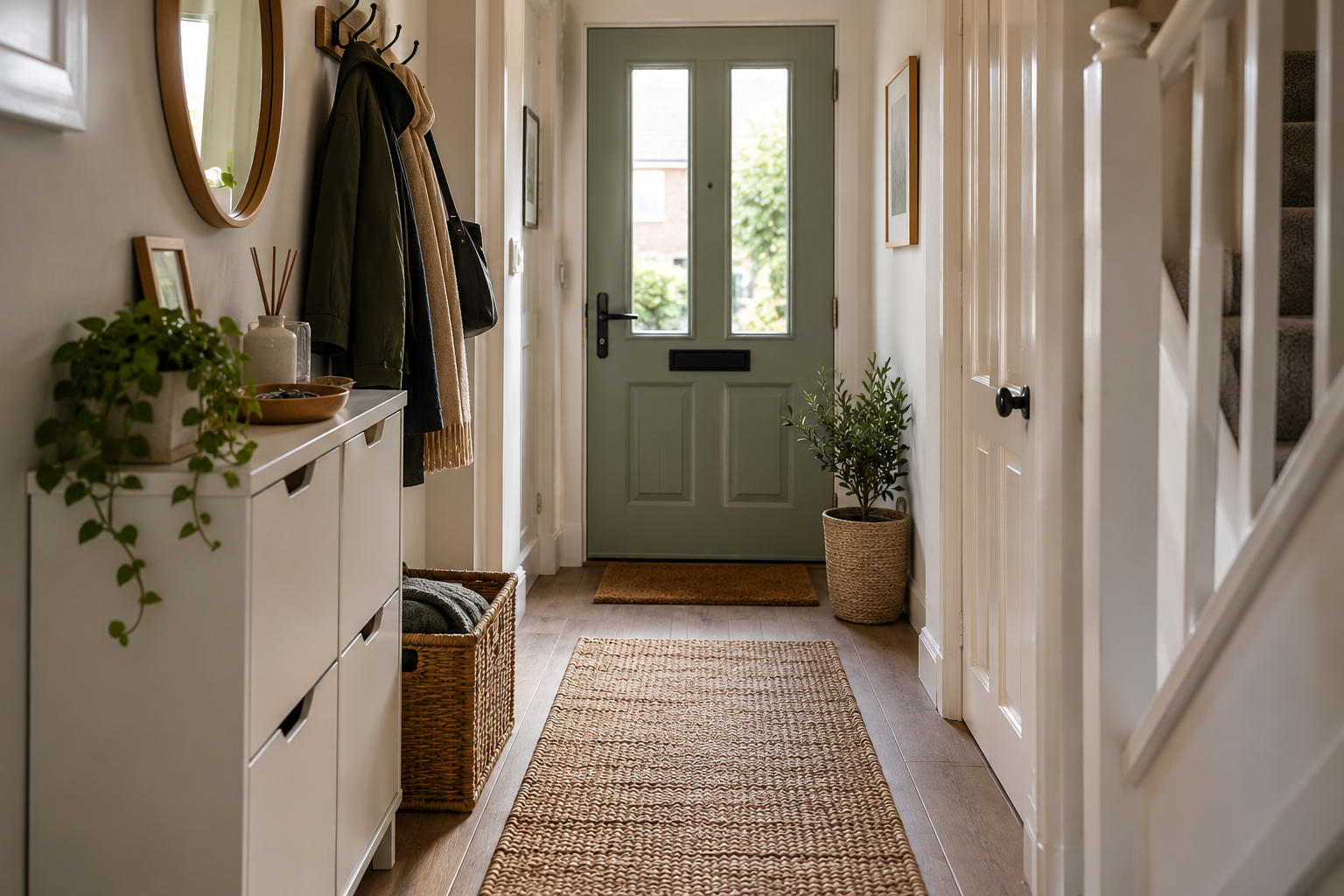
A small hallway has to work surprisingly hard.
It might be one of the smallest areas in your home, yet it’s expected to handle coats, shoes, bags, keys, post, umbrellas and everything else that follows you through the front door.
In a narrow hallway, it doesn’t take much for everyday clutter to take over. Shoes spread across the floor, coats build up on hooks and bags get left wherever there’s room.
The answer isn’t to squeeze storage into every available gap.
A hallway is first and foremost a route through your home. Good storage should make that route easier to use, not gradually reduce it.
The most useful small hallway storage ideas tend to be shallow, vertical or multifunctional — giving everyday belongings an obvious place to return to without crowding the entrance.
Before buying anything, start with the space itself.
Before You Buy Anything, Measure the Route Through the Hallway
It’s easy to measure an empty section of wall and decide that a cabinet will fit there.
But that’s only part of the calculation.
Open the front door fully. Walk through the hallway carrying shopping bags. Think about where you stand when putting on shoes and whether other doors open into the same space.
Then measure what’s genuinely available.
Pay particular attention to depth. In a narrow hallway, a few extra centimetres can make much more difference than they would in a larger room.
You can mark the footprint of a cabinet or bench on the floor with masking tape before buying. This gives you a much better sense of how the hallway will feel once the furniture is there.
The aim isn’t to maximise storage capacity.
It’s to store what you need while keeping the entrance comfortable to use.
1. Choose a Slim Shoe Cabinet Instead of a Deep Shoe Rack
Shoes are often one of the biggest sources of hallway clutter.
Traditional shelving can work well, but it may project further into a narrow hallway than you expect.
A shallow shoe cabinet can be a better option where space is tight. Some designs store footwear at an angle, allowing the cabinet itself to remain relatively slim.
Closed storage also reduces visual clutter because you aren’t looking at several pairs of shoes every time you walk through the hall.
Don’t choose a cabinet based only on its advertised capacity.
Think about the footwear you actually own. Boots, larger trainers and bulky shoes may need considerably more room than lightweight footwear.
Keep everyday pairs near the entrance and move occasional shoes elsewhere.
Nookcroft tip: Check how much space the cabinet needs when its doors or compartments are open. A slim cabinet isn’t particularly useful if accessing it blocks the entire hallway.
2. Replace a Freestanding Coat Stand With Wall Hooks
A traditional coat stand can occupy a surprising amount of floor space.
Wall hooks move that storage onto an area that would otherwise do very little.
They’re useful for everyday coats, bags, hats and scarves and can be positioned at heights that suit the people using them.
The main problem is how easily hooks become overloaded.
Five hooks don’t need to hold fifteen coats.
Leave enough space for clothing to hang without forming one thick mass against the wall, and keep the hallway for the outerwear you’re currently using.
If you’re renting, check what’s permitted before drilling or making permanent alterations.
3. Use the Space Above Head Height
The upper part of a hallway is often overlooked.
A high shelf can provide useful storage for lightweight belongings you don’t need every day, such as hats, spare bags or seasonal accessories.
This works particularly well above a row of hooks because you’re making one section of wall work harder rather than creating another storage zone elsewhere.
Baskets or boxes can keep smaller belongings together and reduce visual clutter.
Keep heavy objects and frequently used items somewhere easier to reach.
High-level storage is most useful for belongings you only need occasionally.
4. Choose a Bench That Earns Its Floor Space
A hallway bench gives you somewhere to sit while putting on shoes, but in a small entrance it should ideally do more than provide a seat.
Look for storage underneath.
That might mean drawers, cubbies, a lift-up compartment or simply enough clearance for a couple of baskets.
Shoes are an obvious choice, but the space could also hold bags, outdoor accessories or other things you regularly need near the front door.
Keep the scale appropriate to the hallway.
A compact bench that combines two functions can be extremely useful. An oversized one that dominates the entrance isn’t.
5. Make Better Use of the Space Under the Stairs
If your hallway includes a staircase, the area underneath it can offer some of the most valuable storage in the home.
And it doesn’t automatically require expensive fitted cabinetry.
A deep under-stairs cupboard often becomes difficult to manage because belongings disappear behind one another. Adding shelves, hooks or labelled containers may make the existing space considerably more useful.
Open areas beneath stairs can sometimes accommodate drawers, a low cabinet or baskets without requiring a complete renovation.
If you’re considering fitted storage, decide what each section needs to hold before commissioning anything.
The unusual shape means good organisation matters just as much as capacity.
For more ways to make awkward areas work harder, our guide to small-space storage ideas covers under-stairs storage and other easily overlooked parts of the home.
6. Create a Proper Drop Zone for Keys and Post
Small objects create a surprising amount of visual clutter.
Keys land on the nearest surface. Letters get placed beside them. Sunglasses, receipts and loose change follow.
One small drop zone can stop that clutter spreading through the hallway.
You don’t need a large console table.
A shallow shelf, compact tray or small section of an existing surface may be enough.
Give keys one consistent place and create a separate spot for incoming post. Deal with the post regularly rather than allowing it to become permanent hallway storage.
Put the drop zone where you naturally reach for these things when entering or leaving the house.
Convenience matters more than perfect symmetry.
7. Use a Shallow Console Where a Standard One Won’t Fit
A console table can be useful in a hallway, but many are deeper than a narrow entrance can comfortably accommodate.
If you genuinely need one, look for a shallow design.
Even a slim surface can provide somewhere for keys or post, while drawers underneath keep smaller belongings out of sight.
Wall-mounted designs can leave the floor underneath feeling more open, although they need appropriate installation.
Before adding a console, ask what job it’s going to do.
If its only purpose is displaying decorative objects, leaving the wall clear may be more valuable.
In a compact hallway, furniture should solve a problem.
8. Make Sensible Use of the Back of a Door
The back of a suitable door can provide useful storage without introducing another piece of furniture.
Depending on the door and how it’s used, hooks or an over-door organiser might hold lightweight accessories such as scarves, hats or reusable shopping bags.
Keep the setup modest.
Too much weight can make a door awkward to operate, while bulky storage may interfere with the frame or nearby furniture.
Check the clearances before buying anything and make sure the solution is suitable for the particular door.
Renters should also be cautious with products that claim to be removable or damage-free. Surfaces vary, so follow the manufacturer’s instructions carefully.
9. Give Smaller Accessories Their Own Basket
Gloves, hats, dog leads and reusable bags are easy to lose because they’re too small to justify their own piece of furniture.
Grouping them can work better.
One basket or container for everyday outdoor accessories gives those smaller belongings a clear home without creating lots of individual storage systems.
A basket beneath a bench might work for things you reach for regularly, while less frequently used accessories can go somewhere less accessible.
Keep the purpose of the basket specific.
Once it becomes the place where anything without a home gets thrown, it stops being useful storage.
10. Plan for Wet Shoes and Coats
Hallway storage needs to work on rainy days as well as dry ones.
Wet shoes pushed straight into closed storage bring moisture and dirt with them, while damp coats packed tightly together may take much longer to dry.
Create somewhere practical for wet items.
A washable mat or boot tray can contain wet footwear near the entrance, while enough space between coat hooks gives damp outerwear a better chance to dry.
You don’t need an elaborate mudroom-style setup.
You simply need somewhere sensible for wet belongings to go before they’re put away properly.
In a UK hallway, that’s a problem worth planning for from the beginning.
11. Turn an Awkward Alcove Into a Storage Zone
Hallways often contain recesses created by stairs, chimney breasts, doorways or adjoining rooms.
Standard furniture may not fit particularly well, but that doesn’t make the space useless.
A narrow shelving unit, row of hooks, compact cabinet or a few baskets might be enough to turn an awkward recess into useful storage.
You don’t automatically need custom joinery.
Freestanding furniture can be considerably cheaper and may be preferable if you’re renting or expect your needs to change.
Use the alcove to solve a specific problem rather than simply filling it because it’s there.
12. Keep Most of the Storage on One Side
In a particularly narrow hallway, storage on both sides can create a corridor between obstacles.
Where the layout allows, concentrate most of it on one wall instead.
You might combine a slim shoe cabinet, hooks and a high shelf on one side while keeping the opposite wall relatively clear.
This can create a stronger visual line through the hallway and make the entrance feel calmer.
The clearer wall can still hold a mirror or artwork without taking up walking space.
This is one of those situations where deliberately leaving space unused can improve how the whole area works.
13. Make Hallway Storage Renter-Friendly
Renting doesn’t prevent you from creating a more organised hallway.
Start with storage that can move with you.
A slim freestanding shoe cabinet, storage bench, baskets or compact shelving may provide everything you need without permanent alterations.
If you want to use adhesive hooks or removable fixings, make sure they’re suitable for the surface and follow their instructions carefully. Paint condition and wall finishes vary, and removable doesn’t always mean completely risk-free.
For larger changes, check your tenancy agreement and speak to your landlord or letting agent where necessary.
Our guide to renter-friendly storage ideas has more ways to create useful storage without relying on permanent changes to your home.
14. Rotate Coats and Shoes With the Seasons
Your hallway doesn’t need to store every coat and pair of shoes you own all year.
A heavy winter coat doesn’t need prime position beside the front door in July, just as sandals don’t need to compete with everyday footwear in January.
Keep current items close to the entrance and move the rest elsewhere until they’re needed again.
That might mean another wardrobe, a suitable storage box or the space beneath the bed.
Before putting seasonal clothing or footwear away for a long period, make sure it’s clean and properly dry.
If bedroom space is also limited, our guide to small bedroom storage ideas covers wardrobes, under-bed storage and other overlooked areas in more detail.
15. Declutter Before Adding More Hallway Storage
When a hallway feels overwhelmed, the instinct is often to buy another organiser.
First, gather everything currently stored near the entrance.
You may find:
- coats nobody currently wears
- shoes that belong elsewhere
- more reusable bags than you need
- broken umbrellas
- old post
- bags that rarely leave the house
- seasonal accessories that could be stored elsewhere
Once those are removed, the problem may look very different.
Your hallway needs to support the things that regularly pass through it.
It doesn’t need to become long-term storage for everything without another home.
How to Make a Narrow Hallway Feel Less Cluttered
Once the practical storage is working, look at what’s still visible.
Keeping as much of the floor clear as possible can make an immediate difference. A line of shoes stretching along the skirting board will make even an otherwise tidy hallway feel busy.
Grouping storage into defined areas usually looks calmer than scattering hooks, baskets and organisers throughout the entrance.
Closed storage can also help with visually messy items such as shoes and smaller accessories.
A mirror is useful because it adds something to the hallway without occupying floor space, while good lighting can prevent a narrow entrance from feeling unnecessarily dark.
But sort the practical problems first.
Once everyday clutter has somewhere sensible to go, the hallway will already feel more organised.
Where Should You Start on a Small Budget?
Start with what you already own.
Remove shoes, bags and loose belongings from the floor and decide which ones genuinely need to stay near the entrance.
Then do the same with coats.
You may be able to make a noticeable improvement without spending anything.
If you still need storage, identify the biggest remaining problem.
For too many shoes, that might be a slim cabinet.
For coats, a sensible row of hooks may make more difference.
For disappearing keys and post, create a small drop zone.
Solve one problem properly before buying organisers for everything else.
Common Small Hallway Storage Mistakes
Choosing Furniture That’s Too Deep
A piece of furniture can fit along the wall and still make the hallway uncomfortable to use.
Pay particular attention to depth in narrow spaces.
Forgetting About the Front Door
Check how the entrance works when the door is fully open and someone is standing nearby.
Storage shouldn’t interfere with getting into or out of the home.
Putting Too Many Coats on Hooks
Overloaded hooks quickly create a thick wall of clothing.
Keep current everyday coats near the door and move the rest elsewhere.
Leaving Every Pair of Shoes in the Hallway
Prime hallway storage should go to the footwear you use most often.
Occasional and seasonal pairs can usually live somewhere else.
Putting Storage in the Wrong Place
If shoes are awkward to put away or the key tray is nowhere near where you naturally reach for your keys, the system is unlikely to last.
Put storage where the behaviour actually happens.
Filling Every Available Wall
An empty wall isn’t necessarily wasted space.
A little visual breathing room can make a narrow hallway feel considerably calmer.
Small Hallway Storage FAQs
How Do I Add Storage to a Very Narrow Hallway?
Start with solutions that use little or no floor space.
Depending on the layout, that might include wall hooks, a high shelf or a shallow shoe cabinet.
Protect the route through the hallway before deciding how much storage to add.
What Is the Best Way to Store Shoes in a Small Hallway?
Keep frequently worn shoes near the entrance and move occasional or seasonal pairs elsewhere.
A shallow shoe cabinet can work well where a traditional rack would project too far into the hallway, but check that your footwear will fit comfortably inside.
How Can I Store Coats Without a Coat Cupboard?
Wall hooks or a suitable rail can provide accessible everyday coat storage without requiring a full cupboard.
Avoid overcrowding them and rotate seasonal outerwear so the hallway isn’t holding every coat you own at once.
How Can I Make Hallway Storage Renter-Friendly?
Prioritise freestanding furniture, baskets, benches and other storage that can move with you.
Before making holes or using adhesive products, check your tenancy agreement and make sure the fixing method is appropriate for the surface.
What Should I Store Near the Front Door?
Prioritise things you regularly need when entering or leaving the house.
That might include everyday shoes, current coats, keys, umbrellas, reusable shopping bags or a dog lead.
Items used less frequently can usually be stored elsewhere.
How Do I Stop My Hallway Looking Cluttered?
Reduce the number of belongings permanently kept there, keep the floor as clear as practical and group storage into defined areas.
Closed shoe storage, sensible coat rotation and a small drop zone for keys and post can make a noticeable difference without requiring a complete redesign.
Final Thoughts
A small hallway doesn’t need to store everything.
It needs to make everyday arrivals and departures easier.
Start by protecting the route through the space. Then give the things you genuinely use — shoes, coats, keys, bags and outdoor accessories — somewhere obvious to go.
Use height where it makes sense, choose shallow furniture carefully and move seasonal belongings elsewhere rather than allowing them to occupy valuable hallway storage all year.
Most importantly, don’t judge a storage solution by how much it can hold.
Judge it by whether the hallway is easier to use once it’s there.
For more practical ways to organise a compact home, explore our guide to small-space storage ideas that actually work in UK homes.