
Affiliate disclosure: This article contains affiliate links. If you buy something through one of these links, Nookcroft may earn a small commission at no extra cost to you. We only include products that are relevant to the ideas in this guide.
Under the stairs is one of the easiest places in a home to waste.
At first, it seems useful. There is plenty of depth, a reasonable amount of floor space and perhaps even a cupboard door to hide everything behind. Then shoes start creeping towards the back, the vacuum cleaner gets wedged behind the ironing board and reusable bags somehow multiply in every available corner.
The problem isn’t always a lack of space. It’s the shape of it.
Under-stairs storage gets progressively lower, can be surprisingly deep and often needs to accommodate several completely different things at once.
The good news is that you don’t necessarily need expensive fitted cupboards to make it useful.
With the right combination of shelves, boxes, hooks and a little planning, even an awkward space beneath the stairs can become one of the most practical storage areas in a small home.
If storage is a problem throughout your home rather than just beneath the staircase, our guide to small-space storage ideas that actually work in UK homes has more ways to make awkward and overlooked areas useful.
Before You Start: Decide What You Actually Need to Store
Before buying baskets or shelving, work out what you want the space to do.
If possible, empty the area first and measure its usable height, width and depth. Pay particular attention to the lowest and deepest sections because these are usually where standard storage furniture becomes difficult to use.
Then think about the space in three zones:
- Easy-to-reach space for things you use regularly
- Higher or deeper space for occasional items
- Low awkward space for boxes and seasonal belongings
An under-stairs cupboard beside the front door might work best for coats, shoes and bags. One closer to the kitchen could be more useful for household supplies or pantry overflow.
Trying to make it store everything usually results in a cupboard that doesn’t work particularly well for anything.
Also check for electricity meters, consumer units, pipework or other services before installing anything permanent. These should remain accessible.
Once you know what the space needs to achieve, the storage itself becomes much easier to plan.
1. Add Adjustable Shelves to an Existing Under-Stairs Cupboard
One large empty cupboard often provides less useful storage than it appears to.
Without shelves, everything ends up competing for floor space. Boxes get stacked, smaller items disappear behind larger ones and eventually the back of the cupboard becomes somewhere things go to be forgotten.
Shelving lets you use the height as well as the floor.
Adjustable shelves are particularly useful because they can accommodate the changing height beneath the staircase. Use taller shelving where you have more headroom and reduce the number or spacing of shelves as the ceiling slopes down.
Keep frequently used items between roughly waist and shoulder height where they’re easy to see.
Baskets can then contain smaller categories such as cleaning cloths, spare bulbs, batteries or household supplies.
This is the same principle that works in many compact rooms: when floor space is limited, start looking upwards. There are more examples of making unused height work harder in our small-space storage ideas guide.
Xtralite Omni Motion-Activated Wireless Light – For dark under-stairs cupboards: A battery-powered motion-sensor light can make deep shelves much easier to use without needing to wire in permanent lighting. It can be particularly useful near the lowest or deepest part of the cupboard.
2. Use Pull-Out Boxes in the Deepest Section
Depth is one of the biggest problems with under-stairs cupboards.
A cupboard can technically offer plenty of storage while still being frustrating to use if you need to remove half its contents to reach something at the back.
Instead of filling that space with loose belongings, use containers that can be pulled towards you.
Low boxes with handles work particularly well beneath the slope. You can slide the whole container out, find what you need and put it back without crawling into the cupboard.
Use the deepest section for things you don’t need every day, such as:
- Christmas decorations
- Picnic equipment
- Spare bedding
- Travel bags
- Seasonal accessories
- Decorating supplies
Everyday items should stay closer to the entrance.
The difference sounds small, but organising the cupboard according to how often things are used can make it considerably easier to live with.
EVERGOODS 4-Pack Fabric Storage Boxes with Handles – Useful for deep shelves: These foldable storage boxes have handles at the front, making them easier to pull out from deeper under-stairs shelving. A simple option for keeping seasonal accessories, spare household items or other loose belongings together.
3. Create a Proper Shoe-Storage Zone
If your staircase is close to the front door, shoes are an obvious use for the space underneath it.
The mistake is allowing the floor itself to become the shoe rack.
A stackable rack, narrow shelving or individual compartments can make use of vertical space while keeping pairs together.
Everyday shoes should be easiest to reach. Occasional footwear and out-of-season pairs can sit higher up or further back.
A washable tray or mat underneath muddy footwear is also worth considering, particularly during a wet British winter.
If shoes aren’t the only problem in your entrance, our small hallway storage ideas for narrow UK homes looks at ways to manage coats, bags, shoes and everyday clutter without making a narrow hallway feel even tighter.
Slanted Narrow 5-Tier Shoe Rack – A compact option for shoes: A narrow vertical shoe rack can make better use of the taller part of an under-stairs cupboard without taking over the floor. This five-tier design could work particularly well where width is limited.
4. Don’t Waste the Back of the Cupboard Door
When floor space is limited, look for surfaces that aren’t currently doing anything.
The inside of the cupboard door is a good example.
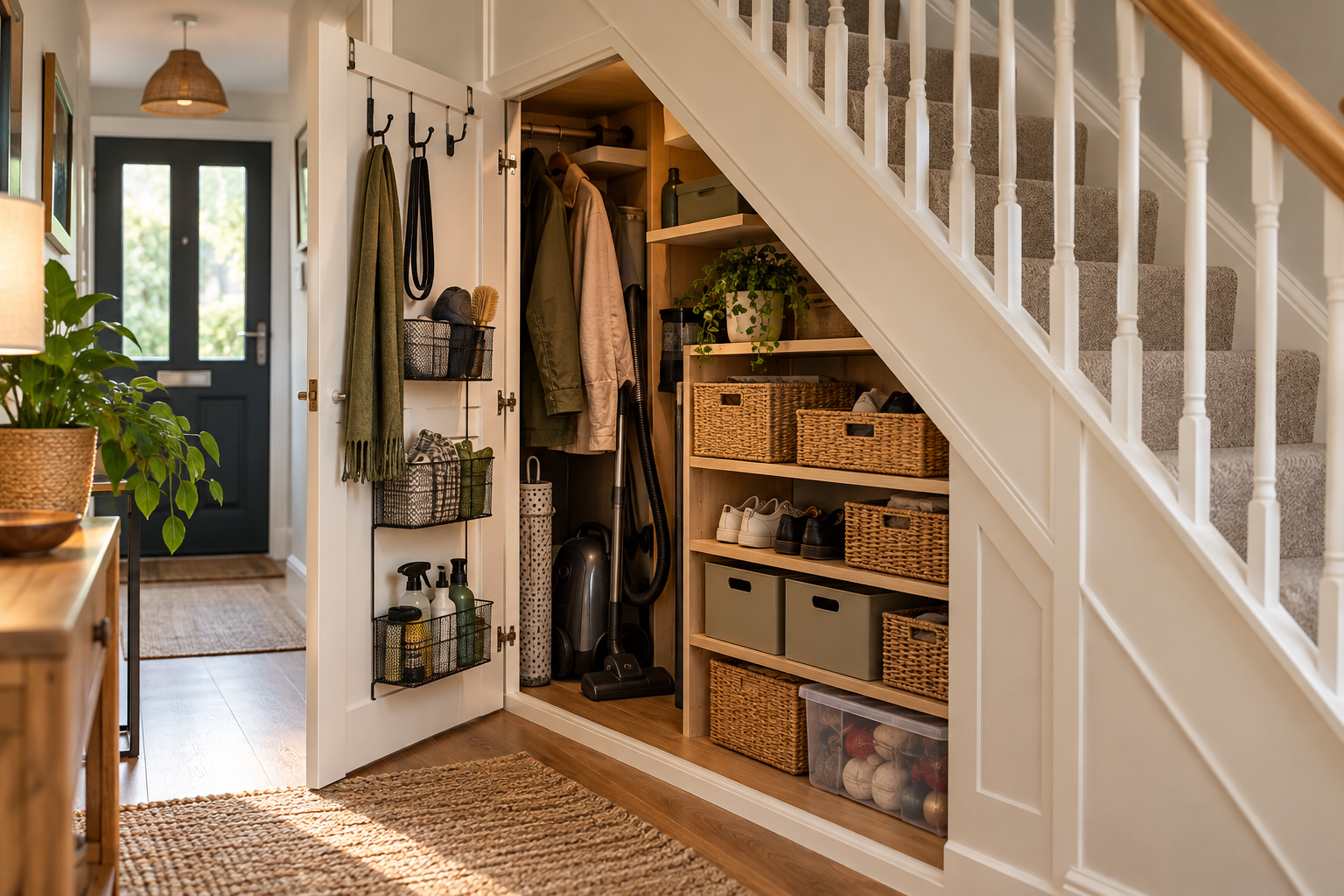
An over-door organiser can provide pockets for smaller belongings without occupying a shelf. Alternatively, a few appropriately fitted hooks may be all you need.
Depending on the location of the cupboard, the door could hold:
- Gloves and scarves
- Reusable shopping bags
- Dog leads
- Shoe-care products
- Cleaning cloths
- Small umbrellas
- Lightweight household accessories
Keep the arrangement fairly light.
The aim is to gain a little extra storage, not make the door difficult to open or close.
For anyone who can’t or doesn’t want to make permanent alterations, we’ve also put together 15 no-drill storage ideas for renters covering ways to gain useful storage without fixing everything permanently to the walls.
SONGMICS Over-Door Storage Organiser – Make use of the cupboard door: An over-door organiser adds storage without sacrificing shelf or floor space. The pockets can be useful for lighter items such as gloves, cleaning cloths, shoe-care products and other small household essentials.
5. Use Hooks for Coats, Bags and Dog-Walking Gear
A conventional wardrobe rail isn’t always the best solution beneath a sloping staircase.
Hooks are much more adaptable.
They can follow the changing height of the wall, with longer coats occupying the tallest section and shorter jackets, bags or children’s coats positioned further down.
Hooks also keep everyday belongings visible.
That’s useful in a busy hallway because things are much less likely to end up on the floor when putting them away takes only a few seconds.
A separate low hook for a dog lead or frequently used bag can be particularly handy near the entrance.
If you’re renting, avoid making permanent alterations without permission. Suitable removable or over-door products may provide an alternative for lighter items, but always check their stated weight and surface requirements.
Our broader guide to renter-friendly storage ideas has more options for adding useful storage when drilling, fitted cupboards and permanent changes aren’t practical.
6. Follow the Staircase With Modular Storage
Standard rectangular furniture can leave large gaps beneath a staircase because the available height constantly changes.
Modular storage gives you more flexibility.
Instead of trying to squeeze one large bookcase or cabinet into the recess, smaller cubes or units can sometimes be arranged in steps that roughly follow the staircase above.
Lower sections could hold shoes or baskets, while taller compartments accommodate books, household supplies or larger containers.
This approach works particularly well when the underside of the staircase is open and visible from the hallway or living room.
In that situation, resist the temptation to fill every compartment.
A mixture of useful storage and a little empty space will generally look calmer than a solid wall of boxes.
7. Use Baskets to Stop Small Things Taking Over
Baskets don’t create additional square footage, but they can prevent lots of small belongings from making a cupboard feel chaotic.
The trick is to give each basket a broad purpose rather than creating an elaborate organisation system nobody will maintain.
You might have one each for:
- Winter accessories
- Cleaning supplies
- DIY bits
- Pet equipment
- Reusable bags
- Shoe accessories
Open baskets are useful for things you reach for frequently.
Lidded boxes make more sense for occasional items that would otherwise collect dust.
Labels can help if several containers look identical, but keep the categories simple. If you have to think about where something belongs every time you put it away, the system is probably too complicated.
SONGMICS Collapsible Storage Boxes – For grouping smaller items: Collapsible fabric boxes can help keep categories such as winter accessories, pet equipment or cleaning supplies together on open shelving. When they’re not needed, they can also be folded down rather than taking up permanent space.
8. Give the Vacuum Cleaner Somewhere Sensible to Live
The vacuum cleaner is surprisingly difficult to accommodate in a small home.
An under-stairs cupboard can be an excellent solution, provided you don’t bury it behind everything else.
Reserve a clear section in the tallest part of the cupboard where the vacuum can stand upright and be removed without moving boxes first.
Wall-mounted holders can keep brooms, mops and dusters from falling across the space.
Then keep smaller cleaning products together in a basket or portable caddy nearby.
If the vacuum has several attachments, give those a container of their own rather than allowing them to migrate around the cupboard.
This is one area where accessibility matters more than maximising capacity. If getting the vacuum out is annoying, the storage isn’t working.
9. Put a Storage Bench Beneath an Open Staircase
No cupboard? The space can still work hard.
A freestanding storage bench can turn an open recess into useful hallway storage while giving you somewhere to sit when putting shoes on.
Look for designs with drawers, doors or removable baskets underneath.
This can be particularly effective in a narrow hallway because one piece of furniture performs two jobs instead of requiring a separate shoe rack and seat.
Don’t assume the bench needs to fill the entire recess.
Leaving some open space around it can prevent a small hallway from feeling boxed in and gives you flexibility if your storage needs change later.
This kind of dual-purpose furniture is especially useful in compact homes, where one piece often needs to do more than one job.
10. Use the Tallest Section for Coats
The highest end beneath the stairs is valuable because it’s one of the few places where you may have enough vertical room for hanging clothes.
Use it accordingly.
A short rail could create a compact coat cupboard, while a shelf above holds hats, gloves or other seasonal accessories.
If the space is too narrow for hangers, hooks may work better.
Keeping tall items concentrated at the high end also allows the rest of the cupboard to follow the natural slope of the staircase, with shoes, baskets and low boxes occupying progressively shorter sections.
Rather than fighting the awkward shape, you’re giving each part of it a job.
11. Turn Suitable Space Into a Small Pantry
If the staircase is reasonably close to the kitchen, an under-stairs cupboard may provide useful overflow pantry storage.
Shelves could hold unopened items such as:
- Tinned food
- Pasta and rice
- Cereal
- Baking ingredients
- Drinks
- Kitchen roll
- Spare household supplies
The biggest challenge with a deep pantry is forgetting what’s at the back.
Avoid filling shelves several rows deep where possible. Tiered shelf organisers, baskets and clearly defined categories can help keep everything visible.
It’s also important to consider the conditions inside the cupboard.
Food storage needs a suitable dry environment, so a space affected by damp, condensation, excessive heat or poor ventilation isn’t a good candidate.
Keep food off the floor and check supplies regularly so forgotten packets don’t spend years hiding behind one another.
If your kitchen itself is short on space, there are more ways to organise cupboards, worktops and everyday essentials in our guide to how to organise a small kitchen.
12. Give the Lowest Space to Seasonal Items
The very bottom of the staircase is often too low for shelves and too awkward for anything you use regularly.
That’s fine.
Not every centimetre needs to be equally convenient.
Use the lowest area for seasonal or occasional belongings instead.
Low boxes can hold Christmas decorations, picnic equipment, summer accessories or other things that only come out a handful of times each year.
Containers with handles are particularly useful because you can pull everything towards you rather than reaching into the triangular space.
Transparent boxes make contents immediately visible. If you prefer opaque containers, add clear labels to the front rather than the top so you can read them while they’re stacked or stored beneath the slope.
13. Add Pegboard for Flexible Wall Storage
An exposed wall inside or beneath the stairs can become useful storage without adding another piece of floor-standing furniture.
Pegboard is particularly flexible because hooks, baskets and small shelves can be repositioned as your needs change.
It can work well for:
- Small tools
- Craft supplies
- Dog-walking equipment
- Lightweight bags
- Cleaning accessories
- Gardening gloves and small equipment
It can also make sense in an open under-stairs area because frequently used objects have obvious places to return to.
Try not to cover every available centimetre.
Pegboard is easiest to use when you can actually see the individual items rather than creating another densely packed wall of belongings.
14. Consider Pull-Out Drawers for Deep Spaces
If you’re prepared to spend more, pull-out storage solves one of the fundamental problems beneath stairs: accessibility.
Instead of reaching into a deep cupboard, the contents come towards you.
Large drawers can work particularly well for shoes, bags, children’s equipment and bulky household items.
They can also make use of sections that would otherwise be difficult to reach because the ceiling becomes progressively lower.
This doesn’t automatically mean commissioning bespoke joinery. Depending on the dimensions, modular or DIY drawer solutions may be possible.
Measure carefully before buying anything.
Under-stairs spaces are rarely as square as they first appear, and a drawer that can’t open fully isn’t much of an improvement.
15. Consider Fitted Storage — But Only If You Need It
Bespoke under-stairs storage can make excellent use of an unusual space.
Pull-out cupboards, drawers and fitted doors can create a clean finish while using areas standard furniture struggles to reach.
But fitted joinery shouldn’t be the automatic answer.
For many homes, shelves, hooks, baskets and a few well-chosen freestanding organisers can solve most of the problem at a fraction of the cost.
Fitted storage becomes more appealing when the staircase has an especially awkward shape, you intend to stay in the property for a long time or you simply can’t find off-the-shelf solutions that make sensible use of the space.
If you do go bespoke, plan the inside before becoming distracted by how the doors will look.
Decide where the vacuum cleaner, shoes, coats, bags and boxes will actually go.
A beautifully fitted cupboard can still become a dumping ground if the interior hasn’t been designed around real life.
What Should You Avoid Storing Under the Stairs?
There is one practical consideration that matters more than squeezing in another basket.
Stairways and hallways can form part of the route you use to leave your home, so storage shouldn’t obstruct doors or your normal escape route.
Particular care is needed with e-bikes, e-scooters and lithium-ion batteries. UK government fire-safety guidance advises against storing or charging e-bikes and e-scooters where they could prevent you from safely leaving the property if a fire occurs, including escape routes.
Avoid using an under-stairs cupboard as a dumping ground for potentially hazardous or highly flammable materials.
And if the space contains an electricity meter, consumer unit, pipework or other services, don’t build permanent storage that prevents appropriate access.
If you’re uncertain about electrical equipment, fire safety or alterations to the space, get appropriate professional advice before making permanent changes.
How to Organise an Under-Stairs Cupboard That’s Already a Mess
If opening the door currently causes an avalanche, don’t start by buying more organisers.
Start by taking everything out.
Once the cupboard is empty, you’ll probably discover that some of its contents don’t need to be there at all.
Group what remains into broad categories and decide which things genuinely benefit from being stored under the stairs.
Then rebuild the cupboard around how often you use them.
Put Everyday Items Near the Front
Shoes, coats, dog leads and the vacuum cleaner should be easy to grab.
You shouldn’t have to remove three boxes to reach something you use every day.
Send Occasional Items Towards the Back
Christmas decorations, travel bags and seasonal equipment can occupy the less convenient areas.
Get Things Off the Floor
Use shelves, hooks and wall organisers wherever appropriate so the entire cupboard doesn’t depend on one increasingly crowded floor.
Keep Similar Things Together
You don’t need a complicated labelling system.
You simply need to know roughly where cleaning products, winter accessories, tools and other categories live.
Don’t Fill Every Last Gap
This might be the most important part.
A cupboard operating at maximum theoretical capacity is usually horrible to use.
Leave enough room to remove things without dismantling everything around them.
That little bit of empty space is what makes the storage practical.
Make the Awkward Shape Work for You
The best under-stairs storage isn’t necessarily the one that fits the greatest number of possessions.
It’s the one that makes everyday life easier.
Use the tallest section for things that need height. Put shelves and hooks on otherwise unused walls. Give the lowest and deepest areas to belongings you only need occasionally, and keep everyday essentials somewhere you can reach without moving anything else first.
Most importantly, work with the shape of the staircase rather than trying to force conventional storage into it.
You may eventually decide that fitted drawers or cupboards are worthwhile. But you might also discover that a few shelves, hooks, baskets and pull-out boxes solve the problem perfectly well.
And if you’re trying to improve storage throughout a compact home rather than just beneath the staircase, continue with our small-space storage ideas for UK homes for more practical ways to make overlooked space work harder.
Either way, the goal is the same: turning a forgotten triangular space into storage that actually earns its place in your home.