Finding enough storage in a rented home can be frustrating. You might have an empty wall that would be perfect for shelves, a cramped bathroom that needs somewhere for toiletries, or a kitchen where every cupboard already seems full — but drilling holes into a property you don’t own isn’t always an option.
Fortunately, creating more storage doesn’t have to mean making permanent changes.
Some of the most useful no-drill storage ideas for renters don’t attach to the walls at all. Freestanding shelves, over-door organisers, under-bed boxes and cupboard inserts can all make use of space that might otherwise go wasted.
If you’re looking for more general ways to organise a rental, our guide to renter-friendly storage ideas that won’t damage your walls has more ideas for making temporary spaces work harder.
Even in a small rented flat or house, there are often overlooked areas that can work much harder.
The aim isn’t to squeeze storage into every available corner. It’s to make better use of the space you already have.
Here are 15 practical ways to create more storage in a rented home without reaching for the drill.
Before Adding Storage to a Rented Home
Before buying organisers or attaching anything to a surface, take a few minutes to check what you’re actually working with.
Check your tenancy agreement
Rules around decorating and alterations vary between rented properties.
If you’re unsure whether you’re allowed to attach something to a wall, door or cupboard, check your tenancy agreement or ask your landlord or letting agent first.
Look at the surface
A product described as removable or renter-friendly isn’t necessarily suitable for every wall.
Smooth tiles, glass, painted plaster and textured surfaces can all behave differently. Older or poorly bonded paint may also lift when adhesive products are removed.
If you’re uncertain about a surface, storage that doesn’t attach to it at all is usually the simpler choice.
Check the weight
A removable hook holding a tea towel is very different from an adhesive shelf loaded with bottles or books.
Always check the manufacturer’s stated load limit and make sure the surface itself is suitable.
Think about removal now
Don’t wait until moving day to work out how something comes off.
Keep removal instructions for adhesive or tension-fit products somewhere safe, and avoid installing anything you’re unsure you’ll be able to remove cleanly.
With those basics covered, there are plenty of ways to create useful storage without permanently altering your rental.
1. Make Use of the Back of a Door
Doors provide a surprisingly useful area for storage, particularly in small rented homes where wall and floor space is limited.
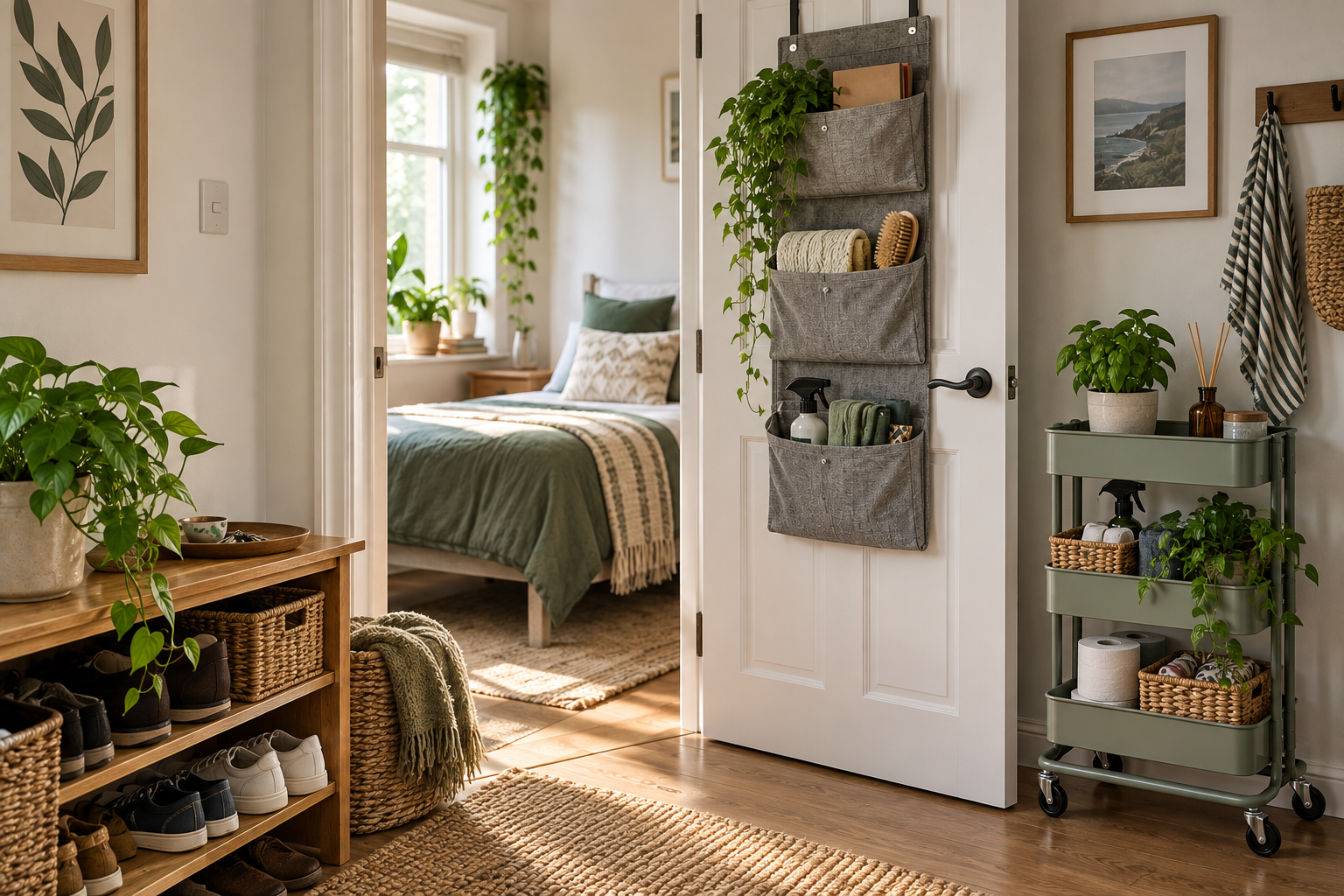
An over-the-door organiser can turn the back of a bedroom, bathroom or cupboard door into somewhere useful without drilling into the wall.
In a bedroom, you might use one for accessories, scarves or smaller clothing items. In a bathroom, pockets or baskets can hold toiletries. An organiser over a utility cupboard door could provide extra space for cleaning supplies.
Measure before buying one.
Check the thickness of the door and make sure there’s enough clearance above it for the hooks. The organiser shouldn’t stop the door closing properly or repeatedly knock against the wall.
Where the door is suitable, though, this is an easy way to create storage from an area that otherwise does very little.
2. Use the Space Under Your Bed
Under-bed space is one of the easiest storage opportunities to overlook.
If there’s a reasonable gap beneath your bed, shallow storage boxes can provide a home for things you don’t need every day, including:
- Spare bedding
- Towels
- Seasonal clothing
- Shoes
- Bags
- Christmas decorations
Lidded containers help keep dust away, while boxes with wheels or handles are easier to pull out regularly.
For particularly bulky textiles such as spare duvets or winter clothing, vacuum storage bags can reduce the amount of space they take up.
Try to keep some order underneath the bed. A few clearly separated containers are far more useful than pushing loose belongings underneath and forgetting what’s there.
In a small bedroom, this can add a surprising amount of storage without using any additional floor space. The same principle — finding overlooked areas before adding more furniture — runs through our guide to small-space storage ideas for UK homes,
3. Choose Freestanding Shelves Instead of Wall-Mounted Ones
Wall shelves are useful, but they aren’t the only way to make use of vertical space.
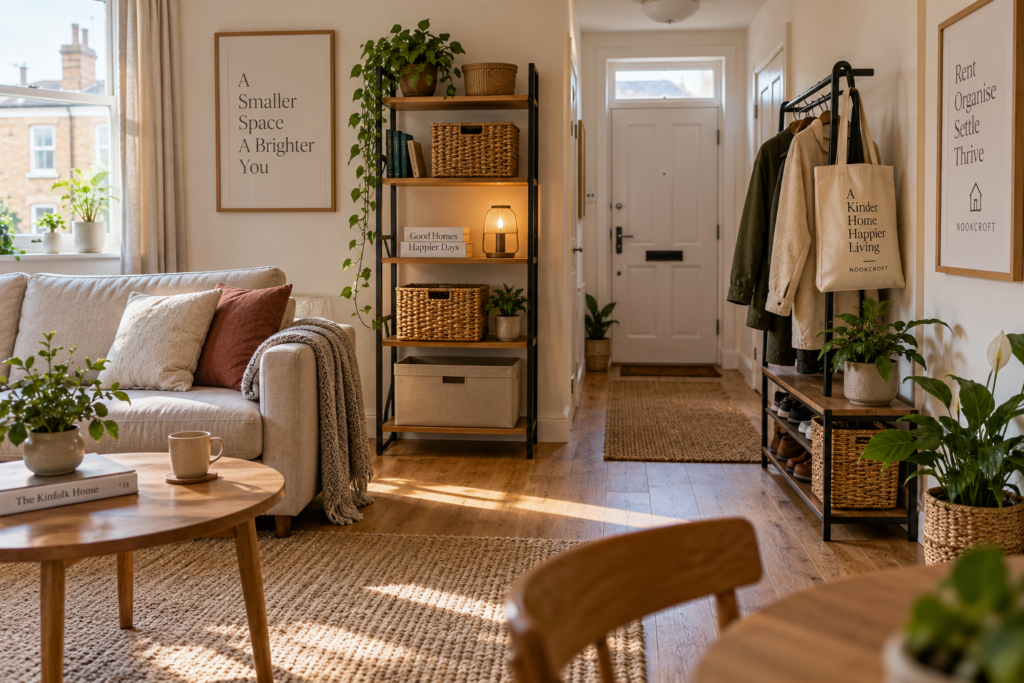
A tall freestanding shelving unit can provide several levels of storage without requiring holes in the wall.
Narrow shelving is particularly useful in smaller rooms because it uses height without taking over too much floor space. Adding baskets or boxes to some shelves can also keep smaller belongings contained and reduce visual clutter.
Measure both the available width and height before choosing a unit.
Stability matters too. Tall furniture should always be used according to the manufacturer’s safety guidance, particularly where there’s a risk of it being pulled or knocked.
For renters, freestanding furniture has another major advantage: when you move, your storage can move with you.
4. Fit a Tension Rod Inside a Cupboard
A simple tension rod can sometimes turn unused cupboard space into useful storage.
Under a kitchen sink, for example, a suitable rod can provide somewhere to hang lightweight spray bottles by their triggers, leaving the bottom of the cupboard clearer for other cleaning supplies.
Depending on the cupboard, smaller tension rods can also help organise lightweight cloths or accessories.
Because the rod is held between two suitable surfaces using pressure, there’s no need to drill holes.
Measure the space carefully, choose a rod designed for the width you’re working with and don’t exceed its recommended load.
It’s a small change, but in an awkward cupboard it can make the available space much easier to use.
5. Turn Narrow Gaps Into Storage With a Slim Trolley
Look around your kitchen or bathroom and you may find narrow gaps that aren’t currently doing anything.
The space beside a washing machine, next to a kitchen unit or between pieces of furniture might be too small for conventional storage but wide enough for a slim trolley.
In a kitchen, it could hold packets, bottles or cleaning supplies. In a bathroom, it might provide somewhere for toiletries, spare toilet rolls or cleaning products.
A trolley on wheels is particularly useful because you can pull the whole unit out rather than trying to reach into a narrow space.
Measure carefully before buying one — including the depth and any skirting boards or pipes that could get in the way.
A few centimetres can be the difference between useful storage and something that doesn’t quite fit.
If your kitchen has several awkward spaces like this, there are more ways to reclaim them in our guide to organising a small kitchen.
6. Add Another Level Inside Cupboards With Shelf Risers
Sometimes you don’t need another cupboard. You just need to make the cupboard you already have work harder.
If there’s a large amount of empty space above short items on a shelf, a freestanding shelf riser can effectively create another level.
They’re particularly useful in kitchen cupboards containing plates, mugs, tins or packets, but the same idea can work in bathroom and utility storage.
Because a riser simply sits on the existing shelf, there’s normally no installation required, and it can easily be rearranged later.
Measure the internal height, width and depth of the cupboard rather than relying on its outside dimensions.
It’s one of the simplest no-drill storage ideas because you’re improving storage you already have rather than adding another piece of furniture to the room.
7. Use Removable Hooks for Lightweight Storage
Removable adhesive hooks can be useful in a rented home, but they’re best treated as a lightweight storage solution rather than a substitute for every wall fixing.
They can provide convenient places for things such as:
- Keys
- Tea towels
- Lightweight kitchen utensils
- Small accessories
- Empty reusable bags
The important word is lightweight.
Check that the hook is suitable for the surface, follow the installation and removal instructions and stay within the manufacturer’s stated load limit.
Paint condition matters too. An adhesive product may remove cleanly from one painted surface but cause problems on another, particularly where paint is old, poorly bonded or unsuitable for the product.
If you’re concerned about the surface, look for a storage solution that doesn’t attach to it at all.
8. Use the Inside of Cupboard Doors
Cupboard doors don’t only hide what’s inside. In the right cupboard, the inside of the door can become useful storage too.
Small organisers, hanging baskets or suitable lightweight hooks can provide somewhere for frequently used items that would otherwise disappear into the back of a cupboard.
In the kitchen, this could mean cleaning cloths or small accessories. In a bathroom cupboard, it might be toiletries or hair products.
Before adding anything, check the clearance.
Close the cupboard slowly and look at where the shelves and contents sit. An organiser that’s too deep can hit what’s inside and stop the door closing properly.
Avoid putting excessive weight on a cupboard door, too.
Used thoughtfully, however, this can turn an overlooked surface into genuinely useful storage.
9. Add a Freestanding Clothes Rail
Not every rented home comes with enough wardrobe space.
A freestanding clothes rail is one of the simplest ways to add hanging storage without installing anything.
If space is limited, look for a design that also makes use of the area underneath. A lower shelf can hold shoes, while baskets below the rail can provide space for folded clothes or accessories.
It can also relieve an overcrowded wardrobe, making the clothes you already own easier to see and reach.
Don’t overload the rail. Check its weight limit and distribute clothes sensibly so it remains stable.
And if you rearrange the bedroom — or eventually move home — the whole rail can simply move with you.
10. Choose Furniture That Does Two Jobs
When floor space is limited, adding more furniture isn’t always the answer.
Instead, look at whether furniture you already need could provide storage as well.
A storage ottoman might hold spare blankets. A bench with compartments underneath could provide somewhere for shoes. A bedside table with drawers can hide smaller belongings that would otherwise gather on top.
A bed with built-in drawers can add a significant amount of bedroom storage without requiring another piece of furniture at all.
This is particularly useful in smaller rented homes because you’re getting two functions from roughly the same footprint.
Before buying storage furniture, think about what you actually need to put inside it.
The best option isn’t necessarily the one with the most compartments. It’s the one that solves a real storage problem in your home.
11. Add Stackable Storage Inside a Wardrobe
A wardrobe with one hanging rail and a large empty area underneath isn’t necessarily using its space efficiently.
Freestanding stackable drawers, boxes or modular organisers can make the lower part of the wardrobe much more useful without modifying the wardrobe itself.
They can work well for:
- Folded clothes
- Shoes
- Accessories
- Bedding
- Bags
Measure the usable interior carefully, particularly if hinges, sliding doors or a low hanging rail reduce the available space.
And resist the temptation to fill every centimetre.
Good wardrobe storage should make belongings easier to reach, not create another tightly packed space you have to dismantle whenever you need something.
12. Add No-Drill Storage to the Bathroom
Bathrooms can be particularly awkward for renters because drilling into tiles isn’t something to do casually.
Where the room and surfaces are suitable, a tension-fit shower caddy can provide several levels of storage for shampoo, shower gel and other toiletries without permanent fixings.
Check the measurements carefully and choose something intended for a damp environment.
Don’t overload the baskets, and periodically check that the unit remains secure.
A tension caddy isn’t the only option. Depending on the room, a freestanding narrow unit or suitable over-door organiser could provide the storage you need without attaching anything to the bathroom walls.
This is especially useful in a small bathroom, where a little extra vertical storage can make a big difference without taking over the room. We’ve covered more ways to use these awkward spaces in 15 Small Bathroom Storage Ideas That Make the Most of Limited Space.
13. Look Above Wardrobes and Kitchen Units
When storage is limited, look upwards.
The area above a wardrobe or tall kitchen unit often sits empty, yet it can be useful for things you only need occasionally.
Baskets or lightweight boxes can keep the area looking organised while providing somewhere for seasonal items, spare textiles or less frequently used belongings.
Keep heavier items elsewhere and think carefully about accessibility.
If retrieving something requires an unsafe balancing act every time you need it, it’s in the wrong place.
Higher storage is generally better for lightweight items you use occasionally.
Used sensibly, it can free up much more accessible cupboards and shelves for everyday belongings.
14. Make Use of Magnetic Storage
If you already have a suitable magnetic surface, you may be able to create additional storage without drilling or using adhesive.
The side of some fridges, for example, can provide space for lightweight magnetic racks, containers or hooks.
That can be useful for small kitchen items that would otherwise occupy valuable worktop or cupboard space.
Don’t assume every metallic-looking appliance is magnetic, though. Test the surface first and make sure any accessory is appropriate for it.
Avoid covering vents, controls or anything the appliance needs to operate safely.
For the right surface and the right items, magnetic storage is a simple way to use vertical space that’s already available.
15. Create a Portable Storage Station
Not every storage solution needs to stay in one place.
A small trolley, basket system or compact freestanding unit can create a portable storage station for belongings you use in different parts of the home.
You might create one for:
- Cleaning supplies
- Craft materials
- Home-office equipment
- Toiletries
- Hair and beauty products
Instead of keeping related things in several cupboards, they stay together and the storage can move to wherever you need it.
This works particularly well when one room has several uses.
If your dining table doubles as a desk, for example, keeping work supplies together in a movable trolley makes it much easier to clear everything away at the end of the day.
It’s also exactly the sort of storage that suits renting: when you move home, the whole setup can come with you.
Which No-Drill Storage Is Best for a Rented Home?
Not all no-drill storage works in the same way.
If avoiding changes to the property is your main priority, it helps to think about how each option interacts with the room.
| Storage type | Contact with the property | Best for | Check before using |
|---|---|---|---|
| Freestanding | No wall contact | General and heavier storage | Size and stability |
| Over-door | Hangs from a suitable door | Accessories and lightweight items | Door thickness and clearance |
| Tension-fit | Applies pressure to suitable surfaces | Cupboards and bathrooms | Surface suitability and load |
| Removable adhesive | Direct surface contact | Lightweight everyday items | Surface condition and load limit |
| Magnetic | Attaches to a magnetic surface | Lightweight kitchen storage | Compatibility and weight |
If protecting painted walls is your main concern, start by looking at solutions that don’t need to touch them at all.
Under-bed storage, freestanding furniture, cupboard organisers and suitable over-door storage can solve a surprising number of problems before adhesive products even need to enter the equation.
No-Drill Doesn’t Always Mean Damage-Free
One of the most useful distinctions to make when organising a rented home is that no-drill and damage-free don’t necessarily mean the same thing.
A storage product can require no screws or nails and still make direct contact with a wall, door, tile or piece of furniture.
Adhesive products are the obvious example.
They can be extremely useful in the right circumstances, but successful removal depends on factors including the surface, the condition of the paint, correct installation and following the removal instructions.
Tension-fit products also need suitable surfaces because they work by applying pressure.
Even completely freestanding furniture needs some thought around stability and safe positioning.
Rather than relying on a product simply because it’s labelled “renter-friendly”, choose the solution that makes sense for the particular surface and job.
And when you’re uncertain about attaching something to a wall, start with storage that doesn’t need to attach to it at all.
If you’re also trying to make a rented property feel more personal without making permanent changes, our renter-friendly decorating ideas cover that side of renting in more detail.
How to Choose No-Drill Storage You’ll Actually Use
It’s easy to buy organisers. Creating storage that genuinely makes your home easier to live in takes a little more thought.
Measure before you buy
Measure narrow gaps, cupboard interiors, wardrobe depths and door thicknesses before ordering anything.
For cupboards and doors, remember to account for the space they need to open and close too.
Solve one problem at a time
Start with what’s actually frustrating you.
If shoes are constantly gathering in the hallway, solve the shoe problem. If cleaning products are taking over a kitchen cupboard, tackle that cupboard.
For a particularly narrow entrance, our small hallway storage ideas look specifically at making these awkward spaces work harder.
Buying storage without knowing what will go inside it can simply create another object that needs somewhere to live.
Keep everyday things within reach
The things you use most should generally be the easiest to access.
Higher shelves, under-bed boxes and the tops of wardrobes are better suited to belongings you only need occasionally.
Think about your next home too
One of the advantages of freestanding and modular storage is that it isn’t designed around one particular property.
A slim trolley that works in your kitchen today might become bathroom storage in your next home. A freestanding shelving unit could move from a bedroom to a home office.
That flexibility is particularly valuable when you’re renting.
Frequently Asked Questions
Can renters put shelves up without drilling?
Yes. If traditional wall-mounted shelving isn’t suitable, freestanding shelving, shelf risers and some tension-fit systems can provide extra levels of storage without drilling into a wall.
Some adhesive shelving products are designed for particular surfaces and loads, but check the manufacturer’s instructions carefully before using them in a rented property.
Do removable adhesive strips damage painted walls?
Products designed to be removable should be used and removed according to the manufacturer’s instructions, but no adhesive solution should be assumed suitable for every painted wall.
The type and condition of the paint, the underlying surface and the way the product is installed and removed can all affect the result.
If you’re unsure about a wall, consider a storage option that doesn’t attach to it.
What is the safest storage option for a rented home?
If your priority is avoiding changes to walls and other surfaces, start with storage that doesn’t attach to the property.
Under-bed boxes, freestanding shelves, storage furniture, portable trolleys and suitable over-door organisers are all possibilities.
Whatever you use should still be stable, appropriately loaded and installed or positioned according to its safety instructions.
How can I add storage to a small rented flat?
Look for space that’s currently underused before adding more furniture.
Under the bed, behind suitable doors, inside cupboards, beneath hanging clothes, in narrow gaps and above existing furniture can all offer useful storage opportunities.
Furniture that combines storage with another function can also help you increase capacity without sacrificing as much floor space.
For more ideas that work across several rooms, see our small-space storage ideas for UK homes.
Make the Home You Have Work Harder
Renting doesn’t mean you have to live with inadequate storage.
Often, the best improvements come from noticing the space that’s already there: the gap beneath the bed, unused height inside a cupboard, the back of a suitable door or the empty area below hanging clothes.
Start with the part of your home that’s causing the most frustration and solve that problem first.
A few well-chosen changes are usually more useful than filling a room with organisers you don’t really need.
And wherever possible, choose storage that can adapt with you.
Because one of the biggest advantages of good renter-friendly storage is simple: when it’s eventually time to move, you can take it with you.