
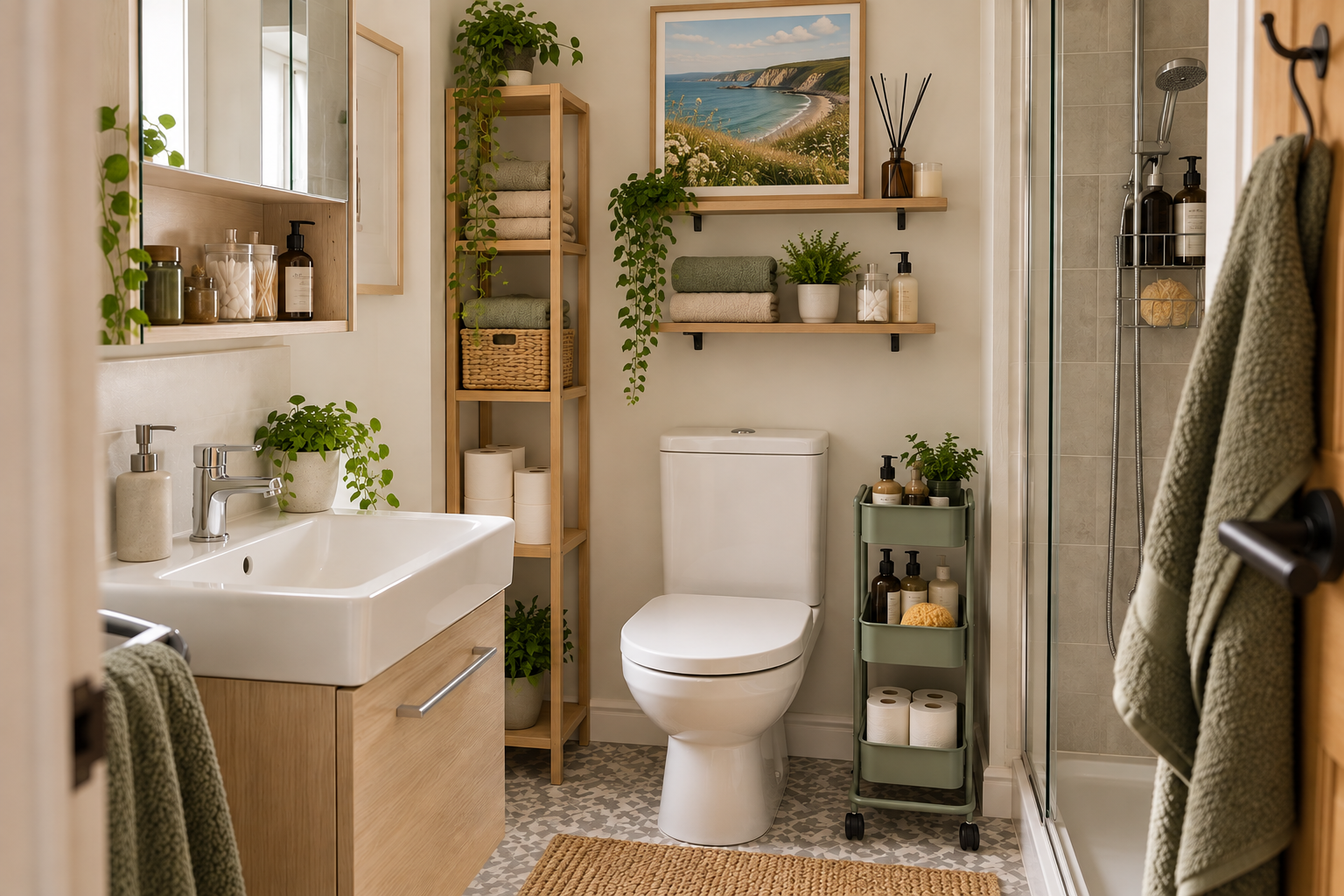
Small bathrooms have an awkward job to do.
Even the smallest room may need to accommodate towels, toiletries, toilet rolls, cleaning products, grooming essentials and everything you use around the bath or shower. Add a lack of cupboards or an awkward layout and it doesn’t take much for the room to start feeling cluttered.
The obvious response is to add more storage.
But in a small bathroom, that isn’t always the answer.
Every additional cabinet, trolley, basket and shelf takes up physical or visual space of its own. Fill every available wall and corner with storage and you can end up making the bathroom feel smaller rather than more organised.
A better approach is to decide what genuinely needs to live in the bathroom, give the things you use regularly an obvious home, and then make better use of the storage you already have.
A small bathroom doesn’t need storage in every available gap. It needs the right things stored in the right places.
Here are 15 practical ways to make that happen.
Before You Buy Bathroom Storage, Empty What You Already Have
Before measuring for another cabinet or ordering a set of organisers, take a proper look at what’s already occupying the room.
Empty bathroom cupboards and drawers one at a time. Look through baskets, shelves and the collection of bottles that may have accumulated around the bath or shower.
You may find half-used products you no longer use, several versions of the same thing, empty packaging or toiletries that have been sitting untouched for months.
Group similar items together:
- everyday toiletries
- shower and bath products
- grooming products
- clean towels
- spare toilet rolls
- cleaning supplies
- unopened toiletries and refills
- occasional-use products
This makes it much easier to see what you’re actually trying to store.
It’s also worth asking whether everything needs to stay in the bathroom.
A large pack of toilet rolls doesn’t necessarily need to sit beside the toilet. Several clean towels don’t always need to occupy a bathroom cupboard. Unopened toiletries could potentially live elsewhere until they’re needed.
The most accessible bathroom storage should usually be reserved for the things you use most often.
Once you know what’s staying, you can start finding sensible homes for it.
1. Make the Space Beneath the Basin Work Harder
The cupboard beneath a bathroom basin can look generous from the outside and turn out to be surprisingly awkward once you open it.
Pipework often runs directly through the middle of the space, making ordinary shelves difficult to use. As a result, bottles and cleaning products tend to accumulate around the pipes with a large amount of unused space above them.
Rather than treating the cupboard as one large storage area, divide it into smaller usable zones.
Small baskets can group similar products together. Stackable organisers may help make use of some of the height, while shallow containers can prevent smaller items disappearing behind bottles.
Whatever you use, keep access to the plumbing in mind.
You don’t want to dismantle an elaborate storage system simply to reach a valve or investigate a leak. Avoid packing the cupboard so tightly that moisture or problems around the pipework become difficult to spot.
Nookcroft tip: Work around the plumbing rather than trying to hide it completely. A slightly less full cupboard that’s easy to inspect can be much more practical.
2. Let the Mirror Provide Storage Too
Most bathrooms need a mirror.
If you’re short on storage, letting the mirror perform a second job can make a lot of sense.
A mirrored cabinet can provide a useful home for smaller everyday items such as skincare products, shaving supplies, dental products and other toiletries without requiring another piece of furniture on the floor.
This is particularly useful above a basin, where many of those items are already used.
Depth matters, though.
In a particularly narrow bathroom, a deep cabinet projecting from the wall may feel intrusive even if it technically fits. Measure how far it will extend into the room and consider how comfortably you’ll be able to use the basin beneath it.
If you’re replacing an existing mirror anyway, a mirrored cabinet can be an efficient upgrade.
If your current mirror works perfectly well and storage isn’t a serious problem, replacing it purely to gain another cupboard may be unnecessary.
The aim isn’t to turn everything in the room into storage. It’s to choose additions that solve an actual problem.
3. Use Shallow Wall Storage
When floor space is limited, walls become an obvious place to look.
But there’s an important difference between using wall space and simply filling the walls with cupboards.
Shallow shelving can provide enough room for small toiletries, baskets or spare essentials without projecting too far into the bathroom. A slim wall-mounted cabinet may offer more concealed storage while keeping the floor beneath it clear.
Think carefully about where wall storage is positioned.
A shelf that works perfectly above the toilet may feel uncomfortable beside a doorway or directly where someone stands up from the bath.
Head clearance matters too.
Before installing anything, move around the bathroom as you normally would and consider where people lean, reach, bend and turn.
In a small room, a few centimetres can make the difference between storage that feels useful and storage that constantly gets in the way.
4. Look at the Space Above the Toilet
The wall above the toilet is often left completely empty.
In the right bathroom, it can provide useful storage without taking away any additional floor space.
A shelf could hold spare toilet rolls, a small basket or lightweight bathroom essentials. A suitably sized wall cabinet could provide concealed storage if you need more capacity.
That doesn’t mean the entire wall needs filling.
A large, deep cupboard directly above the toilet can make a compact bathroom feel enclosed, particularly if the room is already narrow.
Keep the proportions appropriate to the space.
Anything mounted on the wall should be installed using fixings appropriate for the wall construction and the load being supported.
Think about accessibility too. Everyday products are only useful above the toilet if you can comfortably reach them. Higher storage may be better suited to lighter items or things you don’t need several times a day.
5. Choose Tall Storage Instead of Wide Storage
If you have a small amount of spare floor space, using height can provide more storage without taking over the room.
A tall, narrow cabinet may hold towels, toiletries and spare supplies while occupying considerably less floor area than a wider chest or cupboard.
This can work particularly well in a corner or beside a basin where broader furniture wouldn’t fit.
Before buying, measure the width, depth and height of the available space. Check door and drawer clearance and make sure the unit won’t interfere with radiators, towel rails, switches or other fittings.
Consider how you’ll reach the upper shelves too.
There’s little benefit in creating storage you can barely use.
In bathrooms, the furniture itself also needs to be suitable for where you intend to use it. Follow the manufacturer’s guidance and consider how the materials will cope with the conditions in the room.
The goal is to gain useful vertical storage without making the bathroom feel dominated by furniture.
6. Keep Shower Storage Under Control
Bath and shower areas have a habit of collecting bottles.
Shampoo, conditioner, shower gel, face wash and other products gradually spread across bath edges, windowsills and shower trays until the area becomes difficult to keep tidy.
Before adding a larger organiser, remove products that aren’t currently being used.
If you’ve switched shampoos but kept the old bottle “just in case”, decide whether it genuinely needs to remain in the shower. Do the same with nearly empty products and occasional treatments.
Then choose storage that suits what’s left.
Depending on the bathroom, that might be a shower caddy, corner basket or another organiser intended for use in that environment.
Look for a solution that allows water to drain and doesn’t make the surrounding area unnecessarily difficult to clean.
Nookcroft tip: The shower is prime bathroom space. Reserve it for products you’re actually using rather than treating it as long-term toiletry storage.
7. Give Towels a Proper Home
Towels create two different storage problems.
There are the towels currently being used, which need somewhere they can dry, and there are clean spare towels waiting to be used.
Treating both groups in the same way can waste valuable bathroom space.
A towel rail or appropriately positioned hooks may work well for towels currently in use, provided they’re able to dry between uses.
Clean towels can be folded on a shelf, kept in a cupboard or stored elsewhere in the home if the bathroom doesn’t have enough room.
You don’t necessarily need the entire household towel supply inside the bathroom.
If space is particularly limited, keeping one or two clean replacements nearby and storing the rest elsewhere can free a surprising amount of room.
The important distinction is between storage for clean towels and somewhere suitable for a damp towel after a bath or shower.
8. Use Hooks for Frequently Used Items
Hooks are one of the simplest ways to add useful storage without occupying much space.
They can work well for robes, towels and other lightweight everyday items, particularly where there isn’t room for freestanding furniture.
The trick is not to turn every available wall into a row of hooks.
Too many items hanging in a small bathroom can quickly make the room feel cluttered, even if everything technically has a designated place.
Use hooks for things that genuinely benefit from being immediately accessible.
Position them where hanging items won’t block doors, trail on the floor or interfere with other fittings.
If you’re installing permanent hooks, make sure the fixing method is appropriate for the surface and avoid drilling where concealed pipes or electrical cables may be present.
Renters may prefer non-permanent alternatives, which we’ll cover later.
9. Put the Back of the Door to Work
The back of the bathroom door can provide useful storage because it normally occupies no additional floor space.
Depending on the door and layout, it could accommodate hooks, a hanging organiser or a rail.
This can be particularly helpful for robes, lightweight towels or smaller bathroom accessories.
Before buying anything, check the clearance.
An over-door organiser or hook needs enough room between the top of the door and the frame, and whatever you hang from it shouldn’t prevent the door opening fully.
It’s also worth considering what happens when the door is open.
A bulky organiser may collide with a wall, radiator, cabinet or towel rail.
The back of a door is useful precisely because it’s otherwise underused. Keep the solution simple enough that the door still works as a door.
If you’re looking for more ways to use overlooked areas around a compact home, our guide to small-space storage ideas covers doors, awkward gaps, under-stairs spaces and more.
10. Turn Narrow Gaps Into Useful Storage
Bathrooms often contain small gaps created by the position of the basin, toilet, bath or existing furniture.
Some of these can be useful.
A narrow trolley or slim storage unit may fit beside a basin or in another awkward space and provide a home for toiletries, toilet rolls or other suitable supplies.
Measure the gap properly before buying anything.
Check the width at more than one point, particularly in older homes where walls and floors may not be perfectly straight.
Measure depth too.
A unit that fits the width of a gap but projects too far into the room may create more problems than it solves.
Also consider whether the gap needs to remain accessible for cleaning, plumbing or other fittings.
Not every narrow space needs filling. Use it when doing so genuinely improves the room.
11. Consider a Movable Storage Trolley
A slim trolley can be useful when a bathroom has very little built-in storage and you don’t want to install permanent cabinetry.
Its main advantage is flexibility.
It can sit beside a basin or in an unused corner, then be moved when you need to clean or access the area behind it.
Different levels can also separate categories of items — perhaps everyday toiletries at the top and less frequently used supplies lower down.
Avoid overloading it.
A narrow trolley packed with tall bottles and loose items can quickly become awkward to move and visually messy.
Think about whether the trolley could serve another purpose elsewhere too.
For renters in particular, adaptable furniture can be more useful than something purchased specifically for one unusual gap in one property.
12. Organise Inside the Storage You Already Have
One of the easiest ways to gain bathroom storage is to improve the cupboards and drawers you already own.
Deep drawers can become jumbled collections of small products. Cupboards can end up with everything lined along the front while the space behind becomes difficult to reach.
Simple internal organisation can help.
Group similar products together so that dental care, skincare, grooming items and other categories each have an obvious place.
Small containers or drawer dividers can prevent tiny items becoming scattered throughout a large drawer.
You don’t need a perfectly matching set of organisers.
Before buying anything new, try repurposing small containers you already own and see whether the system actually works.
Put frequently used products where they’re easiest to reach and occasional items further back or higher up.
A well-organised cupboard can create more usable capacity without adding another piece of furniture to the room.
13. Separate Everyday Toiletries From Backups
Bulk buying can save money, but spare products don’t deserve the most convenient storage in the bathroom.
If you’re currently using one bottle of shampoo, the unopened replacements don’t need to sit beside it.
The same applies to toothpaste, soap, toilet rolls and other supplies.
Keep the product you’re actively using within easy reach and move backups into less valuable storage.
That might mean the back of a cupboard, the upper shelf of a tall unit or somewhere outside the bathroom entirely.
This distinction between active and backup storage also makes it easier to see what you already own.
When every bottle is stored together, it’s surprisingly easy to buy another product because you’ve forgotten about the unopened one hidden at the back.
If storage is extremely limited, consider that when buying large multipacks too. A saving isn’t quite as useful if you have nowhere sensible to keep what you’ve bought.
14. Make Bathroom Storage Renter-Friendly
Renting can limit how much you’re able or willing to change.
You may not want to drill into tiles, install cabinetry or make permanent alterations simply to gain a little more storage.
Fortunately, many useful small-bathroom solutions can be freestanding.
A slim trolley, narrow cabinet, baskets or other movable organisers can add useful capacity without becoming part of the property.
Over-door storage may also work where the door and frame allow it.
Adhesive hooks and similar products are another possibility, but don’t assume that something marketed as removable is guaranteed to leave every surface untouched.
Paint, tiles, finishes and adhesives vary.
Follow the product instructions, consider the surface underneath and check your tenancy agreement before making changes to the property.
Our guide to renter-friendly storage ideas has more ways to organise a home without relying on permanent fitted storage.
Nookcroft tip: For renters, portability has value. Storage that can move to another room — or another home — may be a better purchase than something designed around one very specific bathroom.
15. Decide What Doesn’t Need to Live in the Bathroom
Sometimes the easiest way to gain bathroom storage is to move something out of the bathroom.
If the room is extremely small, look at what’s occupying valuable cupboard and shelf space and ask whether it genuinely needs to stay.
Spare towels could live in a bedroom or linen cupboard.
Bulk packs of toilet rolls might fit elsewhere.
Unopened toiletries could be stored with other household supplies until they’re needed.
Some cleaning products may also have a more appropriate storage location elsewhere in the home, depending on their instructions and household circumstances.
The same applies to products that aren’t suited to the conditions in a bathroom.
Bathrooms can experience regular changes in temperature and humidity, so follow the storage instructions provided for medicines, cosmetics and other products rather than assuming the bathroom is automatically the right place for them.
Moving something elsewhere isn’t cheating.
The aim isn’t to make the bathroom hold as much as physically possible.
It’s to make the bathroom work.
How to Make a Small Bathroom Feel Less Cluttered
A bathroom can be well organised and still look busy.
That’s because small rooms make every visible object more noticeable.
Start with the surfaces you see most.
If the basin is surrounded by bottles, grooming products and spare toiletries, decide what actually needs to remain there every day.
The same applies around the bath and shower.
You don’t need to hide everything.
A hand wash beside the basin or a few products in the shower are part of a functioning bathroom. The goal isn’t to make the room look as though nobody uses it.
Instead, reduce the number of objects competing for attention.
Grouping smaller products together can make them feel less scattered.
Closed cupboards are useful for collections of small toiletries, while open shelves work well for a smaller number of items that are easy to keep organised.
Preserve some open space too.
In a compact bathroom, a clear section of wall, worktop or floor can help the room feel calmer and make cleaning easier.
Where Should You Start on a Small Budget?
Start without buying anything.
Declutter the bathroom, group similar products together and reorganise the storage you already have.
You may discover that the problem isn’t a complete lack of storage. The most useful spaces may simply be occupied by things you rarely need.
Once you’ve reorganised, identify the biggest remaining problem.
If toiletries constantly cover the basin, concentrate on everyday toiletry storage.
If clean towels consume an entire cupboard, decide whether some can live elsewhere.
If the bathroom has virtually no built-in storage, one carefully chosen cabinet or trolley may make a significant difference.
If the shower is cluttered, solve that problem before buying organisers for other parts of the room.
You don’t need to redesign the entire bathroom at once.
One storage solution that fixes a genuine problem is usually more valuable than five inexpensive organisers purchased without a plan.
Common Small Bathroom Storage Mistakes
Buying Storage Before Decluttering
It’s difficult to choose the right storage when you don’t yet know how much you genuinely need.
Declutter first.
Otherwise, you risk buying furniture and organisers simply to create permanent homes for things you don’t actually use.
Ignoring Moisture
Bathrooms aren’t ordinary rooms.
Storage may be exposed to steam, splashes and regular changes in humidity.
Choose products suitable for where they’re being used, follow manufacturer guidance and avoid arrangements that make surfaces unnecessarily difficult to dry or clean.
Blocking Access to Plumbing
Under-sink storage can be useful, but pipework still needs to remain accessible.
Don’t pack cupboards so tightly that checking for leaks or reaching accessible plumbing becomes unnecessarily difficult.
Adding Too Much to the Walls
Vertical storage can be extremely useful in a small bathroom.
That doesn’t mean every wall needs a cabinet, shelf or hook.
Too much wall-mounted storage can make a narrow room feel enclosed and may create obstacles around doors, baths, toilets and basins.
Keeping Too Many Products in the Shower
The shower should contain the products you regularly use there.
When every ledge is covered with bottles, the area becomes harder to clean and can look cluttered even when the rest of the bathroom is organised.
Trying to Use Every Available Gap
Not every empty corner represents a storage opportunity.
Sometimes leaving a gap empty makes the bathroom easier to clean, improves access or simply prevents the room feeling overcrowded.
Judge storage by how well the bathroom works afterwards, not by how many containers you’ve managed to fit into it.
Small Bathroom Storage FAQs
How can I add storage to a bathroom with no cupboards?
Start by looking for areas that don’t require much floor space.
A mirrored cabinet, shallow wall storage, appropriately positioned shelves, a slim freestanding unit or a movable trolley may provide useful capacity depending on the room.
The back of the door can sometimes provide additional storage too.
Before adding anything, reduce what needs to stay in the bathroom. A small amount of well-planned storage may be enough once backups and rarely used items have been moved elsewhere.
What can I store under a bathroom sink?
Under-sink cupboards can work well for suitable bathroom supplies, provided they’re organised around the pipework and the area can still be inspected and accessed when needed.
Baskets or small containers can help separate categories and make items easier to remove.
Avoid packing the space so tightly that plumbing becomes difficult to access or signs of moisture are hidden.
Follow the storage instructions supplied with individual products.
How do I organise toiletries in a small bathroom?
Separate toiletries into everyday products, occasional products and unopened backups.
Give everyday products the easiest-to-reach storage.
Occasional items can go further back in a cupboard or higher on a shelf, while unopened replacements may be able to live elsewhere until they’re needed.
Grouping similar items together also makes it easier to see what you own and avoid unnecessary duplicates.
How can I store towels in a small bathroom?
Separate towels currently being used from clean spare towels.
Damp towels need somewhere they can hang and dry appropriately, such as a suitable rail or hook.
Clean towels can be kept on a shelf or in a cupboard, but if bathroom space is very limited there’s no rule saying all your spare towels have to stay there.
Keeping additional clean towels elsewhere can free valuable bathroom storage.
What bathroom storage works well for renters?
Freestanding storage tends to offer the most flexibility.
Slim cabinets, trolleys, baskets and other movable organisers can provide useful storage without requiring permanent changes.
Over-door solutions may also work depending on the door.
If you’re considering adhesive or wall-mounted products, check the manufacturer’s instructions, the surface and your tenancy agreement rather than assuming that a product described as removable will always be damage-free.
For more ideas around rented homes, see our guide to renter-friendly storage ideas that won’t damage your walls.
How do I make a small bathroom look less cluttered?
Reduce the number of products left on visible surfaces and group smaller items together.
Keep only regularly used products around the basin, bath and shower.
Closed storage can help with collections of small toiletries, while leaving some walls, surfaces and floor areas free can prevent the room feeling overcrowded.
Most importantly, don’t confuse filling every available space with good organisation.
Final Thoughts
Small bathrooms don’t necessarily need large amounts of storage.
They need storage that reflects how the room is actually used.
Start with the things you reach for every day and give them convenient homes.
Make sensible use of overlooked areas such as the space beneath the basin, the back of the door and appropriate sections of wall.
Allow damp towels and shower areas to dry properly.
Keep plumbing accessible.
Move spare supplies elsewhere when they don’t need to occupy valuable bathroom space.
And resist the temptation to fill every empty gap with another basket, shelf or cabinet.
Sometimes the best small-space decision is to leave a little room empty.
If you’re looking beyond the bathroom, our guide to small-space storage ideas for UK homes explores more ways to make awkward gaps, doors, furniture and overlooked areas work harder throughout the home.
Before buying your next bathroom organiser, ask one simple question:
Will this make the bathroom easier to use — or will it simply give me somewhere to keep more stuff?