
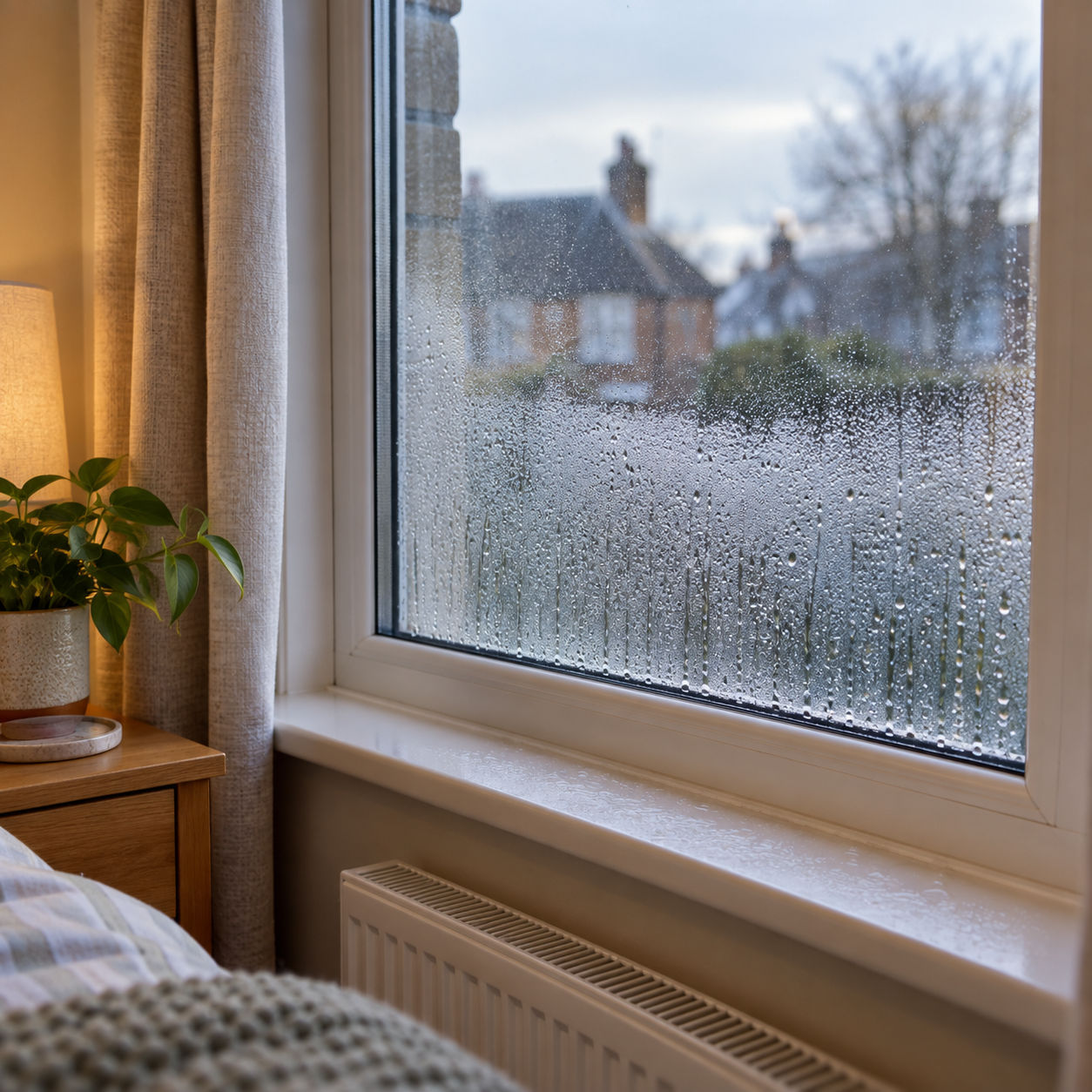
Waking up to wet windows is common during colder weather, but if the glass is regularly covered in water every morning, it’s worth finding out why.
Condensation on the inside of a window usually happens when moist indoor air meets cold glass. The most effective approach is therefore not one miracle product or household hack. It’s a combination of reducing excess moisture, giving that moisture somewhere to escape and preventing rooms and surfaces from becoming unnecessarily cold.
Start with the simple things: clear away water that’s already formed, keep trickle vents open, use extractor fans when cooking and showering, ventilate rooms when needed and pay attention to activities such as drying washing indoors.
But before changing anything, check where the condensation is actually forming. Moisture on the inside, outside and between the panes of a window can mean very different things.
Why Do Windows Get Condensation?
Air inside your home contains water vapour.
Everyday activities continually add more of it. Cooking, showering, drying clothes and even breathing all release moisture into the air.
When warm, moisture-laden air reaches a sufficiently cold surface, some of that water vapour turns back into liquid water.
That’s condensation.
Windows are often where you notice it first because the glass can be one of the coldest surfaces in a room, particularly during autumn and winter.
This explains why a bedroom window might be completely dry when you go to bed but covered in droplets the following morning.
The goal isn’t to eliminate moisture completely. Every occupied home contains moisture.
What you’re trying to avoid is excess moisture repeatedly collecting on cold surfaces and keeping parts of the home damp.
First, Check Where the Condensation Is
Before buying anything or changing your routine, look carefully at where the water is appearing.
There are three main possibilities.
Condensation on the inside of the window
If you can touch the moisture from inside the room, indoor humidity is usually meeting a cold surface.
This is the type of condensation most of this guide addresses.
A small amount appearing occasionally isn’t necessarily unusual. But windows that are regularly soaking wet deserve more attention, particularly if you’re also seeing mould or damp around them.
Condensation on the outside of the window
Water on the exterior surface of modern glazing isn’t necessarily a problem.
Well-insulated glazing can keep more heat inside the home, leaving the outer pane relatively cold. Under the right outdoor conditions, moisture can then condense on that exterior surface.
It will normally disappear as the outside temperature and humidity change.
Condensation between double-glazed panes
If the moisture appears to be inside the sealed space between two panes of glass, that’s a different issue.
Opening the window, running an extractor fan or buying a dehumidifier won’t remove moisture trapped inside a sealed glazing unit.
It can be a sign that the seal around the unit has failed.
If the misting remains trapped between the panes, the glazing may need to be inspected and the sealed unit repaired or replaced.
What Should You Do When Your Windows Are Wet in the Morning?
Start by removing the water.
Use a microfibre cloth, absorbent towel, squeegee or window vacuum and pay particular attention to:
- the bottom edge of the glass
- corners
- seals
- frames
- window sills
This isn’t a cure for condensation.
The water has already formed, so drying the window doesn’t address the reason it happened.
What it does do is prevent water from sitting against frames, paintwork, sealant and surrounding materials while you tackle the cause.
Once the window is dry, start looking at what’s creating or trapping moisture in the room.
1. Keep Trickle Vents Open
If your windows have small vents built into the frames, they’re likely to be trickle vents.
These provide a small amount of background ventilation even when the windows themselves are closed.
Check that they’re:
- open
- reasonably clean
- not blocked by curtains or blinds
- not deliberately sealed over
It can be tempting to close every possible opening during winter because you’re trying to keep the heat in.
But controlled ventilation and unwanted draughts aren’t the same thing.
If you’re also trying to make a cold home feel more comfortable, our guide to draught-proofing doors and windows explains how to tackle unwanted gaps without treating intentional ventilation as something that needs sealing.
2. Ventilate Rooms at the Times That Matter
Ventilation doesn’t necessarily mean leaving a window slightly open all day.
Short periods of more purposeful ventilation can help replace moisture-laden indoor air with fresher air from outside.
Useful times include:
- after getting up in the morning
- after showering or bathing
- after cooking
- while or after drying washing indoors
- after several people have spent a long time in one room
Where it’s practical and secure, opening windows more fully for a short period can create better airflow than leaving one barely open for hours.
You can then close them again rather than unnecessarily losing heat throughout the day.
3. Use Kitchen and Bathroom Extractor Fans Properly
Some household activities create far more moisture than others.
Showering and cooking are two obvious examples.
If you have extractor fans, switch them on while the moisture is being produced, rather than waiting until the bathroom mirror is completely steamed up or the kitchen already feels humid.
Allow the fan to continue running afterwards where appropriate.
It’s also worth checking the fan itself.
A vent clogged with dust or grease won’t work as effectively, and a fan that barely seems to move air may need cleaning or maintenance.
When showering, keeping the bathroom door closed can also help stop humid air immediately spreading into bedrooms and hallways.
Then ventilate the bathroom afterwards.
When cooking, use pan lids where practical and run the cooker hood or extractor if it vents appropriately.
The idea is simple: deal with moisture close to where it’s being produced rather than allowing it to spread through the home.
4. Think About Where You’re Drying Washing
Drying clothes indoors doesn’t make water disappear.
The moisture that was in the fabric has to go somewhere, and much of it ends up in the surrounding air.
That’s particularly noticeable in smaller homes.
In an ideal world we’d simply put the washing outside, but British weather doesn’t always cooperate and many flats and rented homes don’t have suitable outdoor space.
So the realistic answer isn’t “never dry clothes indoors.”
It’s to manage the moisture when you do.
Try to:
- choose a room with good ventilation
- avoid drying washing in an unventilated bedroom
- keep the room ventilated while clothes are drying
- use extraction where appropriate
- avoid completely covering radiators with wet clothes
- keep moisture contained rather than allowing it to spread throughout the home
If you’re fortunate enough to have a separate laundry space, organising it properly can make drying and managing washing much easier. We’ve covered ways to make even a compact setup work harder in our small utility room storage ideas guide.
If drying washing indoors is a regular part of life, a dehumidifier can also be genuinely useful.
5. Avoid Letting Rooms Become Extremely Cold
Temperature is another part of the equation.
The colder the window surface becomes, the easier it is for moisture in the air to condense on it.
That doesn’t mean the answer is simply to turn the heating up as high as possible.
Heating alone won’t remove excess moisture.
But allowing rooms to become extremely cold and then introducing warm, humid air can make condensation more noticeable.
Where practical, aim for a reasonably comfortable indoor temperature rather than repeatedly allowing problem rooms to become very cold.
Think of condensation as a balance between three things:
moisture + ventilation + temperature.
Concentrating on only one of them can miss the bigger picture.
6. Improve Airflow Around Windows and Cold Walls
Sometimes condensation and mould are concentrated in one particular part of a room.
That can happen where air barely moves.
Common problem areas include:
- behind wardrobes
- behind sofas
- around window recesses
- behind heavy curtains
- in external corners
- behind furniture pushed tightly against a cold wall
Where space allows, leave a modest gap between large pieces of furniture and cold external walls.
Around windows, open curtains and blinds during the day rather than leaving the glass permanently enclosed.
You don’t need to remove curtains—they’re useful for warmth and privacy.
The aim is simply to avoid creating a pocket of stagnant, damp air around an already cold surface.
7. Consider Measuring the Humidity
If condensation keeps returning, a simple digital hygrometer can help you understand what’s happening.
Rather than guessing whether your home is particularly humid, you can see how the reading changes:
- overnight
- after showering
- while cooking
- when drying washing
- after ventilating a room
The individual number is less useful than understanding the pattern.
For example, if humidity rises sharply while clothes are drying and falls after ventilation, you’ve learned something useful about one of the moisture sources in the home.
That makes a small hygrometer a sensible diagnostic tool before you start buying lots of products intended to “stop condensation.”
8. Consider a Dehumidifier When Moisture Is Persistent
A dehumidifier removes water from the air and collects it in a tank or drains it away.
That can make one particularly useful where indoor moisture is difficult to avoid—for example, if you regularly need to dry laundry inside.
But there’s an important distinction:
A dehumidifier removes moisture. It doesn’t provide ventilation.
It shouldn’t automatically replace extractor fans, trickle vents or sensible ventilation.
And if there’s an underlying leak, building defect or failed glazing unit, a dehumidifier won’t repair that either.
Think of it as a tool for managing excess humidity, not a universal cure for damp.
9. Keep Removing Water While You Solve the Cause
If condensation is still forming, don’t simply leave the water sitting there.
Continue drying the glass, frames and sills while you work through the possible causes.
This is especially important if water is pooling on:
- timber frames
- painted window sills
- sealant
- wallpaper
- surrounding plaster
A cloth is perfectly adequate for small amounts.
If several windows are heavily covered every morning, a window vacuum can make the job considerably quicker.
Again, removing the water isn’t the solution.
It’s damage control while you address the reason the water keeps appearing.
Why Are Bedroom Windows Wet Every Morning?
Bedrooms often show condensation most clearly first thing in the morning.
There are several reasons.
You’re spending many hours in the room breathing, which continuously adds moisture to the air.
At the same time, the bedroom door and windows may remain closed throughout the night.
Then outdoor temperatures fall, making the glass colder.
You therefore have moisture accumulating in a relatively closed room while one of its surfaces becomes progressively colder.
By morning, droplets may have formed across the glass.
If this happens regularly, check:
- whether trickle vents are open
- whether the bedroom gets enough ventilation
- whether the room becomes particularly cold overnight
- whether washing is being dried nearby
- whether heavy curtains trap air against the window
- whether furniture is blocking airflow around cold walls
After getting up, remove significant water and give the room some ventilation.
If you’re seeing heavy condensation every morning despite sensible changes, look beyond the window itself for other sources of moisture or ventilation problems.
Do Condensation Hacks Actually Work?
Search for condensation advice online and you’ll quickly find household tricks involving everything from bowls of salt to washing-up liquid.
It’s worth asking one question before trying any of them:
What is this actually fixing?
There are three very different jobs involved:
- removing water that’s already condensed
- removing moisture from the air
- preventing the conditions that caused excessive condensation
A cloth or window vacuum performs the first job.
A dehumidifier can perform the second.
Ventilation, moisture control and keeping surfaces from becoming unnecessarily cold help with the third.
A homemade trick that merely changes how water sits on the glass hasn’t necessarily reduced the amount of moisture in the room.
That’s why something can appear to “stop” visible droplets without addressing the underlying conditions.
What About Disposable Moisture Absorbers?
Small moisture absorbers can be useful in the right setting.
They’re inexpensive, silent and don’t require electricity.
That can make them suitable for small enclosed spaces such as:
- cupboards
- wardrobes
- small storage areas
But they’re not equivalent to an electric dehumidifier.
A little moisture absorber sitting on a windowsill shouldn’t be expected to control the humidity of an entire bedroom or flat.
If you’re dealing with significant recurring condensation, look first at the moisture source and ventilation rather than surrounding every window with disposable tubs.
Can Better Windows Stop Condensation?
Better-insulated glazing can reduce the likelihood of condensation forming on the room-facing surface because the internal pane may remain warmer.
But replacing your windows shouldn’t automatically be the first response to condensation.
If indoor moisture levels are high, water may simply start appearing on another cold surface.
Before assuming the windows need replacing, investigate:
- moisture sources
- ventilation
- room temperature
- airflow
- whether the condensation is actually between the panes
That last point matters.
Persistent misting between double-glazed panes is a glazing issue rather than ordinary room-side condensation.
What If You’re Renting?
If you’re renting, there are plenty of everyday things you can still do: use the ventilation provided, run extractor fans, manage moisture from cooking and washing, and remove heavy condensation when it forms.
There are also plenty of improvements you can make without permanently altering the property. Our guide to renter-friendly decorating ideas that won’t risk your deposit covers simple ways to make a rented home work and feel better without relying on permanent changes.
But persistent damp and mould shouldn’t automatically be treated as something you have to solve yourself.
Problems with the property can also contribute, including inadequate ventilation, leaks, insulation issues and other defects.
If you’ve tried reasonable moisture-control and ventilation measures but windows remain heavily wet, mould repeatedly returns or damp is appearing elsewhere, document what’s happening and report it to your landlord or letting agent.
Photos taken over several days can be useful for showing that the problem is recurring rather than a one-off event.
When Condensation May Point to a Bigger Problem
A few droplets on a cold morning are very different from persistent damp.
Pay closer attention if you’re seeing:
- windows soaking wet almost every day
- recurring black mould
- persistent damp patches
- peeling paint or wallpaper
- damaged plaster
- musty smells
- signs of a plumbing or roof leak
- water appearing somewhere that normal condensation doesn’t explain
- moisture trapped between double-glazed panes
- condensation remaining severe despite sensible ventilation and moisture control
Not every damp problem is caused by somebody failing to open a window.
The building itself can contribute through inadequate ventilation, insulation problems, leaks or other defects.
If you own your home and can’t identify what’s causing persistent damp, getting the source properly investigated can be more useful than repeatedly treating the visible symptoms.
For other manageable household repairs that don’t require a major renovation, our easy DIY jobs that make a home feel better guide is a useful place to continue.
A Simple Routine for Condensation on Windows
You don’t need to overhaul your entire home overnight.
If you’re regularly waking up to wet windows, start with a simple routine.
In the morning: remove substantial condensation and briefly ventilate the room.
During the day: keep trickle vents open and allow air to circulate around windows and cold external walls.
When cooking or showering: use extraction while the moisture is being produced.
When drying washing: choose a ventilated area and consider using a dehumidifier if indoor drying is frequent.
Over the next week: pay attention to whether the amount of condensation changes.
If the windows become noticeably drier, you can start identifying which changes are making the biggest difference.
If nothing improves, that’s useful information too.
Rather than buying more anti-condensation products, investigate the possibility of a larger ventilation, moisture or property problem.
Frequently Asked Questions
Is condensation on windows normal?
Occasional condensation can happen, particularly during cold weather or after activities that produce a lot of moisture.
Regular heavy condensation is worth investigating, especially if frames remain wet or mould is beginning to appear.
Should I wipe condensation off my windows?
Yes. Removing accumulated water prevents it from sitting against the frame, sill and surrounding finishes.
But wiping the glass only deals with water that’s already condensed. If it returns every day, you should still investigate why.
Does opening windows stop condensation?
Ventilation can help because it allows moisture-laden indoor air to escape.
However, opening a window isn’t a guaranteed cure for every condensation problem. Moisture production, temperature, insulation and the home’s ventilation can all contribute.
Should trickle vents stay open in winter?
Trickle vents are designed to provide controlled background ventilation.
They shouldn’t normally be treated in the same way as an unwanted draught around a poorly sealed window or door.
Will a dehumidifier stop condensation on windows?
A dehumidifier can help when excess indoor humidity is contributing to condensation because it physically removes moisture from the air.
It won’t repair leaks, failed glazing or other underlying property defects.
Why are my windows wet every morning?
Bedrooms can accumulate moisture overnight from breathing while the glass becomes colder as outdoor temperatures fall.
Closed doors, limited ventilation, indoor washing and particularly cold rooms can make the problem more noticeable.
Why is there condensation between my double glazing?
Moisture between the panes can indicate that the seal around the glazing unit has failed.
Because the water isn’t sitting on the accessible room-facing surface, ordinary ventilation and moisture-control measures won’t resolve the failed seal itself.
Is condensation the same as damp?
Condensation is one potential source of unwanted moisture, but not all damp is condensation.
Leaks, water entering through the building and other defects can produce damp as well, which is why persistent or unexplained moisture deserves further investigation.
The Bottom Line
If condensation is forming on the inside of your windows, resist the temptation to start with miracle sprays or internet hacks.
Start with the basics.
Remove water that’s already there, control avoidable sources of moisture, use the ventilation your home provides and pay attention to rooms and surfaces that become particularly cold.
Then watch what happens.
For many homes, relatively simple changes can reduce the amount of water appearing on the windows.
But if they’re still soaking wet every morning, mould repeatedly returns or you’re finding damp elsewhere, don’t assume you simply need to open the windows more often.
Persistent moisture can have several causes, and sometimes the property itself needs attention.
The goal isn’t simply to make the glass look dry.
It’s to understand where the moisture is coming from and help the home manage it properly.