
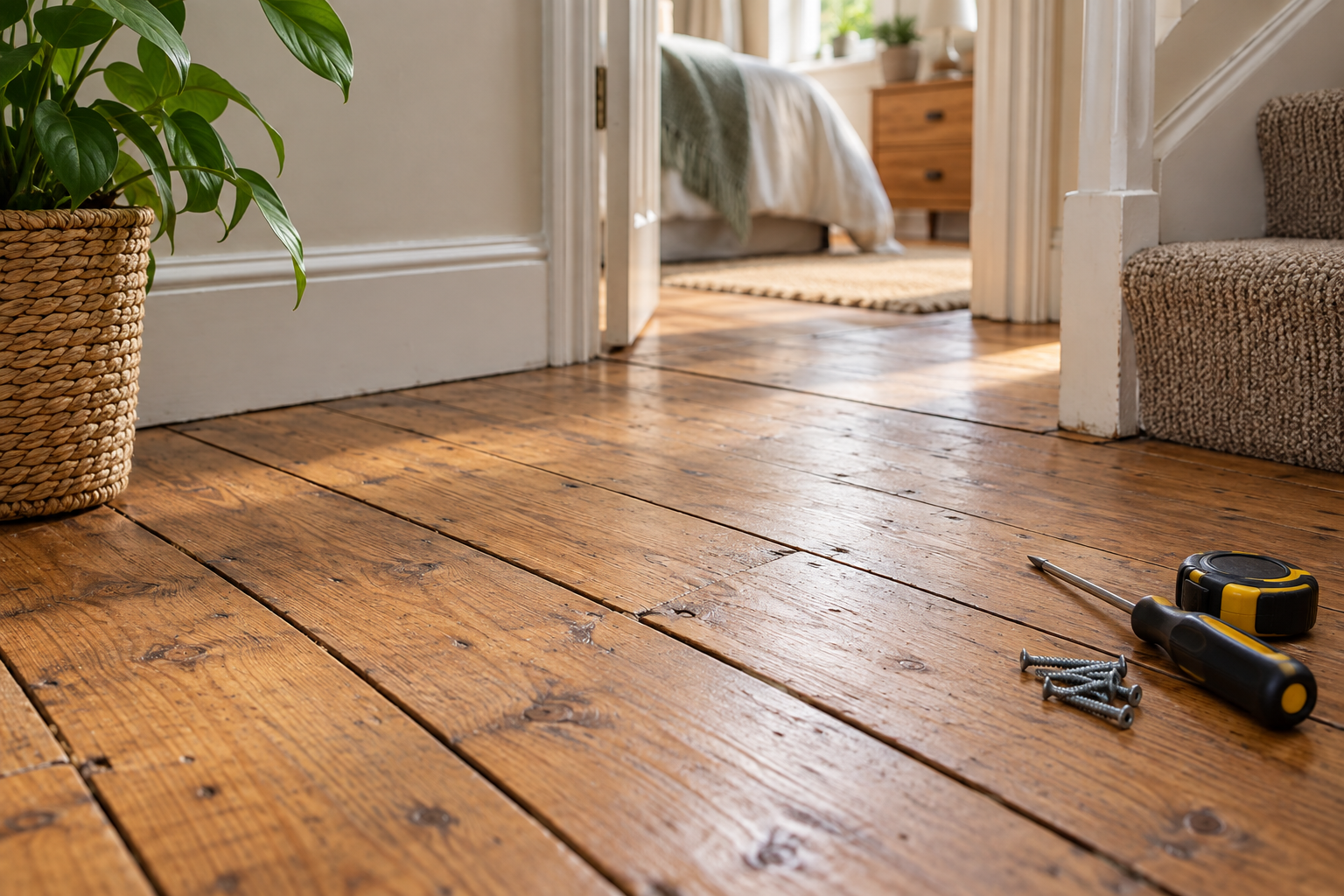
A squeaky floorboard can become surprisingly irritating once you know exactly where it is.
You cross the bedroom and hear the same creak. Someone walks across the landing and one particular board squeaks. Or perhaps a larger section of floor makes noise whenever weight is put on it.
The good news is that an isolated squeak doesn’t automatically mean there’s something seriously wrong with the floor.
Often, the noise is caused by a small amount of movement: two pieces of timber rubbing together, a board moving around an old fixing or a floorboard flexing against its support underneath.
The important thing is to find out what’s moving before trying to fix it.
For a minor squeak, the solution may be as simple as reducing friction between two boards. A genuinely loose floorboard may need securing properly. An unsupported or damaged section needs a different repair again.
So don’t start by putting another screw through the floor.
Start with the squeak itself.
Quick Answer: How Do You Fix Squeaky Floorboards?
To fix squeaky floorboards:
- Find the exact source of the noise.
- Look for visible movement or loose fixings.
- Check whether two boards are rubbing together.
- Secure a loose board only after checking what’s underneath.
- Investigate any unsupported board ends.
- Take extra care if the floor is covered by carpet or another finish.
- Inspect from underneath if you have safe access.
The right fix depends on what’s causing the movement.
And before drilling, screwing, nailing or cutting into a floorboard, remember that pipes and electrical cables may be hidden underneath.
If you can’t establish what’s below the floor, don’t guess.
Why Do Floorboards Squeak?
Squeaky timber floors are usually caused by movement.
As someone walks across the floor, one part moves slightly against another and creates the familiar creaking or squeaking sound.
Possible causes include:
- two floorboards rubbing together
- a loose board moving around an old fixing
- a board moving against the joist underneath
- an inadequately supported board end
- movement elsewhere in the floor or subfloor
- timber changing slightly with temperature and moisture
- pipework moving beneath the floor
Older timber floors can gradually develop more movement as fixings loosen, boards dry or previously lifted sections are refitted.
The sound itself isn’t really what you’re repairing.
You’re trying to stop the movement that creates it.
If you’re gradually working through smaller problems around the house, our easy DIY jobs that make a home feel better guide covers several other manageable improvements that don’t require a full renovation.
Before You Start: Think About What’s Under the Floor
Before reaching for a drill or screwdriver, consider what may be hidden beneath the boards.
That can include:
- electrical cables
- central-heating pipes
- water pipes
- other services
Previous plumbing or electrical work can make things harder to predict. A floorboard may have been lifted, cut and replaced years before you moved into the property.
Old cuts, damaged edges or clusters of fixing holes can sometimes indicate previous work.
If a repair involves drilling, screwing, nailing, cutting or lifting floorboards, make sure you understand the floor construction and the position of hidden services first.
A suitable pipe and cable detector can form part of those checks, but don’t treat a detector reading as permission to drill blindly.
If you’re unsure, stop and get appropriate help.
A squeak is considerably easier to deal with than a damaged cable or pipe.
1. Find the Exact Source of the Squeak
Start by reproducing the noise.
Walk slowly across the area and listen carefully.
When you find the general location, put a small piece of masking tape beside it.
Then test immediately around that spot.
Step:
- directly on the noisy area
- slightly to either side
- farther along the same board
- on the neighbouring board
You’re trying to work out whether the squeak comes from one small point, the joint between two boards or a wider section of floor.
If possible, ask another person to walk over the area while you watch from nearby.
Look for movement.
Does one board shift slightly?
Does it move around an existing nail?
Does the noise occur where two boards meet?
Does a larger section flex?
Those observations can tell you much more than the squeak alone.
If the floorboards aren’t visible
Carpet, laminate and other floor coverings make diagnosis more difficult because you can’t see what’s moving.
Don’t put a fixing through the floor covering simply because you’ve identified the approximate location of the sound.
Covered floors need a little more investigation, which we’ll come to later.
2. Check for a Loose Board or Fixing
With exposed timber floorboards, inspect the noisy area closely.
Look for:
- raised or loose nails
- old fixing holes
- damaged timber around a fixing
- movement when someone steps on the board
- signs that the board has previously been lifted
If a board moves around an existing nail or fixing, you’ve found a likely source of the squeak.
An old nail can gradually lose its grip, allowing the board to move slightly each time someone walks over it.
That doesn’t mean the solution is to add another fixing at random.
First establish how the board is supported and make the appropriate checks for anything hidden underneath.
If the board itself is sound and you can safely identify the support below, refixing it properly may remove the movement.
3. Check Whether Two Boards Are Rubbing Together
Sometimes the board isn’t noticeably loose at all.
The squeak may simply come from the edges of two timber boards rubbing as the floor flexes slightly underfoot.
If the sound is concentrated along the joint between two exposed boards and there’s no significant movement or damage, friction could be the cause.
A traditional low-impact approach is to work a small amount of dry talcum powder into the joint.
The powder can act as a dry lubricant between the rubbing surfaces.
Apply only a small amount, work it into the joint and test the area again.
Is talcum powder a permanent floorboard repair?
No.
It’s better thought of as a possible treatment for a minor friction squeak.
It won’t repair:
- a loose floorboard
- a failed fixing
- an unsupported board end
- damaged timber
- movement in the structure underneath
If the floor visibly moves, feels loose or continues squeaking despite treating the joint, investigate the movement rather than repeatedly adding more powder.
4. Secure a Genuinely Loose Floorboard
If you’ve established that a sound floorboard is moving against its support, securing it properly may stop the squeak.
An appropriate screw can provide a firmer fixing than an old nail that has worked loose.
But this is the point where diagnosis matters.
Before adding a fixing, you need to understand:
where the board is supported
and
what may be running underneath it.
If a board can be safely lifted and inspected, the structure and any hidden services become much easier to understand.
Existing fixing positions may provide clues to the joist position, but don’t rely on clues alone when the consequences of getting it wrong could be significant.
If everything has been properly checked and the board remains sound, it can then be secured using a fixing appropriate for the floor construction.
The finished fixing should not protrude above the floor surface.
If the timber is badly split or damaged around the fixing point, simply tightening it down may not be an adequate repair.
If you’re starting to tackle these kinds of small household problems yourself, our guide to fixing a door that sticks uses the same basic principle: identify the cause before making a more permanent change.
5. Check for an Unsupported Board End
Sometimes the squeak isn’t caused by a loose fixing.
The board may not have enough support underneath it.
This can happen where a floorboard has previously been cut between joists, perhaps to provide access for plumbing or electrical work.
If the cut end wasn’t properly supported afterwards, it can move whenever weight is placed nearby.
You may notice that the section feels less solid as well as hearing a creak.
The proper solution is to restore adequate support rather than simply adding more fixings to an area with nothing substantial underneath them.
Depending on the floor construction, a repair can involve adding suitable timber support so the board end once again has something solid to rest on and be secured to.
This is a more involved job than treating two rubbing boards.
If you expose an unsupported section and aren’t confident about how the floor is constructed or how the support should be added, that’s a sensible point to bring in someone with the appropriate experience.
6. Take Extra Care With Squeaks Under Carpet
A squeak underneath carpet can be more difficult because you can hear the problem without seeing the floor.
Specialist fixing systems exist for certain carpeted timber floors, but they still depend on accurately understanding what’s underneath.
Carpet hides the boards.
The boards hide the joists and services.
That’s why blindly putting a long screw through a carpet isn’t a good way to diagnose a squeak.
For a persistent problem, carefully exposing enough of the floor to inspect it can make the cause much clearer.
You can then look for:
- loose boards
- old fixings
- previous cuts
- damaged timber
- visible movement
If you’re not comfortable lifting and refitting carpet, a flooring professional or other suitable tradesperson may be able to investigate without unnecessarily damaging the covering.
What about laminate or engineered flooring?
Treat these differently from exposed traditional floorboards.
The noise may originate from:
- the finished flooring
- joints between flooring boards
- the underlay
- an uneven subfloor
- the original floor underneath
A repair intended for a traditional timber floorboard may therefore be completely inappropriate.
Don’t put screws through laminate or engineered flooring unless you’re following a repair method suitable for that particular flooring system.
7. Investigate From Below If You Have Safe Access
In some homes, looking from underneath can make a squeak much easier to understand.
This might be possible from a cellar, basement or another safely accessible unfinished area.
Ask someone to walk carefully across the noisy section while you observe from below.
You may be able to see movement that wasn’t obvious from above.
For example, there could be a small gap between a joist and the flooring above.
In appropriate situations, a carefully fitted timber shim can help remove movement from a small gap.
The key word is carefully.
The shim should support the floor rather than being forced in so aggressively that it pushes the flooring upwards.
Viewing the floor from underneath may also reveal pipework, previous alterations or a problem somewhere other than the floorboard you originally suspected.
If what you find looks more complicated than a straightforward localised repair, stop and reassess before changing anything.
Could the Noise Actually Be a Heating Pipe?
Possibly.
Pay attention to when the noise occurs.
If stepping on one particular point reliably produces the squeak, movement in the floor is an obvious place to investigate.
If the noise happens when nobody is walking across the floor—particularly as the heating warms up or cools down—pipework could be involved.
Heating pipes change slightly in size as their temperature changes.
Where a pipe passes tightly through timber or another material, that movement can sometimes create ticking, creaking or rubbing noises.
The important lesson is the same:
Don’t add floor fixings in an attempt to silence a noise you haven’t identified.
Why Have My Floorboards Suddenly Started Squeaking?
A new squeak doesn’t necessarily mean something has suddenly failed.
Timber responds to changing temperature and moisture conditions, which can alter the way different parts of a floor move against one another.
An old fixing can also gradually loosen until the movement finally becomes noticeable.
Other possible triggers include:
- recent plumbing work
- recent electrical work
- boards being lifted and replaced
- installation of another floor covering
- seasonal changes inside the home
- gradual wear in an older floor
If the squeak is the only symptom and the floor otherwise feels solid, the cause may be relatively minor.
If the noise appears alongside noticeable movement, damp, sagging or damaged timber, investigate further.
Are Squeaky Floorboards a Structural Problem?
Not necessarily.
Many isolated squeaks result from relatively minor movement between boards, fixings and supporting timber.
What matters more is how the floor behaves and what condition it’s in.
Take the problem more seriously if you notice:
- significant bounce underfoot
- obvious sagging
- a noticeably uneven floor
- several boards moving together
- damp or water damage
- rotten or crumbling-looking timber
- badly damaged boards
- substantial movement rather than just noise
Those signs warrant further investigation.
The objective isn’t simply to make the floor quiet.
It’s to make sure the underlying problem is understood.
When Should You Stop DIY?
There’s a point where investigating a squeak stops being a small DIY task.
Consider getting appropriate professional help if:
- you can’t establish where pipes or cables run
- the floor feels unusually bouncy or unstable
- several boards appear to have lost support
- there’s visible damp or deteriorating timber
- the floor is noticeably sagging or uneven
- you suspect a problem with the joists
- expensive finished flooring would need substantial removal
- you’re unsure how the floor has been constructed
A carpenter or flooring professional may be appropriate for many floor repairs.
If the problem involves plumbing or electrical services, use someone appropriately qualified for that work.
What If You’re Renting?
If you rent your home, don’t start lifting, cutting or screwing into the floor without checking what you’re permitted to alter.
Floorboards form part of the property, so a permanent repair generally isn’t something to improvise without permission.
If the problem is only a minor noise, you may decide it isn’t worth pursuing.
But if the floor also feels loose, unusually flexible, damaged or potentially unsafe, report it to your landlord or managing agent rather than attempting a structural repair yourself.
For improvements that don’t involve altering the property itself, our renter-friendly decorating ideas guide focuses on making a rented home feel better without unnecessary permanent changes.
Can You Fix Squeaky Floorboards Without Lifting Them?
Sometimes.
A minor friction squeak between two exposed boards may respond to a dry lubricant without anything being lifted.
Some straightforward fixing problems may also be repairable from above once the floor construction and hidden services have been properly established.
But lifting a board can sometimes be useful because it provides access to inspect:
- joists
- hidden services
- previous repairs
- unsupported ends
- damaged timber
- the underside of the board
The goal shouldn’t be to avoid lifting a floorboard at all costs.
It should be to understand the problem well enough to repair it safely.
Should You Use Screws or Nails for Squeaky Floorboards?
For a sound board that’s moving because an old nail has become loose, an appropriate screw can provide a firmer fixing.
That doesn’t mean every squeaky floor needs more screws.
A new fixing only helps if loose fixing is actually the cause.
It also needs to go into appropriate support without endangering anything underneath the floor.
If the squeak is caused by rubbing boards, an unsupported end or movement deeper in the floor, another screw may not solve it.
Diagnose first. Fix second.
A Simple Squeaky Floorboard Checklist
Work through the problem in this order:
1. Find the noise.
Mark the exact area and test immediately around it.
2. Watch for movement.
Work out whether one board, a joint or a larger area moves.
3. Inspect existing fixings.
Loose nails and previous repairs may provide useful clues.
4. Consider friction.
If two otherwise sound boards appear to be rubbing, a dry lubricant may help.
5. Think about what’s underneath.
Don’t drill, screw, nail or cut until you’ve considered hidden services and the floor structure.
6. Look for damage or missing support.
An unsupported board needs support rather than a random extra fixing.
7. Know when to stop.
Damp, sagging, significant movement, damaged timber or uncertainty about the structure deserves further investigation.
Frequently Asked Questions
What causes squeaky floorboards?
Usually movement.
Floorboards can rub against neighbouring boards, move around loose fixings or shift slightly against their supporting structure.
Does talcum powder stop squeaky floorboards?
It can sometimes reduce noise caused by friction between timber boards.
It won’t repair a loose, damaged or unsupported board.
Can you fix squeaky floorboards under carpet?
Potentially, but carpet makes the cause and floor construction harder to see.
Avoid blindly adding fixings through the carpet without understanding where the joists and hidden services are.
Why do my floorboards squeak more in winter?
Changes in temperature and moisture can affect timber, while heating systems can introduce additional noises as pipework warms and cools.
Seasonal changes can therefore make existing friction or movement more noticeable.
Are squeaky floorboards dangerous?
A squeak alone doesn’t necessarily indicate a dangerous floor.
However, significant bounce, sagging, damp, damaged timber or substantial movement should be investigated rather than treated purely as a noise problem.
Can I just put another screw into a squeaky board?
Only if you’ve established that a loose board is actually the problem, identified suitable support for the fixing and checked what may be underneath.
Adding screws at random isn’t a good repair strategy.
Are squeaky floorboards normal in older houses?
They’re common in older timber floors because boards, fixings and supporting components can develop movement over time.
That doesn’t mean every squeak should automatically be ignored. Consider the condition and movement of the floor as well as the sound.
The Bottom Line
A squeaky floorboard is usually telling you that something is moving.
Your first job isn’t to silence it.
It’s to find out what.
Locate the squeak, watch how the floor responds when weight is applied and look for rubbing boards, loose fixings or unsupported sections.
A minor friction squeak may need very little attention. A sound but loose board may need to be properly secured. An unsupported or damaged section requires a different repair.
And before drilling, screwing, nailing or cutting into a floor, remember what may be hidden underneath.
Diagnose the movement first. Then choose the least invasive repair that actually addresses the cause.