
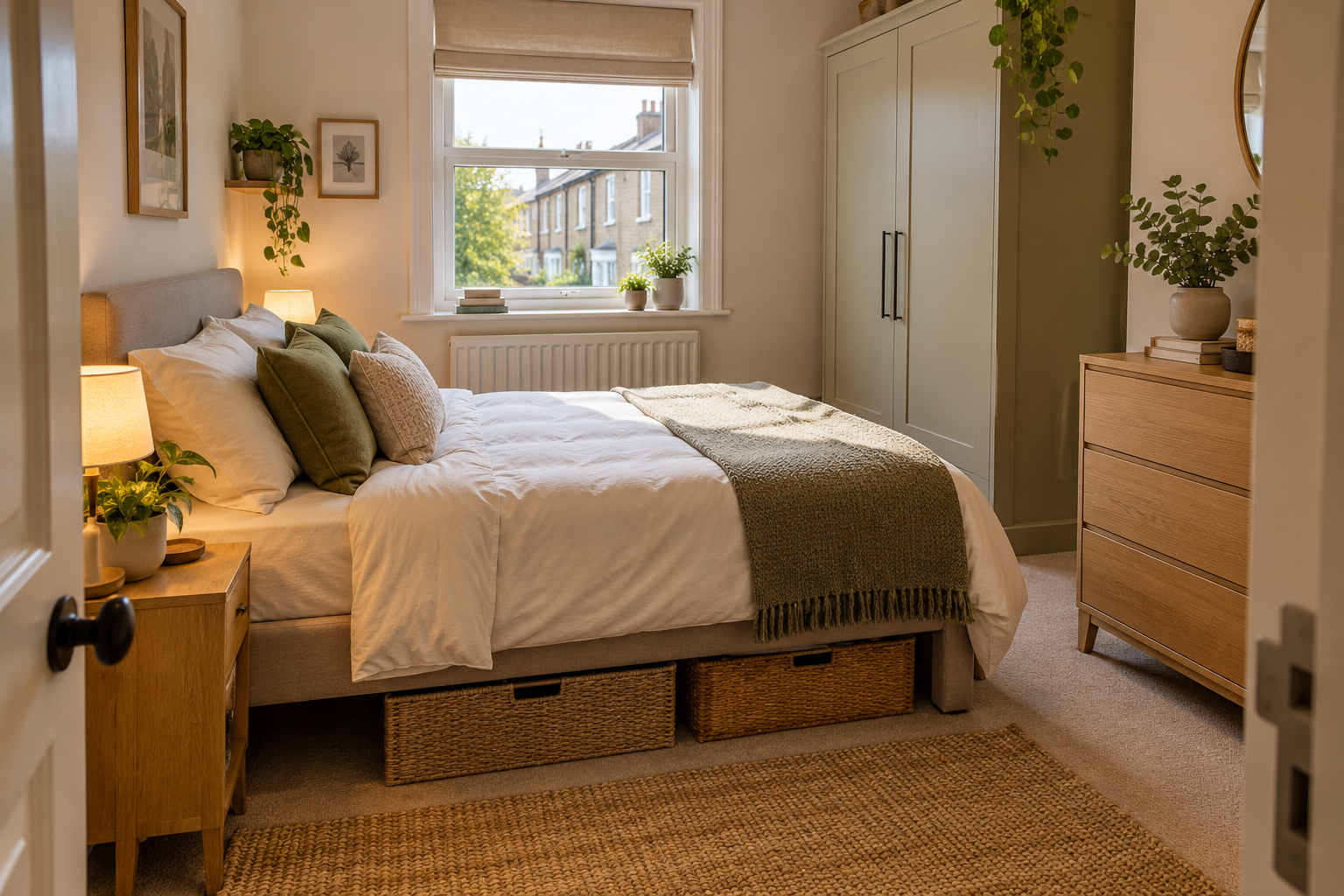
A small bedroom can be perfectly comfortable, but it doesn’t take much for one to start feeling cramped.
The bed takes up most of the floor. A wardrobe needs somewhere to go. You need enough space to open drawers and doors. There may be a radiator underneath the window, a chimney breast breaking up the longest wall, or a bedroom door that seems determined to open into the only sensible place for a piece of furniture.
Then there are all the things a bedroom needs to store.
Clothes, shoes, bedding, laundry, bags and everyday belongings all need somewhere to live.
The temptation is to solve each problem individually: buy another set of drawers, add some shelves, squeeze in a smaller bedside table or find another storage box.
But that can make a small bedroom worse.
A better approach is to look at the room as a whole.
Before buying anything, decide what the bedroom needs to do, position the largest pieces of furniture properly and protect enough open space for the room to remain comfortable.
If you’re tackling more than one compact room, our How to Make the Most of a Small Home: The Complete UK Guide explains the wider Nookcroft approach to getting more from limited space.
For the bedroom specifically, start with the biggest object in the room.
The bed.
Once that’s right, almost every other decision becomes easier.
Quick Answer: How Do You Make a Small Bedroom Work Better?
Start by deciding what the bedroom genuinely needs to do, then position the bed before adding other furniture.
Protect the main walking routes, choose furniture that suits the scale and shape of the room, and use awkward areas deliberately rather than filling every available gap.
Good storage matters, but so does leaving enough empty floor and wall space for the bedroom to feel calm.
In a small bedroom, the goal isn’t to fit in as much as possible.
It’s to make the space you have work properly.
1. Decide What Your Bedroom Actually Needs to Do
Before changing the layout or buying new furniture, work out what you’re asking the bedroom to do.
For some homes, that’s simple.
The bedroom needs to provide somewhere comfortable to sleep and enough storage for clothes.
In others, the bedroom may also need to accommodate a desk, television, dressing area, book storage, laundry basket or occasional exercise space.
That’s where problems can begin.
A small room can usually perform several functions, but every additional function competes for the same limited floor area.
Start with the essentials.
Ask yourself:
- What absolutely needs to happen in this room?
- Which furniture do I use every day?
- What genuinely needs to be stored here?
- Could anything currently in the bedroom live somewhere else?
- Am I keeping furniture because I need it, or simply because it’s already here?
If you work from home occasionally, for example, you might only need a compact desk.
If you work from home every day, that workspace probably deserves more attention.
If you never sit in the bedroom other than on the bed, an additional chair may simply become somewhere to pile clothes.
The aim isn’t to strip the room of personality.
It’s to give its most important functions enough space before you start adding everything else.
This is the same principle behind the Nookcroft Small-Home Audit: diagnose what the room needs before buying solutions for it.
2. Measure the Bedroom Before Buying Anything
Small rooms punish guesswork.
A difference of just a few centimetres can determine whether a wardrobe door opens properly, whether you can walk comfortably past the bed or whether a chest of drawers blocks another piece of furniture.
Before buying anything substantial, measure:
- room width and length
- ceiling height
- door position and swing
- window position
- radiator position
- sockets
- chimney breasts
- alcoves
- skirting boards
- usable wall widths
Then measure your existing furniture.
But there’s another measurement that matters just as much:
the space required to actually use it.
A wardrobe may fit perfectly against a wall on paper but become frustrating if the bed leaves barely enough room to open its doors.
A chest of drawers might fit into an alcove but be awkward to use because the bedroom door opens in front of it.
And a desk might physically fit between the bed and wall while leaving no practical room to pull the chair out.
This is why we use a Measure-First Rule throughout Nookcroft.
Measure the space.
Measure the furniture.
Then measure the clearance needed to actually use it.
A few minutes with a tape measure can prevent an expensive furniture mistake.
3. Position the Bed First
In most bedrooms, the bed is the largest object in the room.
That makes it the logical place to start.
Don’t position wardrobes, drawers and bedside tables first and then try to squeeze the bed into whatever space remains.
Try the realistic bed positions before deciding where everything else should go.
Centred Against a Wall
This is the conventional layout and can work very well if the room is wide enough.
It gives access to both sides of the bed and allows for two bedside surfaces if they’re needed.
But don’t force this arrangement simply because it looks symmetrical.
In a very small room, keeping access down both sides can use a surprising amount of valuable floor space.
Against One Wall
Putting one side of the bed against a wall can release considerably more usable space elsewhere.
It may not be everyone’s preferred arrangement, particularly for two people sharing the bed, but in a small box room, spare bedroom or single bedroom it can transform the layout.
That extra space might make the difference between having a usable wardrobe and having to squeeze past one every morning.
Beneath a Window
A bed beneath a window isn’t automatically a bad idea.
Sometimes it’s the position that makes the rest of the room work.
You will need to consider access to the window, curtains or blinds and whether there’s a radiator underneath it.
Don’t block a radiator in a way that significantly restricts heat circulation, and make sure you can still safely open and reach the window where necessary.
But don’t reject the layout simply because you’ve heard that beds shouldn’t go beneath windows.
Against a Chimney Breast
Older UK terraces and period homes often have chimney breasts and alcoves that dictate furniture placement.
A bed centred against a chimney breast can sometimes make excellent use of the room, particularly if the alcoves on either side can accommodate narrow bedside surfaces, lighting or useful storage.
There isn’t one correct position for every bedroom.
The right position is the one that lets the bed work comfortably without preventing the rest of the room from functioning.
4. Protect the Route Around the Bed
Once you’ve found a promising bed position, walk around the room.
Literally.
Enter through the bedroom door.
Walk to the bed.
Walk from the bed to the wardrobe.
Open the wardrobe.
Open the drawers.
Walk to the window.
If you’re constantly turning sideways, stepping around furniture or moving something to access something else, the layout probably needs more work.
This is one of the easiest things to overlook when arranging a bedroom.
We often judge a layout by whether the furniture physically fits.
But fitting isn’t the same as functioning.
Pay particular attention to pinch points.
These commonly appear:
- between the bed and wardrobe
- between the foot of the bed and a chest of drawers
- beside the bedroom door
- around radiator covers
- between a desk chair and the bed
A slightly smaller piece of furniture can sometimes improve the room far more than another clever storage solution.
Protecting the main route through the bedroom can also make it feel more spacious because you’re not constantly navigating obstacles.
5. Choose the Right Bed Size for the Room
A small bedroom doesn’t automatically require the smallest possible bed.
The primary purpose of a bedroom is still sleep.
If a comfortable double bed fits and the room continues to function, replacing it with something smaller purely to create more visible floor space may not be worthwhile.
But the opposite mistake is common too.
A large bed can dominate a room so completely that wardrobe doors won’t open properly, bedside furniture gets squeezed into tiny gaps and moving around becomes awkward.
Look beyond the dimensions of the mattress.
Consider the complete bed frame.
Chunky upholstered frames, oversized headboards and wide side rails can add noticeable bulk without increasing the sleeping area.
A simpler frame may give you the same mattress size with a smaller overall footprint.
Storage beds can also make sense where they replace other furniture.
An ottoman bed, for example, might provide enough hidden storage to remove the need for an additional chest or cupboard elsewhere.
That’s a useful trade.
One of the principles from our Complete Guide to Making the Most of a Small Home applies particularly well here:
Furniture should earn its footprint.
The bed already performs the most important job in the room.
Just make sure the version you choose isn’t consuming more space than that job requires.
6. Make Bedside Furniture Earn Its Space
A bed doesn’t automatically require two traditional bedside cabinets.
In a compact bedroom, those small pieces of furniture can consume valuable space surprisingly quickly.
Start by asking what you actually keep beside the bed.
Perhaps you only need somewhere for:
- a phone
- a glass of water
- a book
- glasses
- a small lamp
If that’s the case, you may not need a full cabinet.
Alternatives could include a narrow bedside table, small wall-mounted shelf, compact stool, shelf incorporated into a headboard or slim set of drawers.
Wall-mounted lighting can also reduce the amount of bedside surface required for a lamp.
If two people share the room, don’t assume both sides need identical furniture either.
Symmetry can look attractive, but function matters more.
One side might comfortably accommodate a drawer unit while the other only needs a narrow shelf.
That’s fine.
A small bedroom doesn’t have to be perfectly symmetrical to feel considered.
7. Choose Wardrobes That Suit the Layout
A wardrobe doesn’t only occupy the rectangle of floor underneath it.
You also need space to use it.
Traditional hinged doors swing into the room, while drawers require clearance in front.
That can make a large wardrobe far more intrusive than its measurements initially suggest.
Before buying one, ask:
What happens when the doors are open?
In some bedrooms, sliding doors can reduce the clearance required.
In others, a shallower wardrobe may work better than a deeper design.
Fitted wardrobes can make good use of an awkward wall or alcove, although they’re a more substantial investment and won’t suit every home or renter.
An open clothes rail can work too, particularly in a spare room or where clothing storage requirements are modest.
However, be realistic about how it will look once it’s full.
Open storage can quickly make a small bedroom feel visually busy.
If you already own a wardrobe that’s causing problems, don’t immediately assume you need additional storage.
Look at what’s inside it first.
Removing clothes you no longer wear may solve the problem without adding another piece of furniture.
8. Use Under-Bed Space Properly
The area beneath the bed is some of the most useful hidden storage in a small bedroom.
But it works best when used deliberately.
Good candidates include:
- spare bedding
- seasonal clothes
- extra towels
- shoes worn occasionally
- travel bags
- less frequently used items
Storage drawers can make access easy.
Boxes work well beneath a suitable frame.
An ottoman bed can provide a substantial hidden storage area without taking up additional floor space.
But there’s an important distinction between using under-bed storage and putting things under the bed because you don’t know where else to put them.
If you can’t remember what’s underneath there, the space probably isn’t working efficiently.
Group similar items together and use containers where useful.
For a deeper look at wardrobes, under-bed storage and other ways to organise a compact bedroom, see 15 Small Bedroom Storage Ideas That Make the Most of Every Inch.
That guide focuses specifically on storage. Here, we’re concentrating on making the whole bedroom work.
9. Make One Wall Work Harder
A common small-bedroom mistake is spreading furniture around every wall.
A small wardrobe here.
A chest of drawers there.
A shelf on another wall.
A desk squeezed into the remaining corner.
Individually, none of these pieces seems particularly large.
Together, they can make the entire perimeter of the room feel occupied.
Sometimes it works better to make one wall do more.
For example, one wall might combine wardrobe storage, drawers and shelving.
Another might combine the bed, headboard, bedside surfaces and lighting.
A work area might combine a desk with shelves and stationery storage rather than spreading those functions around the room.
Concentrating functions can leave other areas visually calmer.
It can also make the layout easier to understand.
This doesn’t mean building fitted cabinetry across every available wall.
The principle is simply to avoid scattering lots of small storage solutions around the room when a more concentrated arrangement could do the same job.
10. Keep Visible Clutter Under Control
Storage and clutter aren’t exactly the same problem.
You can have plenty of storage and still have a bedroom that looks cluttered.
Open shelves packed with toiletries, books, boxes, cables and miscellaneous objects can make a compact room feel much busier than it actually is.
Try to give visually noisy belongings somewhere less prominent.
Closed storage is particularly useful for things such as:
- spare bedding
- underwear
- toiletries
- cables and chargers
- paperwork
- bags
- laundry
- everyday clothing
Open storage can then be used more selectively.
You don’t need to hide everything.
A few books, a plant, framed photograph or favourite object can make the room feel personal.
The aim is to stop every surface competing for attention.
Our guide to 12 Small-Space Storage Ideas That Actually Work in UK Homes looks at practical ways to create more organised storage throughout a compact home.
In a bedroom, keeping visual clutter under control is particularly valuable because this is one room where you generally want the atmosphere to feel calm.
11. Use Alcoves and Awkward Corners Deliberately
Not every UK bedroom is a neat rectangle.
In older terraces and period properties, chimney breasts can create narrow alcoves.
Loft bedrooms may have sloping ceilings.
Box rooms can contain strange recesses created by stairs or cupboards.
Even newer homes can have awkward corners around radiators, doors and structural features.
Before deciding that an awkward space is useless, ask what function could fit there naturally.
An alcove might accommodate:
- shelves
- a narrow wardrobe
- drawers
- a dressing table
- a compact desk
- a clothes rail
A low area beneath a sloping ceiling might work for drawers or less frequently used storage.
A narrow space beside a wardrobe might be just right for a laundry basket rather than another piece of furniture.
But there’s another possibility worth remembering:
You can leave it empty.
Not every awkward gap needs a custom storage solution.
If filling it doesn’t solve a genuine problem, leaving the space alone may make the bedroom feel better.
12. Make the Bedroom Feel Bigger
You can’t change the physical dimensions of the room without major building work.
You can change how those dimensions feel.
Start with sightlines.
When you enter the bedroom, can you see some open floor?
Can you see towards the window without looking through several pieces of furniture?
Does the room have one or two clear visual focal points, or twenty?
Reducing unnecessary visual interruptions can make a small room feel calmer and more spacious.
Mirrors can help reflect light and create a greater sense of depth, particularly when they’re positioned thoughtfully rather than simply added wherever there’s an empty wall.
Keeping the window area relatively clear can help natural light travel further into the room too.
Curtains that overwhelm a small window can sometimes make the room feel heavier, while a simpler treatment may make the opening feel more generous.
Colour matters, but there’s no rule saying every small bedroom has to be white.
Light colours can create an airy feeling, while deeper colours can make a bedroom feel cosy and intentional.
What often matters more is visual coherence.
Too many competing colours, finishes, patterns and furniture styles can make a compact space feel restless.
A more consistent palette gives the eye fewer interruptions.
And don’t try to make the room feel bigger by filling it with dozens of products marketed as “space-saving”.
Sometimes the most effective way to create space is simply to own less furniture.
13. Get the Lighting Right
Lighting can make a small bedroom feel either calm and comfortable or flat and cramped.
One ceiling light in the middle of the room may provide enough illumination, but it rarely creates the most comfortable atmosphere on its own.
Think in simple layers.
General Lighting
This provides overall illumination for the room and will usually come from your main ceiling light.
Bedside Lighting
This is useful for reading and for creating softer light in the evening.
If bedside surfaces are limited, suitable wall-mounted lights can keep them free.
Task Lighting
If the bedroom includes a desk or dressing area, give that activity appropriate lighting rather than relying entirely on the main ceiling fitting.
Natural Light
Make the most of the daylight you already have.
Avoid unnecessarily blocking windows with tall furniture or allowing clutter to accumulate around them.
You don’t need an elaborate lighting scheme.
The goal is simply to avoid expecting one light source to do everything.
If you’re renting and can’t make substantial changes to lighting or other fixtures, our 15 Renter-Friendly Decorating Ideas That Make a Rental Feel Like Home includes plenty of lower-commitment ways to improve a room.
14. Improve a Small Bedroom on a Budget
You don’t need fitted wardrobes and bespoke furniture to improve a small bedroom.
In fact, the most useful first change may cost nothing.
Rearrange the room before buying anything.
Try another bed position.
Move a chest of drawers to another wall.
Remove a chair you never use.
Swap an oversized bedside cabinet for something smaller that you already own.
Then look for inexpensive improvements.
You could:
- declutter exposed surfaces
- reorganise the wardrobe
- use storage boxes you already own
- add a useful shelf
- improve the bedside lighting
- change tired handles
- move a mirror
- repaint the room
- relocate furniture between rooms
If you’re renting, concentrate on changes you can reverse easily rather than assuming every improvement needs to be permanent.
It’s easy to assume a difficult bedroom needs new furniture.
Sometimes it simply needs fewer pieces arranged more intelligently.
The cheapest small-bedroom improvement is often a better layout.
15. Leave Some Space Empty
This might be the hardest small-bedroom idea to follow.
Once you’ve spent time thinking about storage and making better use of space, every empty corner starts looking like an opportunity.
Perhaps you could fit a basket there.
Or another shelf.
Or a plant.
Or a narrow cabinet.
Or a small chair.
But empty space has a purpose too.
It gives you room to move.
It makes cleaning easier.
It keeps access to furniture clear.
And visually, it gives the room somewhere to breathe.
This is particularly important in bedrooms because large pieces of furniture already occupy so much of the available floor area.
You don’t have to maximise every centimetre.
If your important belongings have somewhere sensible to live and the bedroom performs the functions you need, you can stop.
You don’t need to maximise every centimetre. You need to make the room work.
Small Bedroom Mistakes to Avoid
Small bedrooms tend to become difficult through a series of little decisions rather than one enormous mistake.
Here are some of the most common problems to watch for.
Buying Furniture Before Measuring
A piece of furniture can look compact online and still overwhelm your room.
Measure both the available space and the clearance required to use it.
Assuming the Bed Has to Be Centred
A symmetrical layout isn’t automatically the best layout.
In a very small bedroom, moving the bed towards one side can unlock considerably more useful space.
Adding Storage Before Decluttering
More storage isn’t always the solution.
If the existing wardrobe is full of clothes you no longer wear, another cabinet simply gives the problem somewhere else to spread.
Choosing Furniture That’s Too Bulky
Look at the complete footprint, not simply the advertised width.
Thick frames, deep cabinets and oversized headboards can all matter in a tight room.
Ignoring Doors, Drawers and Radiators
Furniture that technically fits can still be frustrating to use.
Check that doors and drawers can open comfortably and avoid arranging furniture in a way that unnecessarily obstructs radiators.
Using Too Much Open Storage
Open shelves are useful, but covering every wall with belongings can make a small bedroom feel busy.
Filling Every Empty Space
Not every wall, corner and gap needs furniture.
Some of the most valuable space in a small bedroom is the space you deliberately leave alone.
A Simple Plan for Reorganising a Small Bedroom
If your bedroom isn’t working and you’re not sure where to start, don’t try to redesign everything at once.
Work through it in this order.
Step 1: Remove the Obvious Clutter
Take out rubbish, laundry and anything that belongs elsewhere in the home.
Don’t organise everything yet.
First reveal the room you’re actually working with.
Step 2: Identify the Essentials
Decide which functions the bedroom genuinely needs to perform.
Then identify the furniture required to support them.
Step 3: Measure
Measure the room, existing furniture and important clearances.
Pay attention to doors, windows, radiators and wardrobes.
Step 4: Solve the Bed Position
Try the realistic alternatives.
Don’t reject a layout purely because it’s unconventional.
Step 5: Check Circulation
Walk through the room and use the furniture.
Open the wardrobe.
Open the drawers.
Get into bed.
Reach the window.
If something feels awkward now, it will probably become irritating later.
Step 6: Add Storage Around the Layout
Once the room works physically, solve the remaining storage problems.
Don’t build the entire layout around storage furniture you may not actually need.
If storage is still the main problem at this stage, move on to our Small Bedroom Storage Ideas guide rather than adding furniture at random.
Step 7: Stop
This matters.
Once the bedroom functions well, resist the temptation to keep improving it by adding more things.
Give yourself time to live with the new layout.
You may discover that the empty corner you were planning to fill is actually one of the reasons the room now feels better.
Small Bedroom FAQs
How Do I Make a Small Bedroom Look Bigger?
Start by reducing unnecessary furniture and visible clutter.
Keep important routes clear, avoid unnecessarily blocking natural light, allow some floor to remain visible and use a reasonably consistent colour palette.
Mirrors can help reflect light and create a greater sense of depth, but they won’t compensate for a bedroom that’s physically overcrowded.
Where Should a Bed Go in a Small Bedroom?
There isn’t one correct position.
Start with the wall that allows the bed to fit without obstructing the bedroom door, wardrobe, radiator or important walking routes.
Centred against a wall is convenient where space allows, but placing one side against a wall or positioning the bed beneath a window can sometimes create a much better layout.
Should You Put a Double Bed in a Small Bedroom?
If a double bed fits while leaving enough space to move around and use the rest of the furniture properly, there’s no reason the room can’t have one.
The bedroom’s primary purpose is sleep, so don’t sacrifice comfort simply to create more empty floor.
However, consider the dimensions of the complete bed frame rather than the mattress alone.
How Do You Arrange Furniture in a Small Bedroom?
Position the bed first, then protect the main routes through the room.
Add essential clothes storage next and only introduce additional furniture if it serves a genuine purpose.
It’s usually better to have fewer useful pieces than lots of small pieces squeezed around every wall.
What Furniture Works Best in a Small Bedroom?
Furniture that performs its job without occupying unnecessary space.
That could mean a simple bed frame, an ottoman bed with storage, a shallower wardrobe, a narrow bedside table or furniture that combines more than one function.
The best choice depends on the size and shape of the room rather than one particular style of furniture.
How Can I Improve a Small Bedroom Without Spending Much Money?
Start by changing the layout rather than buying new furniture.
Declutter, reorganise the wardrobe, remove pieces you don’t use, move furniture between rooms and experiment with another bed position.
Small changes to lighting, paint, handles or storage can come later.
Often, the cheapest improvement is simply making better use of what you already have.
Is It Okay to Put a Bed Against a Wall?
Yes.
It may not be ideal for everyone, particularly two people who both need easy access to the bed, but there is no rule saying a bed must have space around every edge.
In a very small bedroom or box room, placing the bed against a wall can release valuable floor space and allow the rest of the room to function much better.
Final Thoughts
The best small bedroom isn’t necessarily the one with the cleverest storage bed, the most shelves or the smallest furniture.
It’s the one that feels comfortable to use every day.
Start with the bed.
Protect the routes around it.
Give the belongings you actually use sensible places to live.
Choose furniture according to the room rather than trying to force the room around the furniture.
And when everything important works, don’t be afraid to leave some space empty.
A small bedroom doesn’t need to feel like a puzzle where every centimetre has been filled.
It needs a comfortable bed, practical storage, enough room to move and a sense of calm when you walk through the door.
If you’re working through several compact rooms rather than just the bedroom, continue with our How to Make the Most of a Small Home: The Complete UK Guide for the wider Nookcroft approach to making a smaller home work better.